
Responses to Geelong Writers’ Ekphrastic Challenge for September 2025:
Sea Lake silo
We invited everyone – members and non-members alike – to use this image, ‘Sea Lake silo (image by Jo Curtain) to inspire an original response (either prose or poetry) using 300 words or less.
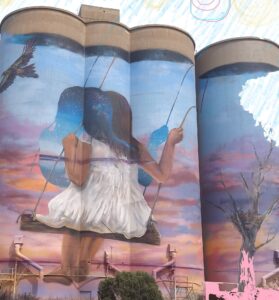
Sea Lake silo (image by Jo Curtain, from the painting by Joel Fergie and Travis Vinson, October 2019)
In response to our invitation, contributors applied their creativity to dusty fields, painting scenes of beauty juxtaposed with soaring laments and inestimable loss. Together, we appreciate their artistry.
We extend a HUGE thank you and congratulations to the following authors for their COLOSSAL endeavours:
Ian Chisholm Mary Szymanski David Bridge
Scott Hunt Howard Osborne Allan Barden
Pauline Rimmer John Heritage Denise Main
Jan Price Fran O’Mara Glenyse Robins-Ward
Stanley G Billing Gail Griffin Hilary Guest
Geoff Gaskill Steve Gray Russell Abbott Julie Edmonds
[icon icon=icon-picture size=25px color=#000 ]
A matter of scale
Leaning on my bicycle, I watch a man in white overalls, standing on a plank above the footpath. A paintbrush in his hand, which rests on a long stick, he paints a perfect, shining red letter O, which I see will be, ‘RAYNER TAYLORS’. His skill, the smell of paint, the smooth shininess of its surface, hold my interest. My ten-year-old mind says, one day I would like to do that.
*
I’m sitting at my desk, a mock-up design beside me. With the fine tip of my size one sable haired brush steady in my hand, I paint a perfect flowing curved letter E. This delicate, stylistic scroll lettering painted in black india ink, is part of the finished artwork of my original design for a perfume package. I am a graphic artist. When young, a signwriter at work was my inspiration.
*
In retirement, I spend hours at my easel, my sable haired brush spreading and mingling colours on the stretched water-colour paper to create pictures inspired by my surroundings. My hand is still steady, my eye still keen.
*
Seeking inspiration in historic old towns, I drive north and into Sea Lake. I stop to admire a brilliant artistic creation. The curved concrete surfaces of seven wheat silos have been transformed into a massive, coloured canvas. The central theme depicts in meticulous detail, a skipping girl; other images show the history and life of this isolated town and its surrounding district.
*
Beneath cobalt sky, I gaze in awe and imagine the artist or artists, undaunted by the immense scale of their task, standing on a cherry picker, working with large brushes, cordless spray guns, spray cans of weather resistant acrylic house paint, creating in bold colours, broad strokes and sweeps, this brilliant work of art.
*
by Ian Chisholm
[icon icon=icon-picture size=25px color=#000 ]
Empty like the silos
Joy rushes out the back door to the swing. Dark, summer skin and tough bare feet sprinting over the dust ground, little clouds betraying a path in her wake. Complete delight as she sways to and fro in her special white dress meant for Mass at 10.30am. Joy’s Mum doesn’t know. She’s sick in bed again. And Dad’s on the road. Again.
She’ll sway back and forth until Aunt Rita comes and they’ll go to the bluestone church, where it’s cool and stoic and echoes with friendly threats of hell if you don’t do as you’re told. The words of hymns make little sense. Joy imagines the music made for bluestone walls escaping through colourful leadlight windows into the drought outside.
She would much rather stay on the swing and watch the eagles wheel the sky like sentries. She pushes higher imagining wings and clouds within reach. Joy dreams that she flies and floats. And sees the farm like a toy on the ground as she glides to the dead gum tree. It holds the eagles’ untidy nest in its deformed cradle branches. No eggs just yet. Not this year, according to Dad.
Mum has the sad sickness again. Turned to the wall and watery eyes. Not a word or movement. Just miniscule groans and occasional whimpers. Empty like the silos.
Poor Mum, Joy thinks, then jolts higher on the swing and waits for Aunt Rita who won’t be mad at the dirty feet and dusty white dress. They’ll sit near the back of the church and mumble through the service, supressing giggles while trying to look pious for the priest.
Aunt Rita will stay until Mum gets better and Dad comes home and life will be wonderful for a while. Until Dad goes back on the road. Again.
by Mary Szymanski
[icon icon=icon-picture size=25px color=#000 ]
Silos, sunsets, and stories
From Saint Arnaud the Mallee stretches out before us,
The AC breathless fights November’s early heat.
Tortured asphalt tests the car’s suspension as wheat fields dominate the view.
At Wycheproof we break for coffee and a cake, desperate for shade.
Keen to make the Lake by lunch we aim for Nullawil
Where Smug’s Kelpie and his owner gaze along the tracks
That trawl the harvest, shadowing the highway.
Awed by realism and scale we record from every angle
Until, roused from our reverie by the passing road train’s rush,
We head north hoping for another concrete canvas
Rivalling the last, and then it’s there, in rainbow hues,
Sunset, sunrise and shades between, blues, reds and yellows,
Scenes surrounding lake views: moonlit emus foraging,
While overhead a wedgetail soars and a young girl swings,
Seemingly displacing time, uncovering stars.
We pace atop the trench bound track
Deciphering the episodic tale worn by a family of silos.
This is a place of power and these are symbols
Forged by untold generations.
Cameras satiated, we head on into town, passing huddled monsters
Waiting for the call to decapitate and sift the grain.
Our nighttime tour confirmed, we choose to get our bearings in the light,
Meandering to Tyrrell’s shore where giant capitals spell out its name
Amidst a snowfield edged in pink and blue.
A myriad flies make sense of Bedouin garb and keep this visit short.
At evening, our guide distributes gumboots and we circle
To a beach, where miniature pink icebergs glitter in a blue lagoon
Pockmarked by footprints lengthening as the sun descends to where
A hand can grasp it, before the twilight paints the mirror surface.
Reluctantly we take our leave, returning with the dawn for one last look,
Sharing the wonder of millennia gazing at the storied sky.
by David Bridge
[icon icon=icon-picture size=25px color=#000 ]
The swing
“Swing for the stars, Sweetheart. One day you’ll fly right outta here,” her Dad would say.
That was back before the drought. Before the light went out of his eyes. Before Mum and him started yelling at each other.
She started spending more and more time down at the park. The few friends she had reckoned the swing was for babies. But she didn’t care. She often wondered if she could swing so high she would flip right out of the seat.
But she never did.
“Swing for the stars, Sweetheart.”
It’s all dust, bindi eyes and the long, slow croak of crows out here.
Most of her friends had left already. Packed up into the family station wagon with their parents and brothers and sisters; fleeing the dry, dying interior for the promises of the city.
Forsaking the land for the laptop.
She’d gotten used to the thwack of the screen door as her Dad stormed out of the house, off to the pub. He’d never been a big drinker. Then the letters started arriving from the bank.
“What’s the fucken use? You’ll never bloody understand,” he’d spray back at the house as he stormed off, boots kicking up dust where lawn once grew.
She loved her Dad. He was her hero. He was her Dad. She just wasn’t sure if this was the same Dad she’d always known.
So she swung higher, remembering his words.
“Swing for the stars, Sweetheart.”
Then one day he was gone.
She never got to say goodbye.
She’d never ever see him again.
One day he was there, the next the house was full of aunts whose names she couldn’t remember, smothering her with hugs thick of perfume that made her eyes water.
One day, she’d swing right outta here.
by Scott Hunt
[icon icon=icon-picture size=25px color=#000 ]
Half in half out
For me, a recollection of my daughter
When she was young, many years ago
Combining several dreamlike fantasies
Hers, and yes, with some of mine too
Absorbed, on a wooden plank swing
Gazing at a suspended blue reflection
Against a cloudy orange sky, at sunset
An eagle flies away into the distance
Below her, surface of a still calm lake
Perhaps a reservoir, with drain pipes
With her bare feet likely to get wet
All this pictured on a strange canvas
As if it’s almost, but not quite, rolled
From which a tear exposes art behind
And an abstract interpretation of rain
It may be due time to be fully awake
Yet still to remember her as she was
Not in this non-existent dreamworld
If only I could see her again, for real
Fully grown up, and of course, alive
by Howard Osborne
[icon icon=icon-picture size=25px color=#000 ]
Flying beyond hunger
Sunday was the best day of Eliza’s week. After six days of constant hunger, listening to her Ma coughing, watching her Da’s face get thinner by the day, for an hour or two every Sunday life seemed lighter. Sunday was when the family walked the stony path to Mass at the little church several miles away.
Eliza enjoyed the priest’s words and the service, but what she really longed for was outside, beyond the church door. From an old ash tree, hung a rope swing. Nothing more than a plank of wood tied with a fraying cord, but it was her heaven.
After Mass while the congregation lingered sharing news and gossip, Eliza would rush to the swing; her brothers in pursuit. Her brothers teased her for being greedy for the swing but they enjoyed pushing her higher and higher.
The first push lifted Eliza into the sky leaving the famine below far behind her. The world blurred and the wind rushed her cheeks. For those few minutes hunger didn’t matter. She could imagine anything. Flying beyond the parish, beyond her hunger, she can pretend that the fields of Co. Wicklow are full of potatoes again and that her Ma and Da are strong and healthy.
Sometimes when the swing is at its highest, Eliza closes her eyes and thinks she might never come down again. But, when the church bells toll, Eliza has to stop her swinging and day dreaming – it was time to go. As her feet touch the ground, she knows that for the next six days, the small cabin, the constant hunger and the emptiness of life all await her.
Eliza dreams of next Sunday when she’ll take to the sky again. She whispers to the old oak tree, ‘See you next week, old friend’.
by Allan Barden
[icon icon=icon-picture size=25px color=#000 ]
Ran off my feet
Late again! I was stuck in a stream of traffic, all heading to school pick up.
“Move!”
I knew the driver in front couldn’t hear me, but I was so frustrated, and it felt good to yell. Annoyingly, I was behind Mr. Slow. He did not seem in a hurry to go anywhere, while my life was nothing but rushing around. It was no good, I was forced to park on the next block and run through the park. I could see the duty teacher pacing and looking at her watch as I waved to Macey.
“I am so sorry,” I puffed.
“You are always late, Mum. All my friends have gone home.”
The teacher gave me a stern face and looked again at her watch.
“I was just about to take Macey to after care.”
“So sorry, but the traffic was terrible and….”
“Well, you are here now. See you tomorrow, Macey.”
She turned on her heel and stalked off.
“Come on, Darling. We have to rush to the supermarket, then go to your netball training. Hurry, please.”
“Oh, Muuuum. Do we have to? We never get to relax. Why are we always rushing?”
I looked at my seven-year-old daughter. She was right. We were always in a hurry to get somewhere or do something. Macey looked sad, and I felt guilty.
I took her hand as we crossed the street. Maybe the shopping could wait.
“Race you to the swings! Come on!”
Her little face split with a huge smile as we took off running through the park to the playground.
“Look Mum, I can go really high!”
I watched my daughter fly toward the sky. I had forgotten how good it felt with the breeze in my hair and nothing but play on my mind.
by Pauline Rimmer
[icon icon=icon-picture size=25px color=#000 ]
high art
to attract
attention
bigger
is better
creativity up
to your imagination
girl on a swing
outs
our inner
child
that should influence
adult behaviour
hundreds of children slaughtered in gaza
by John Heritage
[icon icon=icon-picture size=25px color=#000 ]
Fly high
‘Stretch your fingers and hold the ropes.’
‘Push me, Daddy.’
‘Point your shiny shoes to the bright blue sky.’
‘Daddy, watch me fly higher, and higher, almost to the clouds where Mummy sings.’
‘Hold tight, Sally mine. Fly high.’
‘If Mummy can sing on fluffy cloud nine, why not me?’
‘Because she sings here there and everywhere; over the rainbow and even among the sparkling stars in seventh heaven, Sally dear.’
‘If she can live and sing in the starry, starry sky, why not me?’
‘You must hold tight, fly high, Sally mine.’
‘Daddy, when I fly high, Mummy might see me, blow me a kiss and send a wave.’
‘Yes, little Sally, hold tight, fly high.’
‘Daddy, watch me swing higher and higher maybe even to where the blue birds fly.’
‘Hold tight, fly high Sally, feel the wind in your hair.’
‘Daddy, I will swing faster than the wind, fairies and butterflies. Swing fast and high to see our house, the sheep and cows in their paddocks and the tall silos.’
‘Why can’t Mummy live with us anymore?’
‘She needed heavenly bliss, Sally love.’
‘Why didn’t she take me?’
‘Because Mummy had to go alone and needed us to stay in our red roofed house, to care for the sheep and the cows in their paddocks and grow wheat in the fields.’
‘Will she be lonely without us Daddy?’
‘Not if we think of her and you fly high. Hold tight, Sally my sunshine, fly high.’
by Denise Main
[icon icon=icon-picture size=25px color=#000 ]
Grain silos art at Sea Lake
On a handmade swing
hanging from a mallee
eucalyptus tree
you swing without sound
staring over the vast land
listening to the wind
telling you stories
of the Boorong people
how they as astronomists
navigated the stars
to reveal the seasons
of flora and fauna
as a wedgetail eagle
soars left into the sky
and emus run blind
into the night.
© – by Jan Price
[icon icon=icon-picture size=25px color=#000 ]
Goodbye sweet artist friend – you swung too low too high
Hope is now gone as you gushed your aching self into the sky’s hush
Ending it all in a final silent frenzy of chemical stilling of life’s ache
Leaving us with opaque memories of your smile and laughter’s spell
Entombed images knell across our minds’ recall lonely by your stele
Never again to see your art swing high, your life’s thread early riven
Hand sculpted stories marshalled the world telling your visionary rush
Enduring care brought flowering colours jumping in springtime parade
Light delicate laying of fractured tiles drew splayed paths of life’s grail
Enticing us wander your patchwork trails of parsley, rose and saxifrage
Never more your brushes transform tree gifted light or morning bird din
Humour and joy sang through your eyes as you laughed your inner crush
Ever gentle and soothing your music dissembled arch pain in appearance
Luminous melodic dances beguiled our listening hearts with lilt and curl
Endeared to all your unfurled art and music brushed with effaced rapture
Negated forever with your forced departure leaving us to sing your paean
Hung there in sky’s lucent space soaring on your wings’ last flung push
Engulfed brain in chosen chemical streams of ash and sleep-closing eye
Loosened to swing too high from siloed pain into cosseted cerulean lull
Escape planned with full meticulousness for that final brave flight alone
Now we sing elegies of agony hoping you flew to that sought for haven
by Fran O’Mara
[icon icon=icon-picture size=25px color=#000 ]
Remembering Joy
Up in the air so high, perched on her swing, soaring into the clouds. As her mother watches from the ground, she remembers how it was when Joy had her two feet firmly on the ground.
Full of life and loving her daily trips to the local playground. A precious soul who would fly high every day, watching the people around her on the ground.
Now her only friend that accompanies her on her journey is her eagle friend, Freddie, and he understands what Joy wishes. As he spreads his wings so wide, he looks at the ground and wishes that Joy could join in with the people on the ground, especially her mother.
For Joy’s mother, it was a sad reminder of the day the swing broke at the playground and her precious daughter fell to the ground, hitting her head on the large rock in the corner. She comes every day to see the mural that has been painted in Joy’s honour.
She sees her flying high, especially when the weather is fine and sunny, as the sun shines its light across her back, and then a cloud comes and leaves a shadow through that reflective glow.
On other days, the wind appears to whisper in Joy’s ear. Your mother’s here. She is watching from below. She sees your hair is glistening in the breeze that I have created, and as you swing, it looks like you are moving with me.
As Joy and Freddie look down at her mother, Joy sees her mother’s face with a smile, as she looks up to remember her, and this gives her a glimpse of hope that she will be reunited with her someday.
by Glenyse Robins-Ward
[icon icon=icon-picture size=25px color=#000 ]
Harvest time
Harvesting wheat in the stinkin’ heat
After a twelve-hour shift, tired and beat
Rain is comin’ so harvesting is a must
Sick of hot sun and the choking dust
If it gets too hot we’ll need to work all night
To start a bush fire, simply wouldn’t be right
If the rain hits now, waste of time even sowin’
No time for sleep, best keep harvester goin’
When the last grain is picked and wife appears
I’ll wash down this dust with a few cold beers
Tomorrow, truck it to town where all grain goes
Sell it to the buyers with their big painted silos
Silos were big cold and grey, made of concrete
Now they are being painted and most look neat
As my wheat is conveyed, I feel a little jubilation
Tourists drive past and look in total fascination
Be home soon, probably less than an hour
Looking forward to a very well-earned shower
Hot and sweaty, covered in dust, what a sight
Starting to yawn, won’t need any rocking tonight
I’ll lay down tonight to rest my weary old head
Knowing I’ve done a part in keeping the world fed
Farming is hard here, with floods, fire and drought
Would I give it up? Hell no, what you talking about?
by Stanley G Billing
[icon icon=icon-picture size=25px color=#000 ]
Maddie and Maisie
Maddie and Maisie shared a keen sense of oneness
Using non-verbal communication and gestures often
As well as gibberish and babble only they understood
With an intuitive ability to co-ordinate thoughts and actions
Even planning together to tackle complex situations
Well above the expectations of those around them
Like twins sharing identical daily events and environments
For them, every day was filled with endless possibilities and wonder
Belief that they could do and be anything they wanted
In their collective minds they became high trapeze artists
When reaching to go higher, higher on their backyard swing
Before leaping off and flying through the air
Landing on the lawn below and rolling forward to stand and bow
Arms stretched above their heads to a make-believe audience
Convinced they could do anything and everything
Invincible in the face of everyday activities and challenges
Climbing, riding, creating, role playing, choosing what else to do
With the abundance of options and space available to them
Agreeing on time out to take stock and catch their breath
Revelling in each other’s closeness, enjoyment and fun
Before springing into action, resuming their return to play
Maddie’s parents were worried until told by their doctor
‘It’s a sign of positive developmental progress
Imaginary friends, playmates, companions, fantasy worlds even
Unique and extraordinarily special to their child creator
Especially for those first born or those without siblings
A perfect solution to relieve loneliness or boredom
Or blame another for naughty or mischievous behaviour.’
As author Edward Rutherford once wrote:
‘Children have a passport into places where their parents cannot go.’
by Gail Griffin
[icon icon=icon-picture size=25px color=#000 ]
Changeling
He had been a pretty little girl; the bus driver certainly thought so. “I will take you for a special drive. It will be our secret.” To speak of it would have brought more horror on his head than the act itself. He had always wanted to be a boy. Even as he was adorned with ribbons and frills, he longed to run and jump, to spit and swear like his brothers.
He consulted a doctor, in the city, no point in going locally. The process was explained: long, arduous, but possible. No point talking to the family; taking this journey would revolt the church, bring shame on his minister father.
He never saw them now, his family. But he had a life, his chosen life. Almost, he smiled, like being born anew. His own personal version of the pentecostal mantra. Sometimes he pondered country life: fresh, clean air, and minds as closed and painful as a metal steel-jaw trap.
by Hilary Guest
[icon icon=icon-picture size=25px color=#000 ]
The art critics
It was my mate, Sam who’d talked me into a bus tour of the silo art trail. However, after passing all day on what he said was Australia’s ultimate road trip, staring at the country’s largest outdoor art gallery, I was about siloed out.
Not Sam, however. Silo fatigue wasn’t part of his world.
‘Look at it,’ he said of what I hoped was the last for the tour. ‘This is why Australia is the best country in the world.’
I refrained from giving him the news–it isn’t. Not that he’d have listened or believed me.
Instead, I hummed and hawed, looking from him to the painting before us. Correction. The very large picture on the side of, what I hoped was the last bloody silo for the day. ‘I hate to tell you, mate,’ I tried in a show of dissent, ‘but best-ness, is like beauty. It’s in the eye of the beholder.’
But I was right–Sam wasn’t listening. ‘Looking at that,’ he sighed, nodding at the huge concrete canvas before us, ‘is like looking at Mona Lisa. Why travel overseas to see the best painting in the world?’
I followed his stare upwards to the picture on the side of the silo.
Was I missing something?
I didn’t see a Mona Lisa. All I saw was bloody great silo with a badly painted picture on its side.
‘Silo art’s not to everyone’s taste,’ I tried.
But I had to admire Sam. There was something to his blind enthusiasm that was as big as that painting.
by Geoff Gaskill
[icon icon=icon-picture size=25px color=#000 ]
And there she sits
Sarah’s image now gazes quietly over the wide plains, immortalised on the curved wall of the wheat silo. A silhouette of innocence, her small back legs folded beneath her as she swings on the rough-hewn timber and rope. It was the picture her family offered, not a smiling face or playful scene, but this quiet, playful memory, captured forever.
The community understood. Some whispered that a brighter, happier portrait might have softened the wound, yet most agreed that this sombre vision spoke the truth of their grief. Every person passing the silo would see her there and remember.
The day she died sits heavily on every heart. A harvest day, the sun warm, the crop golden, the machinery loud. Her grandfather, intently focused on the wheat bending before the harvester’s teeth, never saw her cross behind.
He has never forgiven himself, and perhaps never will. When the machine was stilled and the dreadful discovery made, the land itself seemed to fall silent. Police, ambulance, neighbours, they all came, but there was no saving her. Barely four years old, so full of laughter and light, she had been folded into the merciless machinery of progress.
Some say she tripped. Others believe she wandered too close, eager to be near the man she adored. None knows for certain. The cruellest detail is held by her sister, just eight, who stumbled upon her broken body pressed into the soil. That sight will live with her forever, as it will with all who shared in the loss.
Her grandfather called her his second pride and joy, and she loved him beyond measure. Now his fields, his sky, his every day is marked by absence. And the silo stands as witness—a haunting reminder carved against the horizon, of love, of loss, and of a little girl gone too soon.
by Steve Gray
[icon icon=icon-picture size=25px color=#000 ]
I want to touch the stars
Annie was born a gentle soul. Her early years were happy, growing up on her family’s remote dairy farm. However, in her sixth year she was diagnosed with leukaemia.
She eventually became a resident in a Palliative Care Unit. Her Grandfather “Pops” moved from the farm to a house close to Annie’s care unit.
Pops saw her every day and on her “good” days took Annie on outings. She loved the town playground and swings; she had many happy hours with Pops providing power to send her higher and higher.
As she grew weaker Pops installed a swing in his front garden so she could rest in the house when she felt tired. Pop’s house faced a disused railway yard with a large silo.
One day an artist arrived at the silo and commenced to prepare the silo as a “Silo Art” installation. The area was to become part of the Silo Art Trail. Annie enjoyed a short burst of energy watching the progress from her swing, “Higher Pops I want to see them working”. She waved to the artist at the top of her swing arc. The artist, high on his crane, waved back and enjoyed Annie’s laughter. Pops and Annie played a guessing game as to what the artwork would be.
Sadly, Annie’s deteriorating health meant she could no longer leave the unit. However, on the unveiling of the silo art, Pops wrapped her up and took her to the silo. Annie was given the honour of switching on the flood lights for the first time.
The silo art was of a young girl on a swing reaching for the stars with the caption “Higher, I want to touch the Stars.”
Annie reached her stars a few days later.
by Russell Abbott
[icon icon=icon-picture size=25px color=#000 ]
Sophia and the swing
I’ve just visited Sophia (Adnate, 2017). She’s in Goorambat, an unhurried, silo art town. Sophia’s not on a silo. She’s a mural on a wall inside a small, weatherboard church—the unlocked door an invitation to enter. Sophia’s ceiling-to-floor presence seems larger than the church itself. In the religious world, Sophia represents the feminine aspect of the Holy Spirit. Her name means wisdom.
Alone in the church, far from the clang of the world. I focus on Sophia’s eyes; her gaze lifted to somewhere beyond the confines of the building. Seeking communion, deeper wisdom, perhaps. Possibility emanates from her. I sit. And reflect on the confines I’ve subconsciously placed around myself. And on the stealth of my diminishing confidence.
The clatter of daily life awaits me. I procrastinate about leaving Goorambat. And Sophia. An idea nudges a challenge—butterflies of excitement stir. I walk until I know how to respond. And my pace towards the park quickens.
It’s been years since I felt the thrill of powering a swing through the air. Visiting Sophia reminded me of the confidence I’d had as a child. I sit on the swing. And move my legs back and forth with increasing momentum. Until my whole body’s sending the swing higher. Higher. United, the swing and I fly. And I recalled the day at the playground with my great-aunt. I was six. And daring! My hands gripping the swing’s chains, my legs urging it higher, pretending I was a bird seeking the horizon. The joy of seeing it, like I’d flown
to the edge of the world. And I leaped off the swing!
Unharmed. My great-aunt was not impressed.
Confidence nurtured.
Almost ready to leave.
Just one more swing, maybe two …
(With the wisdom not to leap off.)
by Julie Edmonds
[icon icon=icon-picture size=25px color=#000 ]
Leave a Reply