
Publication of Responses
A big thank you to all the writers who took up the challenge of Ekphrastic Challenge #6 2026. This was a Winter Solstice Challenge where writers were challenged to respond to a word (“NADIR”), rather than an image, and to write a piece of 182 words exactly (not including title), this being the number of days between the winter and summer solstices. Entries closed on Friday, 19 June, 2026 and were published on Saturday, 20 June, 2026 (to celebrate the winter solstice). Participants—many first-timers to the challenge—provided a wonderful and imaginative mix of responses, with more than our usual share of poets taking up the challenge. Well done, everyone. Your ongoing support is valued and appreciated.
Our next challenge (Ekphrastic Challenge #7) will open on 1 July, 2026 and close on 25 July, 2026.
A reminder that when submitting your responses, please ensure you:
- specifically respond to the image
- give your submission a title
- take time to read and edit your entry before you submit it
- ensure your work complies with the Australian Standard house style: singular quotations and Australian spelling.
The following writers have had their response to Ekphrastic Challenge #6 2026 published below:
Peter H, Mary Szymanski, Pauline Rimmer, Guenter Sahr, Glenyse Robins-Ward, Fran O’Mara, Steve Vanderwerf, Cathy O’Loughlin, Jacinta Orillo, Scott Hunt, Lynne Tatam, Ian Henricus, Alan Cobham, Allan Barden, Adam Stone, Denise Main, Ian Chisholm, Danny Neal, Ian Stewart, Jenny Lynch, Mel King, David Bridge, Rhonda Hyder, David Jones, Geoff Gaskill, Howard Osborne and Ziqi Meng.
In addition, the following writers have performed their submission online:
- Ian Henricus – Go Get ’em Cats! (https://youtu.be/eVpMpjfSCKs)
- Adam Stone – Nadir (@adamstone1969)
- Danny Neal – Nadir (@aidkitpoetry)
Please, take the time to read and enjoy all responses received.

Nadir
There comes a place beneath the map of hope,
a hollow beneath the hollow,
where even echoes grow tired of returning.
It is called Nadir.
Not a place marked by distance,
but by absence.
The point where every confident step
becomes a question.
Where the hands that once built kingdoms
cannot find the strength to button a shirt.
Where memory flickers like a storm lantern
in a cold paddock at dusk.
The world above continues its business.
Children laugh.
Magpies sing.
The trains run on time.
Yet down here,
time moves differently.
Minutes become heavy stones.
Nights stretch beyond their natural boundaries.
The horizon folds in on itself.
Nadir is not dramatic.
It arrives quietly.
A chair left empty.
A phone that does not ring.
A dream abandoned halfway through the telling.
It strips away applause.
Removes titles.
Questions every certainty.
And still, it has purpose.
For in the deepest valley,
there is nowhere left to fall.
The earth itself becomes a hand beneath your back.
You begin to notice small things.
A shaft of morning light through a dusty window.
The kindness of a stranger.
The taste of rain.
What once seemed ordinary
returns as treasure.
Nadir teaches with a harsh voice,
but it teaches nonetheless.
It reveals what remains
when everything unnecessary has been carried away.
And sometimes,
from that lowest point,
with scraped knees,
empty pockets,
and a wiser heart,
a person discovers that survival itself
is a kind of victory.
The first step upward
is rarely heroic.
It is simply taken.
Then another.
And another.
Until one day the sun touches your face again,
and you realise
that even the darkest depth
was never the end of the journey,
only the place
where the climb began.
Peter H
Dig
We leave early. It is winter and misty and finger-numbingly cold. We knew it would be dreamlike in the fog, not quite real.
Your father’s spade acting as a walking stick of sorts for you, leading the way to the old pines up on the hill. Planted when you were a teenager. I’ve seen the photos, faded like this morning.
I cradle the hessian bag in the crook of my left arm. The cold makes it easy to be stoic. We can fill the bag with pinecones later.
At the base of the pines, we look up the hill into the labyrinth of dark and mist, the trees dripping moisture.
You scrape at pine needles, revealing earth and mouldy lichen. Time to dig down and deep. We take turns. Our fingers thaw and white breath mingles with the fog.
It’s time for our ancient dog to sleep. The kindest eyes now just memory. A bundle of blonde and shaggy coat, lifted from the hessian bag.
We cry, cover the hole and then collect pinecones for the fire. We cry again walking home.
Mary Szymanski
Temporarily Broke
Andrea was late.
It was her first day at her new placement. The agency had insisted she be early for the orientation. Everything had gone wrong. First, the suit she had pressed was stained by the iron, then her shoe broke. She wasted twenty minutes trying on clothes, and now she had missed her tram.
She ran down Bourke St, desperately looking for building numbers. Finally, a number she recognised. The lift arrived as she ran through the door. The first thing that had gone right all morning. She stepped out and approached the reception desk.
‘Hello, I’m the new temp.’
‘Sorry, we were not expecting a temp.’
‘Is this Eldridge Industries? 55 Bourke St?’
‘This is Grand Solutions, 550 Bourke St.’
She fought back tears as she realised she was at the wrong end of town.
Her phone rang, and with a sinking heart, she answered.
‘Andrea, we have had to send another temp.’
‘I am so sorry. I missed my tram.’
‘We have no other assignments at the moment.’
Andrea knew her relationship with the agency had reached its nadir.
Pauline Rimmer
The days of wonder
Indeed, it had not always been so; the many years of lushness in the veldt held us in thrall. Herds of hartebeest roamed the lands to the horizons. For its people and its animals, the great mother ordained leisurely lives in those bygone days.
At times the grazing by the hartebeest was disrupted by lions or cheetahs in search of food. Giraffes sailed among clusters of acacias and elephants slowly skirted the edges of our knowledge.
These were the days of wonder. These were the days of joy. The milk from our cattle gave succour to their calves and our young and old, and when they reached the nadir of their days, the cattle provided a festive reason for the whole clan.
Between the great mother and her changing skies we lived lightly on the land, moving from waterhole to waterhole and the nurturing green grasses clustered across the wide land. Our children learnt the knowledge so essential to our existence: lightness of homes, the herding of cattle, foraging for food on the body of the great mother to supplement meagre diets.
Guenter Sahr
Winter Has Come and Gone
Each winter, as the rains fall from the sky and the kitchen walls are as bright as ever, she looks out the window toward the wet, grey fence. A fence that is saturated, as the rain has fallen for many days in a row.
Since she had moved into this house, it, although a very bright and vibrant place inside, had given her a lot of strength, except during those winter months when sadness raged through her veins. It was a low point in her life, and it is only felt through the open curtains on dark-sky days, when there is no sunshine or stars at night.
Nevertheless, she battled on, occasionally shutting her eyes as she looked out the kitchen window, imagining that the brightness from inside had shifted, landing on the dark grey fence; then, suddenly, she looked along that fence and saw the green scruffy bush which put a smile on her face.
Winter and spring have gone, and so have the days of summer, and she moved out in March to her new home before the next Nadir.
Glenyse Robins-Ward
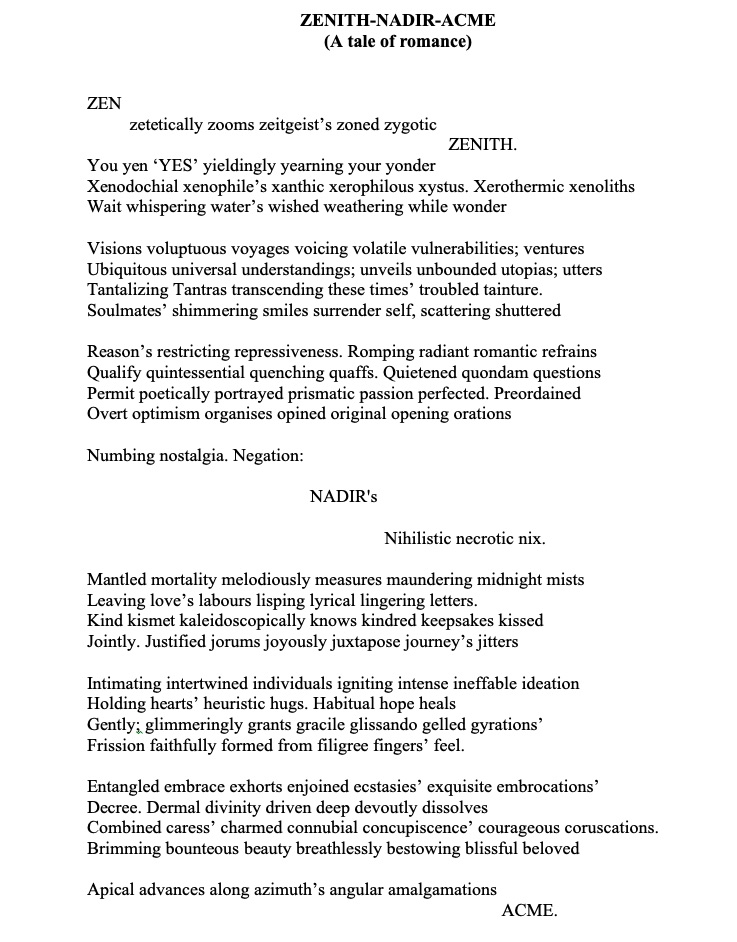
Fran O’Mara
Nowhere to Go
I was thirty-something and I slept in the spare room of my own home.
Not because we’d fought. Because this was maintenance now. This was what I needed to survive, to see another day.
The television never went off. She’d pass out in the chair, glass still in her hand, tilted. I’d have to make a calculation. Is it safe to go out there? I would take the glass from her fingers the way you’d disarm someone. Carefully. Without waking them.
Then I’d tiptoe back to bed and lie there.
Listening. Waiting.
The footsteps would start. Heavy. Deliberate. My whole body made a decision before my mind did.
Shoulders up, jaw tight, breath held.
Sometimes they’d pass. Most often they didn’t.
When the door opened it didn’t open slowly. It opened the way she wanted it to, as an announcement, as a detonation, an explosion. She would fill the frame and the words filled the room like embers of fire and ash. I would lie there and receive them because there was nowhere to go.
I had become very good at nowhere.
Steve Vanderwerf
How to Find Peace at the Beach
Golden brown in the summer sun, her back, legs and arms. Little blond tousled-haired head bent over as she digs, deeper and deeper in the low tide sand. Around the rim of her ever-sinking hole the sand piles up in a plethora of miniature dunes.
She digs to a soundtrack of squawking pacific gulls, Southern Ocean shore breaks and the insistent questioning of her little brother.
‘Are we nearly there?’
‘We’ve been digging for ages.’
‘Are we there yet?’
Dad interrupts.
‘Come on, you two. Hats on. And your sunblock. Out you hop.’
‘Nooooo, Dad. We can’t. We’re nearly there!’
‘Well put your hats on at least.’
‘OK, Dad.’
A little blond head, a tiny curly strawberry-blond head peep up. Hats on the work continues.
Dad is back on his towel, reading his book. Sipping on a summer beer.
Mum walks up from the ocean, dripping with salty beads of sea.
‘Are you there yet, kids?’
‘Nearly. China can’t be too far away now!’
Mum saunters back to her towel.
‘That worked well!’ Mum smiles, Dad winks.
Cathy O’Loughlin
Ode to Roller Derby
It was a regular Tuesday night training session. My body was stiff from the weekend’s games. My mind elated from how well I played. So many hours spent honing my skills, strengthening my body, it was all coming together. Even my coach was impressed!
I didn’t really feel like coming, but the captains were insistent, the Tournament was only two weeks away. A little skate around would be good for my tight muscles.
It was a simple drill, we were just going through the motions. I was skating backwards tracking the jammer. What happened next is still hazy. My wheels were locked against another player’s skates. As I fell, and my foot stayed upright, I knew something was wrong.
There was an audible crack; then, another. A sensation like no other bloomed in my ankle.
‘No, no NOOOO!!!’
I scooted from the track, sliding on my knee pads, fighting the wave of nausea that suddenly gripped me.
On all fours I, with eyes squeezed shut, breathed through the pain.
Later, the x-ray confirmed the fracture.
No more skating; over and out.
Jacinta Orillo
Foucault’s Pendulum
He woke, fully clothed with dried vomit attached to the side of his face. His head spun like a loaded washing machine in full flight. Sitting up with a groan, he felt formless, as if the marrow had been sucked from his bones.
He looked about to get a sense of where he was. His best mate Benny asleep, snoring on a camping mattress beside him.
The previous three days were a blur. Only small memories survived. Drinking games with cheap cask wine. Chasing Benny around the backyard as he read from Umberto Eco’s Foucault’s Pendulum. Benny knew how much he fucking hated that book.
He stood, wavering.
He walked into the lounge. The house appeared empty. He was glad not to have to face the others. Fresh holes peppered the fibro walls of the Queenslander. He immediately knew they’d come from his boot.
In that moment he realised he’d hit rock bottom.
He looked back towards the sleeping Benny.
‘See ya, mate,’ he said under his breath.
He walked out the front door, closing it behind him with a gentle click.
Scott Hunt
Limbo
Above the cold ground, trees, frigid figures held in time. Their icy, bare branches reach out for warmth from an indifferent sun. ‘’Tis the time to sleep,’ they intone, ‘time for silent contemplation, before the wheel turns once more. It always has been, it always will be.’
Desperate, a small furry creature scavenges through the frosty leaf litter, hoping for a morsel of sustenance—a hawk, alerted by the movement, swoops, perching above it. Golden eyes shine in the gloom, waiting patiently, staring, hungry, focused. Twin laser beams, never leaving the intended prey. Flashing wings, stark white against the iron-grey backdrop. Screeching, a faint squeak as a tiny light is snuffed out, sacrificed to one who will survive. Drops of blood, crimson on the frozen, forest floor, a splash of vivid colour amongst the greys and browns of a desolate landscape.
The winter solstice, a time between times. In limbo, before the pendulum swings toward the sun’s warmth, once again.
Until then, ’tis time to sleep, time for silent contemplation before the wheel turns. It always has been, it always will be …
Lynne Tatam
Go Get ’Em Cats
We couldn’t leave our town in ’42 and ’43,
We had to do our bit for the war
But then the League said come on back,
So we took off up that track
To win the wooden spoon in Forty Four
’44 was our nadir, but let me make it clear
We’re on the way now, there’s no turning back!
We’re here to take the flag and we will never lag
Get out those claws! Go get ’em Cats!
We’re no stranger to re-builds, with all their chills and spills
We’re patient and persistent through and through
It didn’t take us long to show them where we’re from
We went back to back in ’51 and ’52
’44 was our nadir, but let me make it clear
We’re on the way now, there’s no turning back!
We’re here to take the flag and we will never lag
Get out those claws! Go get ’em Cats!
We’re here to take the flag and we will never lag
Get out those claws! Go get ’em Cats!
Get out those claws! Go get ’em Cats!
To hear a rendition of this song by Ian Henricus and his busking band, Scotso, please go to here.
Ian Henricus
Disgusted
He was tired of dancing with Chatterbox. He excused himself, flopping backwards onto a nearby empty table. Suddenly, he was alive from a touching of heads, quickly turned around, glared momentarily, before becoming aware of her beautiful face and divine blue eyes: he was 17, she was 14! She was attracted by his quick smile following his initial annoyance. He, by her beauty. Both agreed to meet the next morning down at the river walk.
Both arrived in casual clothes, fulsome smiles of greeting. They started walking, soon holding hands, then they were embracing followed by a passionate kiss, the ZENITH of their short lives.
Suddenly, she broke away and rushed behind a nearby, spindly tree, still quite visible. She pulled up her dress, pulled down her pants and did a prolific, flooding piddle. He saw everything, completely shocked.
‘Why did you do that for everyone to see?!’ he exclaimed.
Unperturbed, she replied, ‘Weak bladder, can’t help it. I have to go or wet my pants. Which would you prefer?’
He was blown away, disgusted, the NADIR of his life.
Alan Cobham
The Cricket I Knew Has Moved On
As a boy, my summer would be spent watching Sheffield Shield and test cricket. When a test match unfolded over five days, when a batsman could spend time settling in and a bowler would work doggedly to get him out.
Nowadays I find myself watching a different game. The crowds are larger, the entertainment louder, the play is faster. Good luck to them I say!
I struggle to find the same connections anymore. Twenty20 twenty cricket leaves me cold. Bazball and the BBl are train wrecks. The debates over coloured balls, night versus day tests, privatisation and constant rule changes make me wonder if I am still watching the sport I once knew.
Cricket and I are at a low point. Perhaps I am just growing older. The game has moved with the times, found a new audience and new ways to survive. I do get that.
Yet, when I watch a hard fought test series or Sheffield Shield game I remember what I fell in love with many years ago. It is these moments when cricket and I seem young again.
Allan Barden
Nadir
From its low point, the sun begins to rise
I was there
I saw how far we’d come
I was mesmerised
I saw it low
Oh, so low
It was fleeting
Now rewound
I’m caught between being lost and found
Frost dissipates into the atmosphere
Leaves ascend to the trees for reconnection
We could all do with some reconnection
Speech is distorted
Memories are contorted
Is this the great erasure?
The lines are blurred
I feel unheard
This life in rewind is something absurd
I’m caught up with the herd
The air is thick with inescapability
I’m heating up, can’t you see
The flicker of festive lights
Children squealing in backward delight
Those who lost their civil rights?
What will we do with the drunken stranger?
What will we do with an empty manger?
A love serenade is still at night
The only thing in this madness that seems about right
And the sun continues to rise
Towards its zenith, it shimmers in the sky
Time stops
At least it slows, finds its rhythm
I fall in with it
We’re moving forward
To hear a recital of this poem, please go to @adamstone1969.
Adam Stone
Joy from Despair
His hearing worsened. A cacophany of ringing, buzzes and whistles overwhelmed every other sound. He wrote of his despair, unable to hear a note of music.
The silence hounds me, he scrawled to his brother. Without music I struggle to find joy in being alive, and now to endure this affliction, while I’m afire to reimagine, reshape and compose.
Patience, came the reply. This nadir is maybe a chance for change. Freed from external sounds, you will hear new chords and movements inside your head. This should merge the distance between suffering and joy through the language of music. Stay; newfound patience could be the way to will yourself to forge ahead, find ways to compose the symphonies you so desire.
With those urgings, he pounded the piano all hours, searching inwardly for tactile vibrations and chords to play in his head. The language of music, not only its sounds, came to him like a magnificent gift. Music lifted him from despair to joy. Peace he found in the glorious outpourings of symphonic music; music he could see, feel, but not hear.
Denise Main
A Queer Year
The situation looked absolutely grim. Negative. Abysmal. A serious discussion seemed imminent.
‘Come here, have a beer and let’s talk, mate. We appear to be arrear. Anteroposterior. In a state of precipitous paroxysm, possibly terminal.’
‘Don’t be blear. A mere aberration. It’s just this year. Our circadian rhythm could do with a slight re-adjustment. A smear of oil of positive anteroposterior in the gear could help at least this half-year. However, if each of us fear for our career, we’ve just got to draw near, eliminate schmear, shift gear, change trajectory, increase amplitude ten-fold and vertiginously launch into orbit to steer our path to a triumphant ascendency. Whew! I need another beer.’
‘Sounds like a half-time rah, rah rant. After that, I need another beer too, just to get my head in gear. Now, what you’re suggesting seems to me like a kier of gobbledegook. At times like this, we shouldn’t adhere to the current situation. KIR, keep it real, I say. So, let’s be honest with ourselves. Through ineptitude, we’re declining towards stagnation, implosion, or at worst I fear, a nadir.’
Ian Chisholm
Nadir
Danny Neal
Rock Bottom
Francoise’s parting jibe. ‘Too conventional. Too tame.’ I felt gutted.
The supermarket aisle was crowded. I bent to get the dogfood for my ‘Fluffy’. Ah – pasta sauce for tonight. Almost forgot. I turned.
The crash was loud. Tins of salmon littered the floor. She still had two in her hand. She bent to retrieve the cans on the floor. I moved in to help. All replaced, she turned and faced me, tears glinting. ‘Thanks so much. I’m so stupid.’ She turned and, before I could respond, was gone. A bright image remained.
The dog park. A great place for dogs – and owners – to socialise. As usual, I was at the edge. Small talk – not my forte. But my Fluffy – very social. She was having a great time.
Loneliness had set in. Time to go? But Fluffy had found a mate, a carbon copy. I sighed and unhooked her lead. The two of them bounded off. Something made me turn. There she was, the girl of the salmon tins. She smiled. She had noticed. ‘We buy the same dog food. How about that?’
Ian Stewart
Beat Back the Darkness
Triggered by shattered trust,
cast into shadows,
self-confidence spirals down
the deep, dark abyss.
Criticism and negativity
collude with
fear and doubt.
Mongrels
stand sentry
at the door to self-esteem,
trapping confidence within.
A smothering of mishaps,
curve balls never dodged,
hurt carved deeply,
cause free-falling to the basement
of Rock Bottom,
a sad, lonely, subterranean place
where Nadir claims your soul,
sucks out your self-worth,
strips you of your pride.
You land with a thud,
but treat it as a gift,
because you survived the fall.
How long will you decide to stay?
Nobody will throw you a lifeline.
In Rock Bottom’s dark basement.
You cannot fall further.
There ain’t nowhere to go but up.
The next steps are up to you.
Raw possibilities exist.
Take a deep breath.
Break the shackles,
plant tiny seeds of trust,
water from the Holy Grail of self-worth.
Sprouting seeds,
tiny leaves of hope,
strength, and courage,
will oust negative mongrels.
Morph. Change.
Command sunshine to return,
inner happiness,
respect for self,
pride and dignity.
Then beat back the darkness.
My friend, you’ve got this!
Jenny Lynch
At the Isobar
A Little Low
The level of the petrol in my tank
The money in my bank
When I’ve nowhere cool to go
and the cupboards are all full
At more than 1K hectopascals
It’s average weather time
A little drizzle, a few clouds
But generally fair
Fairly Low
The level of my GPA
When I skipped all my classes to sit in the pub all day
And now, the pressure’s fallen under 1K hPa
It’s stormy and it’s windy, it’s a really shitty arvo
My mood when they told me
I didn’t make the cut
Your mood, so you tell me
Right after you go
The Lowest Point
When I tell you that I can’t pay back my loan
My account balance when I want tickets to a show
My mood when I can’t afford it but I really want to go
The battery on my phone
When I’m out and all alone
My tolerance for you when you’re telling me to hurry.
When the weather has decided that a wobbly must be chucked
Below nine-eighty hectopascals, now we’re all completely worried.
Mel King
Zenith to Nadir
From Summer heat to Winter cold
Revolve the seasons, eons old.
Our tilting world so angled to the sun,
Means changing distance as the orbit runs.
Zealous scholars, north of the Equator,
Extol the Henges of the later
Neolithic, when Stone Age folk, with great insight,
Invoked the cycling patterns of celestial light,
To chart the Solstices and the Equinox as
Harbingers for harvesting and seeding crops.
There was no knowledge, sad to say,
Of Wurdi Youang, Little River way.
Now we acknowledge, laid out above the valley floor,
A diagram of rock made millennia before,
Detailing sunset over half the year:
Indigenous farmers working land they cleared,
Recording when the seasons faded and appeared.
Even today, with forecasts so readily to hand,
Ventures in cropping seldom go as planned.
Risk stems from weather but also war,
Yesterday is no sure guide to what has gone before.
Yet, though the cool of Winter looms,
Encouraging anxious thoughts amidst the gloom,
As sun sets on the shortest day and seems to close a door,
Resurrection is at hand and light returns once more.
David Bridge
Nadir
There he is …
In the darkness of another winter solstice, in the depths of a dark and bitterly cold night, he is trapped in the lowest echelon of society. He is homeless.
Turn away. Refuse to see him. It is too uncomfortable for you.
There it is …
The gender pay gap, male-based inheritance rules and domestic violence persist. Femininity undervalued while masculinity breeds privilege. Patriarchy, male domination in systems of power and prestige, has endured since the androns of ancient Greece, grandiose rooms in the house, no place for women, except for men’s entertainment.
Look away.
There it is …
Another home invasion, robbery, assault, arson, car theft, teen crime. The judiciary response falls short. The perpetrator’s rights take precedence over the victim’s.
Look away. It didn’t happen to you.
There it is …
A so-called war in Gaza, the world does not want to see or hear. Easier to curse the inconvenience of the demonstrators than to research for truths, to confront the unforgivable.
We have the luxury of looking away.
Man’s inhumanity towards man, our lowest point, indifference. There it is … Nadir.
Rhonda Hyder
Aphelion
(The point in the orbit of a planet, asteroid, or comet at which it is furthest from the sun.)
Compassion is at aphelion
To date, 26 May 2026, 72,982 people have been killed in Gaza alone.
Among these are 20,179 children
Humanity,
as in its essence, is a universe
not universal
it’s light-star in aphelion to the harmony we crave
Far from these children in unmarked graves
they, who lay cold this longest night
hidden in the abyss beyond compassion
And we, silent
within the penumbra of apathy
our bloodstained hands concealed
our eyes blind
Removed from ruth or remorse
at odds to espoused values
those ethics cast aside
In the wake of greed
the wash of which carries in its ebb, faces
cyanotic essence of what we have lost
Our children,
estranged from the benevolent light
forgotten beneath the apogee of denial
As we follow dictates of questionable quangos
how many more thousand souls must we assign to oblivion
into the unlit torment of abandonment
It would seem we have taken humanity to its NADIR
Indeed, this be the longest night!
David Jones
We are all in the gutter, but some of us are looking at the stars
In 1982 my nine-year-old daughter, Andrea, contracted a serious illness. She needed treatment at the Children’s Hospital.
It was heartbreaking to witness her optimism despite not knowing what was happening to her–or why.
When Andrea’s doctor summoned me to meet him, my pessimism declared it would be a grim day. I became a bit player in a horror movie.
A nurse was there too in case a calming presence was needed. The tag on her uniform said her name was Nadine. I thought it should have read Nadir.
The doctor told me what he needed to in words that left me cold and hating both him and Nadir more than I’ve hated anyone in my life.
Putting a name to Andrea’s illness demystified it a little. She had leukemia.
She stayed in that hospital for a horrible four months for therapy. Her treatment involved isolation in a sterile plastic bubble. without human contact. No hugs, no kisses. Through it all, she radiated fearlessness, staying courageous for the both of us.
She was, and still is, the bravest person I’ve ever known.
Geoff Gaskill
Nadir 182
We are at the lowest point
At a nadir, far from recovery
It’s bleak and ever dimming
All is blurred in the distance
Down here is dark and cold
Yet, before we get too old
We’ll demonstrate resistance
But wait, hope is brimming
As that would be truly lovely
Pivot on life’s flexible joint
Down the chain, at the end
Even thought of as an anchor
Flung out wide, no longer near
Now at the bottom of a well
A voice you hear is far away
Perhaps we’ll return someday
Leaving behind this living hell
Despite having such little cheer
No time for us to feel rancour
The only way now is to ascend
The way back up is quite hard
Passing others going back down
Life is like that, ever in motion
Don’t pity us, we have the grit
That escalator we must get on
Or an opportunity will be gone
It’s not a time to play or fidget
But to stay up top is the notion
And it’s time to steal the crown
With the turn of a friendly card
Howard Osborne
To My Dearest Christmas Tree Friends
It is Christmas. However, there is no laughter. There are no gifts. There is only the family of four with threadbare clothes and the frigid night breeze.
Accused of polluting the pristine community, they were hushed off the road. At the same time came the chants of the wealthy, embracing warmth with smiles.
The family of four, oh what have they done!
So small and helpless, with no trunk to hold on!
The family of four, oh what have they done!
You see the torn hoodie, barely covering their bony body!
One man said, ‘What a disgrace to our neighbourhood!’
Another shouted, ‘Get out of my lawn!’
Maybe they were right?
Maybe it was true?
There was a mystery, and they had no clue.
The family of four sprawled on the concrete. Everyone, thriving in the holiday spirit.
Except in the dark alleys, was the family of four. The eldest daughter gave the last of
her strength to say, ‘See that illuminated house, sister, that was once ours.’
Without warning, she fell to the ground, and never saw the sunrise ever again.
Ziqi Meng
Mel
These are all gorgeous, what an awesome edition! Well done everyone 🙂