
Attribution: Image by K_2_K from Pixabay
Publication of Responses
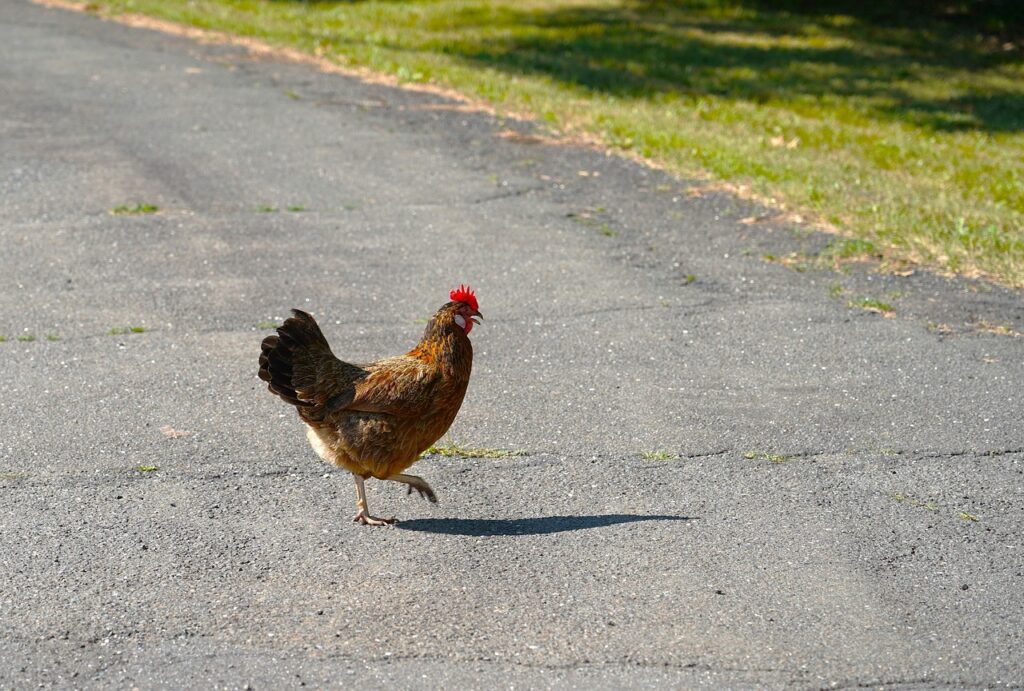
A big thank you to all the writers who took up the challenge of Ekphrastic Challenge #3 2026 and survived crossing the road. Entries closed on Wednesday, 25 March, 2026. Most participants seemed to have a lot of fun with the challenge. The conundrum may not have been solved, but we received a EGGCELLENT range of imaginative, thought-provoking responses to the provided image. Your ongoing support is valued and appreciated.
Our next challenge (Ekphrastic Challenge #4 2026) is now open.
A reminder that when submitting your responses, please ensure you:
- specifically respond to the image
- give your submission a title
- take time to read and edit your entry before you submit it
- ensure your work complies with the Australian Standard house style: singular quotations and Australian spelling.
The following writers have had their response to Ekphrastic Challenge #3 2026 published below:
Jean Pearce, Robin Purdey, Julie Edmonds, David Bridge, Glenyse Robins-Ward, Ian Stewart, Adam Stone, Geoffrey Gaskill, Ian Chisholm, Catherine Mahar, Russell Abbott, Jenny Lynch, Alan Cobham, Denise Main, Christine Scheiner, Jenny Eddy, Rhonda Hyder, Fran O’Mara, Allan Barden, Kerstin Lindros, Dulara Jayasekara, Stan Billing, Steve Gray, John Heritage, Kim Virt, Scott Hunt, Ian Henricus, Zoe Sanders, Mary Szymanski, Henry Vapp, Helen Hewitt and Caroline Florence.
Please, take the time to read and enjoy their responses.
I Don’t Get it
The council must introduce laws to stop chickens crossing roads. I say, we will have no chickens crossing our roads. No chicks either. They shouldn’t be allowed to jaywalk just because they are cute and fluffy. Don’t get me wrong. There’s a place for chickens, but not crossing our roads. Yesterday I saw a whole chicken family cross the highway. Nearly had an accident. I tooted the horn and nothing happened. I shouted, stop. Need I say more?
On the topic of chickens, let us not forget the roast chicken Christmas dinner is always tough and stringy and has no taste. Also, wishbones are a myth we are all led on to believe by our mothers and grandmothers, who should know better! I have to say. Last year I found a wishbone in my Christmas dinner, did a pinkie pull with my cousin Frankie and silently wished for a yellow EV MG, but did I get one? No. To this day, I swear I’m still driving my black diesel, Ute. I protest. Wishes do not come true. Ban wishbones too, I say!
Not to mention the chocolate Easter egg in coloured foil that sits innocently on supermarket shelves year in, year out, along with touchy-feely chicks in picture books. Parents and grandparents need to reconsider. I say, keep chicks out of supermarkets. Who knows who has been writing these books? Probably AI.
The most appalling part of all this is that when I come up with good suggestions and pertinent opinions, you all laugh!
Everyone seems to think what I say is hilarious. I don’t get it. You may even think I’m AI, but I reassure you I’m not.
Jean Pearce
Why the Chicken Didn’t Cross the Road
There are no line markings or traffic lights for this chicken, so he is certainly taking his chances. A car on this open road could easily have sent him flying. Still could—he’s not there yet. He looks pretty determined, so clearly there is something he wants on the other side.
For ages I have kept a non sequitur cartoon by Wiley Miller in the Age newspaper years ago on why the chicken didn’t cross the road. It’s stuck on my frig with a frig magnet (a London bus, actually). His chicken is looking at the ‘WALK’ lights at a pedestrian crossing. I suppose they would be green. He says to himself, ‘On the other hand, I might be sacrificing my freedom by mindlessly following such an arbitrary dictate …’
Wiley Miller was way ahead of his time. These days we are constantly bombarded with talk of human rights, freedom of speech, political correctness—the list goes on.
Perhaps all those drivers not wearing seat belts or not indicating if they’re turning left or right are thinking like Wiley’s chicken.
Robin Purdey
A Cushioning Place. A Refuge.
Laughter alerts us to them. We’re on the beach after enjoying dinner at the pub over the road. They’re in the dunes enjoying a few drinks: two mates—an ocean bay arcs before them. A range of hills sweeps behind them. They see us, beckon, and call us over. We chat and laugh with them. One of them cleans houses during the day and works nights at the pub, content with his life. Disturbed by world events, he ignores the news. In their tussock shelter, with its soft, cool sand, his mate tells him as much news as he wants to hear. Separated from the town by a road and from the sea by a beach, the dunes provide a cushioning place. A refuge.
Life here flows to the rhythm of the sea. Seasons. And weather. People support each other through daily challenges, personal endeavours and natural disasters. They’ve known the devastation of fishers’ lives lost at sea. It’s a place committed to people. A welcoming place. Peaceful. Tucked between the hills and the sea, it’s farming, fishing and tourism that sustain it; it’s a cushioning place, a refuge for visitors and locals.
Home again. Where the balcony separates the interior from the exterior, the view stretches across treetops, water storage and rooftops. Farmland. A freeway. To the horizon, with its familiar contours. And stillness. My cushioning place. My refuge—shared happily with birds and possums. I appreciate the balcony and its view every day, even the grey, miserable ones. Sometimes I think about the two mates in the dunes, their friendship. Empathy. And vulnerability. Protected in their cushioning place. Their refuge.
I don’t know if those living with conflict, hunger, illness/injury, amidst rubble, controlled by oppression, can find cushioning places. Places of refuge. But I hope so.
Julie Edmonds
The Other Side
I hadn’t given much thought to mortality until I found it virtually impossible to take three paces along a straight line without toppling sideways. I repeated the attempt three times with the same result, an uncontrolled trembling in my lower legs. As someone given to walking as a regular exercise this was confronting. Maybe I’d overdone the wine? Thinking back, I’d had a couple of glasses but nothing out of the ordinary.
Worried, I consulted Dr Google. The results did nothing to calm my nerves, with a range of possibilities, many encompassing life-shortening conditions. If my legs were shaky before, it was now a more prevalent response with my heart conducting the choir. The sage advice accompanying the doom was to consult your health professional. I dialled the surgery, only to discover that the first appointment wasn’t until the following day.
My mind raced through ‘what ifs’. Insurance and wills aside, my uppermost concerns centred on how I would cope with some form of degenerative disease, and what was dying really about, just the end, full stop, or some form of continuing existence? I was certainly in no hurry to test the possibilities, transitioning to the ‘other side.’
My GP listened to my concerns and did a thorough work-up: blood pressure, sitting and standing, neck pulse, ears, urine, blood, and of course, balance. Not a bulk-bill scenario I surmised. He regarded me over steepled fingers. ‘It’s a lifetime change you’re needing.’ I waited anxiously. ‘You must drink more. A lot more.’ So, this was it: drench my sorrows, make way for what lies beyond.
He grinned. ‘You’re dehydrated. Cut back on the wines and short blacks and down more glasses of water.’
I breathed out. The journey to the other side could wait a little longer.
David Bridge
The Marching Hen
Harriett had finally escaped from the lonely coop where she had been laying her eggs. Farmer Fred hadn’t secured the gate when he raced off to take a phone call after collecting her eggs.
She followed the music being played in the distance, leading her across the meadow from the farm towards the park. The band was playing marching music, Harriett’s favourite music. By the time she arrived at the roadside, she was marching to the beat. With every step she took across that uneven road, she did it with pride and joy, her head held high.
Although the music was being played loudly, her hearing was acute; she could hear a truck coming towards the bend, and as quick as a wink, she shifted her marching step into a fast and furious march, enabling her to get to the other side before it ran her over.
When farmer Fred arrived back at the coop, he found the gate open and Harriett missing, but he had no idea where she had gone. All he could see were a few feathers heading in the direction of the meadow. He started to trudge through the meadow, and he could also hear the music playing in the distance. He knew it was Harriett’s favourite music as he had often played it to her when she refused to lay.
When he crossed the meadow, he came to the road where Harriett had crossed about an hour earlier. As he walked across the road, he found her sitting under the large shady tree in the grassy area. By this time, he wasn’t angry; he was overjoyed to have found his prized egg-laying hen. He picked her up in his arms and headed back across the meadow and back to the coop.
Glenyse Robins-Ward
Road Safety
‘Jeez, sir,’ said Barney. ‘Do we really have to go?’
‘You do.’
The lady from the RACV cleared her throat. ‘Now, boys, this is important, what I’m going to tell you. Please pay attention.’ The general hubbub settled and she began her lecture. She brought up, on the screen, a picture of a rooster strutting across a road.
‘Just look at him,’ she said with a smile. ‘Too proud to pay attention to the traffic. Just bear this in mind—it’s not why the chicken crossed the road, it’s how.’
Barney and his mate, Johnno, shouldered their bags and made for the school gate. Barney sneered. ‘What did you think of that old bird from the RACV? All hot air, I’d say.’
They had reached the kerb.
‘I’m going to cross over here, Johnno. Coming?’
‘No, Barn. I think I’ll go up to the zebra and the lollipop lady.’
‘Chicken. See ya.’ With that, Barney stepped into the road.
Johnno turned and began walking away. He heard the sudden screech of tyres on bitumen, then the thump. He ran back and knelt by the figure on the ground. Barney was still. There was no pulse.
Look to the right and look to the left and you’ll never ever get run over.
Ian Stewart
Play Chicken for Me
‘Why chicken? What got into you? Why on earth did you do it?’
‘Well, I was following a rather dark, attractive shape and lost all sense of time and place. Next thing you know, I’d done it. I’d crossed the road.’
‘That’s all good and well, but you need to have more awareness than that. Anything could have happened. I was worried sick when I couldn’t find you. You had me running around like a headless … well, you know.’
‘Yeah, I know, George. You’re right, of course, you’re always so wise. Sometimes I just lose my head, and I don’t know whether I’m Arthur or Martha. I wish I could be more like you, so smart—and tall—and handsome!’
‘Nice try, chicken, but I’ve told you how this ends.’
‘Have you? I don’t remember. How does it end, George?’
‘Well, let’s just say that we all have a purpose in life and for now we serve each other.’
‘Ooh, I like the sound of that, George. I’m happy to serve you. Just let me know what I can do to be of service, and I’ll happily oblige.’
‘Have no fear, chicken. I’ll let you know when the time is right, but for now, eat up, you need to put some weight on.’
Adam Stone
Pet’s Paddock
I once had friends who owned a farm. On part of the property, they set aside a patch of land they called the Pets’ Paddock.
It became home to chooks—principally Gwendolyne, Penelope and Chanticleer. All had passed their egg laying/cock-crowing days.
Then there was also Blind Pew, a sheep that was … well, blind. Blind Pew was named after a character from Robert Louis Stevenson’s story ‘Treasure Island.’ I doubt if Blind Pew (the sheep) had anything in common with Blind Pew (the pirate), but who’d ever know.
There was an ancient horse named Phar Lap, assorted dogs whose working days were well behind them. One of these, for whatever reason, was called Rumpole (as in of the Bailey).
However stupid I think chooks are, God had gone one better—he’d created sheep.
I tried to help my friends with shearing one year. My father always said rounding up woollybacks was ‘like hitting yourself over the head with a hammer. It feels good when you stop.’
My friend was a soft-hearted fellow, unlike his pragmatic wife who was as hard-headed as he wasn’t. ‘Farm animals must pay their way,’ she declared. ‘Once past their usefulness, they should be put down.’
He was appalled. The thought of killing animals, useless or not, was abhorrent.
Out of their disagreement, therefore, was born Pets’ Paddock—a twilight zone for selected, superannuated farm animals.
Pets’ Paddock, however, wasn’t escape-proof. The chooks proved it the day they attempted to cross the busy road outside the farm to frolic with chickens on the other side. In so doing, they answered that eternally vexed issue: Chicken-Road-Cross-Why?
When I next visited my friends, I discovered the vacancy—make that three—in the Pets’ Paddock which had been taken up by Brutus, a very large, possibly gay, bovine.
Geoffrey Gaskill
Love and Loss
She held it tenderly, as if she might easily crush it. In her gentle touch, this tiny ball of chirping fluffiness, pulsating with new life, felt so light and warm. The class of teenage carers sat, eyes focused on their tiny chicks, which added a chirpy chorus to student babble.
She knew the task entrusted to each student; of bonding, nurturing new life and caring for it until it could fend for itself. She knew her little chick must be kept at a constant 35℃, fed special food and water with a syringe, and kept safe overnight, each in a separate small cardboard box.
Each day she continued to bond closely with her chick.
Then came the big decision: give up her chick or keep it. She chose to keep it.
At home, there was a well-protected coop. With the necessary information needed to raise a healthy little chirper into a mature hen, she willingly embraced the daily task with love and dedication. To have the responsibility of raising a living creature and measuring its progress was challenging, exciting, profound.
Her parents consented. Another three chicks were introduced. She watched their daily interaction with fascination as they matured. Another form of bonding.
She had witnessed the miracle of birth, closely observed her protege grow into a beautiful, healthy hen, strutting about, proudly showing off its thick coat of red feathers, as it contentedly chirped, chatted and busily fossicked. It was, for her, a fulfilling experience.
One morning, her beautiful hen was missing. She searched the neighbourhood without success. Days later, a friend said to her, ‘I was looking out the window the other day and saw a red hen strutting across the road. How odd, I thought. I wondered where she was going. How sad.
Somebody’s loss.’
Ian Chisholm
How The Chicken Crosses The Road In Sea Lake
This is a tall tale but true (thank you, Walt).
I was with my dear friend Jenny. We were on our way home from Mildura, where we had given a talk on nursing in East Timor.
Long though the day would be, we decided to drive home to Geelong on the Calder Highway. We stopped at Lake Tyrell to look at the salty pinkness, and the cemetery was given some cursory attention, but we were hungry so we hurried that along and drove into Sea Lake.
It was too late for a pub lunch, and the only possibility was a depressing-looking fish and chip shop. It was not an inviting place, but that was all there was.
As we sat outside the deep-fried-everything shop, eating our elderly potato cakes (unrejuvenated by their bath in hot, stale oil), feeling a bit dispirited by our situation, we saw on the street slightly ahead of us a sign saying Rooster Crossing.
It was a complete pedestrian crossing scaled down to chicken size; the warning sign showed a rooster and the white lines progressed across the road. How we laughed. What a very funny thing some clever town comedian had done. We loved it.
Slow country towns allow eccentric inhabitants to shine; how delightful that someone in Sea Lake had expressed their creativity by going to the trouble of painting the crossing. It was a fine joke for the little town.
Then, oh, mercy, a rooster stepped out of the bushes on the side of the street, paced leisurely over the pedestrian crossing, and sidled into the back of the pub.
If we had laughed before, now we were weeping and breathless with laughter. Such hilarity, such fun, and such happiness. Thank you to the Universe for bringing us that wonderful moment.
Catherine Mahar
Henrietta
Roger Rabbit, Puddle Duck and Henrietta Hen were best mates. They enjoyed each other’s company, with Henrietta assuming the lead. Together they roamed the bush surrounding their farm.
Henrietta devised a dangerous game to spice up their farmyard lives. On summer evenings the trio would make their way to the highway, stand on the white line and wait for a set of headlights to appear over the horizon. Roger was first to go; he hopped out onto the highway directly in front of the headlights, dropping down and flattened himself on the road surface. Once the vehicle had passed safely over him he hopped back behind the white line. Each had a go amid nervous peals of laughter and relief that they had survived.
Word got around; soon other nearby farms formed teams and a tournament was arranged. The team that got the most “home” in thirty minutes would be declared the champions. A night was chosen with six teams lined up beside the highway.
Henrietta’s team soon surged into the lead. Henrietta stood poised ready to take her team to victory. She was on high alert, over the horizon came her chance for glory. A set of slow-moving lights appeared, however, this time there was also an extra flashing red light on top. She waited, took a deep breath and scurried onto the highway, flattened down and waited.
The onlookers heard a blood-curdling scream; an awful thud arose from underneath the vehicle and as it moved on, a rain of red feathers floated down from the heavens, covering all those watching the terrible event.
Roger sadly shook his head and with tears in his eyes said to Puddle Duck, ‘What bad luck for Henrietta to chose a Street Sweeper for a chance at victory!’
Russell Abbott
Fowl Play
It was EGGS-actly what she needed, an EGGS-cuse to see a play.
So, Dora the EGGS-plorer headed up to New Yolk way.
She bought an EGGS-press ticket on a sleek new FowlFleet bus,
Then flapped her way to Broadway with a minimum of fuss.
Although she was EGGS-hausted, in fact, she felt quite stuffed,
She scored a front-row ticket, so was feeling EGGS-tra chuffed.
The programme guide was EGGS-cellent; she read through it super-fast
To reach the page of photos that announced the crew and cast.
It was the play, “Great EGGS-pectations”, a Charles Chickens play to boot.
The ensemble cast—all EGGS-perts—with the lead guy, oh so cute!
Young Pip, played by Cluck Norris, an EGGS-tremely handsome lad,
Princess Lay-a played Estella, which made Dora EGGS-tra glad.
Yolko Ono played Miss Havisham, an EGGS-trordinary role.
But then Dora glanced around her and could not see one damned soul!
The theatre seats were empty—she was on her Pat Malone.
Her EGGS-citement quickly vanished; the silence chilled her to the bone.
She waddled to the foyer to ask an usher to EGGS-plain.
The EGGS-planation that was given spooked poor Dora’s little brain.
You see, it was a FRY-day; a day when hens should stay at home;
A day when men like Colonel Sanders EGGS-ercised their right to roam,
To use EGGS-cessive force to capture plumpish hens and juicy chicks,
And fry them up in butter just to get their dinner kicks.
So, Dora the EGGS-plorer never got to see the play,
EGG-noring all those nagging fears would have ended her that day.
She caught the midnight EGGS-press bus, and to her home she fled.
She snuck back into her chicken coop and sadly went to bed.
Jenny Lynch
Flapper
The determined hen had fled the confines of her cage-locked henhouse and strode across the road towards a neat-looking blue cottage. The ‘chook- vine’ had informed her that an old lady lived there and looked after chooks.
She pecked at the open door to be welcomed by an old lady, untidily dressed, skinny legs and grasping a chook in her spindly arms. Behind her stood a small, muscly man holding a spanner that had been used to fix the stove.
She placed the other chook on the ground and picked up the new hen. She fluttered her wings in protest, but the lady calmed her, ‘You are such a nice hen. Welcome, you can stay here and I’ll call you Flapper. I’ll be your Chook Mum.’
Then she turned to the plumber who was preparing to leave and said, ‘Before you go, I bet you cannot do a sit-up!’
‘What a joke!’ he replied. ‘Look at your muscles compared to mine.’ And he plonked himself down and struggled to do a sit-up, got halfway and collapsed.
Then Chook Mum lay on the floor, still clutching Flapper, picked up a medicine ball, placed her on top of it and easily did five quick sit-ups.
The plumber was amazed.
‘How in the hell?’ he spluttered.
‘I did weightlifting all my life and was the World Champion in the over-40 Masters Games. I’ve kept in training ever since. I don’t think I need to pay you anything after beating you.’
‘I bet you my fee that Flapper couldn’t ride my skateboard down your driveway. It’s in my car.’
‘Okay, let’s do it.’
Flapper was plonked on this board and, to her amazement, she stayed on.
‘Great work, Flapper.’
Alan Cobham
Red the Runner
Gates crashed, voices screamed, roosters screeched, pandemonium as police raided the cockfight. Our sanctuary team was bent on rescuing victims and hens. One red hen did a runner across the road, her tilt at freedom.
‘Let her go,’ Fred yelled.
‘Nah,’ I returned and scampered after her. She settled under a tree. I cooed and clucked. Her bright eyes flashed, fixed, as I tossed crumbs. She sensed I wasn’t a predator and with a gentle throw of the net, I had her in my arms.
‘Safe now, Red,’ I murmured.
Red and I firmed our friendship. She answered my calls, sprinting to my lap, eyes pinning with excited affection. Without quarrel, she established the pecking order in the hen house until one day, she wasn’t there: no sign of predator carnage. Must have flown the fence, done a runner. I missed her and hoped she was OK. Weeks later she reappeared with a brood of fluffy chickens. I was jubilant. She joined the rest of the brood and took her position as if she had never left.
Red accepted me as she mothered her chicks; clucking, murmuring contentedly as they foraged. Her warm body was for them, eyes alert for danger, wings spread for shelter, soft chest feathers for hiding,
Another cockfight raid resulted in a miserable melancholic hen, eyes blank from neglect, arriving for care. I named her Daffodil. She crouched alone, forlorn, watching our Red forage, sprint, land on my lap, chicks scuttling behind. Daffodil gradually felt safe and began foraging with Red who clucked, murmuring approval. One day Red led Daffodil to my lap. I lifted the sad bundle into my arms for the first of many hugs.
Red the Runner has no need to run; she is now our Red Queen of Hearts.
Denise Main
The Great Escape
Mr and Mrs Chen raised me from an egg, and I suppose I should be grateful … but I can’t help feeling they have a hidden agenda. For starters, they named me Chow Mein! What a strange name for a chicken! However, since developing a taste for using my spurs, Mr Chen has started calling me by a different name.
It all began when that fat little psychopath of a dachshund (aptly named Weiner) chased me and tried to bite me. The first spur was self-defence, I assure you. Weiner screamed like he had been stabbed—which technically, I guess, was correct—but the bloodlust kicked in as he continued to squeal, and I just couldn’t stop. I was officially weaponised and loving it. I developed an insatiable appetite for violence.
That’s when Mr Chen first started calling me Far Kew. He hit me with a stick and shouted, ‘Come back here, Far Kew!’ when I bolted over the road to hide at the neighbour’s property.
The very next day, Mrs Chen got in on it after I tried a surprise ninja-style ambush attack in the veggie patch. She had no idea it was coming, and I got in two satisfying spur stabs to her calf before she armed herself with a shovel and yelled, ‘Get away, Far Kew!’
When Mr Chen materialised from the garden shed, wielding an axe to back her up, and declared, ‘I put you in a soup pot,’ I hightailed it out of there quick smart … straight back over the road where the neighbour seems far too flabby to defend himself.
Christine Scheiner
The Runaway Bride
Daphne du Maurier skittered down the road as fast as her chicken drumsticks could carry her. In the distance she heard a cock crowing. That damned Brewster MacLeod, he’ll have to do more than call if he wants my attention, she thought as she picked up the pace.
Brewster MacLeod was the kingpin in the hen yard. He could have his choice of any of the hussies there. Lately he’d been looking in her direction and dropping some not-so-subtle hints that he was interested. And that was fine because she was interested too. But she was definitely a one-rooster hen, and she wasn’t prepared to share his affections or become part of a crowded harem. She wasn’t serving herself up on a platter just for him to help himself.
So, Daphne was playing hard to get … and running away would sort out if Brewster was really interested or not. She knew that forbidden fruit was much more attractive than fronting up to a smorgasbord. If she’d ruffled his feathers enough and he came after her, then she knew her plan was working.
‘Cock-a-doodle-doo, Cock-a-doodle-doo!’ The call sounded closer. Daphne slowed her pace to a gentle jog. After all, Brewster catching up with her was part of the plan.
She wasn’t asking for much, but she wanted assurances that their union would be exclusive, maybe even a prenuptial agreement if she could swing it. A hen had to look after her future. She didn’t want her head to end up on a chopping block.
Jenny Eddy
Why Did the Chicken Cross the Road?
The proverbial question “Why did the chicken cross the road?” was first printed in a New York magazine, The Knickerbocker, in 1847. Was the chicken suicidal and just wanted to cross over to the afterlife? Was it merely trying to realise its potential? Was it looking for food, somewhere to lay eggs? Was it just too far to walk around? Was deregulation of the chicken’s side of the road threatening its dominant market position?
Do you give up?
Greek philosopher Socrates wrote, “The only thing I know is that I know nothing.” So, wisdom begins with recognising one’s own ignorance. We really don’t know why that chicken crossed the road.
Mark Twain says, “To succeed in life you need two things: ignorance and confidence.”
Confucius says, “Real knowledge is to know the extent of one’s ignorance.”
Ignorance is not necessarily a negative trait but a natural state.
Plato says a belief must be true and justified to count as knowledge. If this is true, can we ever really know why that gallinaceous creature did what she did?
Knowledge is generally vital for growth, decision-making and power, while ignorance can sometimes offer temporary relief or protective benefits.
The Dunning-Kruger effect explains that people with low skills or knowledge often overestimate their abilities. What these psychologists suggest is that maybe the chicken didn’t have the sense to realise the inherent dangers for him in attempting to cross that road.
As you acquire more knowledge, you become more aware of the vast amount you still do not know; therefore, it can be said that ignorance is bliss. Not knowing can protect one’s peace of mind, avoiding unnecessary, hurtful or overwhelming information. In the age of information, ignorance is a choice.
So, do you still want to know why the chicken crossed the road?
Rhonda Hyder
I Crowed and Crowed
I was compelled to seek that courtyard
To hear that high priest make early ablutions
Before the telling dawn of my darkest day
I, king in waiting to the flock, forced to crow
At that other’s dissimulations
His shrinking from their incriminations
For this designated day of passing over
There was much taunting and cowards’
Jeers around their fire; so much malice
And ire poured forth on the one
Beaten and bound while the maids
Called out his companion’s face
I had no choice but conquer tremulous fear
That morn, leave my home across the road
Be in the yard of pain and leering disdain
Among so many filled with anger and the one
Who stood and cried agonised sad tears
At the song I crowed and crowed for the rising sun
How can I recover my way, grub and peck
My living from the rich soil of my ground
After seeing his tears flow at my song
To the risen dawn, my cockerel crown
Having declared I stand alone and erect
In the emerging light of this newfound world
I do not know the steps my feet could take
To retrace my path to that place of daily
Plans, lay claim to my due heritage
And dominion over the flighty hens
Clucking along the opposing kerb’s herbage
His denials compelled me cross and crow and stay
Fran O’Mara
Marjorie
Marjorie crossed McKillop Street every morning at eight forty-five. Same coat, same pause at the kerb, same glance left then right, just as she’d done for decades. The road was dirt in her youth, but was now bitumen and had widened over the years.
Roads can be included in the chapters of one’s life. She can remember her first crossing alone without a parent’s hand, the reckless dashes in youth and the middle years when she hurried, late for something or other.
Nowadays she is slower, her steps more deliberate, more fragile. She had observed cars becoming faster over the years. She also realised long ago that driver’s manners nowadays are not reliable. New traffic lights, absent in her youth, were a help.
Marjorie stands on the edge of the curb, waiting for the green light. To her left and right, cars idle in anticipation of the green light too. Drivers bowed over phones, some sipping takeaway coffee, others putting on makeup. All seemingly oblivious to old people like her about to step out in front of them.
Family worry about her out walking at that time these days, with the increased traffic and speeding drivers distracted and in a hurry. ‘I’ve been doing it for years’, she would say.
One can picture Marjorie midway across McKillop Street in her final years, cars impatient, the wind lifting the hem of her coat. The fragile yet determined courage of her daily walk in a fast-moving world represents every old man, every old woman, who stands at the edge of change and refuses to stand still.
In Marjorie’s moment in time, the crossing belongs entirely to her.
The white Hilux, speeding to catch the lights before they turned red, failed. Marjorie stepped out on the green light.
For the last time.
Allan Barden
A chook, ahead of its time
‘Why did the chicken cross the road?’ I hear you ask, and then your mates chuckle and answer―for the chicken―proclaiming ever more outlandish reasons.
Seriously? It’s to get to the other side. Simple. That’s all we need to know. Maybe the grass looked greener. So let her explore. It’s a changing world out there.
Maybe she wanted a break, an adventure, become a sunny-side chicken, or learn the chicken dance of over yonder. Maybe she was curious about the new and brave enough to encounter the unknown. Let her grow, for God’s sake, or crow, or learn to cluck and scratch in other languages and try different biryanis. Get to know other chooks and people; a bit of networking will prime her for the inevitable and fast-approaching future.
Maybe she wanted to escape an overly persistent rooster. Or the daily grind, feeling worn out and underappreciated, or bored with her job. Soon she may be replaced by robots who lay AI-designed 3D-printed eggs. With her unique body no longer needed and the job gone, she’ll have to find a new one. Learn new skills. Build a completely new career. They say by 2050, we’ll work in 15 jobs and have seven careers. If she’s ready for that challenge, she might as well start now before she becomes an old chook, and ageism and other biases exclude her from being considered for the new opportunities that will hopefully arise.
And should she want to come back to the old life, so be it. Maybe we can provide a zebra crossing―lots of careless, entitled and substance-affected drivers out there.
C’mon guys. Leave the chicken alone. Chickens should be able to cross the road without being questioned.
Kerstin Lindros
Foes of a Feather
‘Keep MOVING, Garrett, keep moving—’
The feathery fiend currently stalling in the damn middle of the road was Garrett. Just there, chilling with his glossy plumage tanning bronze in the sun, I don’t know, can feathers tan?
‘GARRETT, I SWEAR TO GOD—’
I don’t know why they even kept him on the mission, he was so birdbrained as it was, but they seemed to think he was the world’s best operative.
I mean, the guy can’t even fly. Not properly, anyway. He fudged up some of his license details, but they let him in anyway. I, on the other hand, have FULL qualification, but noooo, Falcon 007 puts me as his second. HIS SECOND.
‘Garrett, WHY ARE YOU WASTING MY TIME? I repeat, he’s flown the coop, now’s your chance—’
Garrett’s head pushes backward and forward in that obnoxious little dance he does when he’s DOING ABSOLUTELY NOTHING.
‘You know, if I was the one in the field, we—’
‘Simmer down, Birdwatcher 101.’ Falcon’s authoritative voice booms from the left speaker.
I seethe, but obey.
‘Nobody likes an angry bird. I know he ruffles your feathers, but we’ve got a mission to do.’
‘I mean, he doesn’t really seem on it right now, and it’s a damn road; anyone with sense wouldn’t just stand there in the middle w—’
He sighs. ‘He’s watching everything like a hawk.’
I scoff. ‘Nice, but I don’t think we’ll catch him if GARRETT is dead as a dodo.’
In my periphery, I see Garrett finally cross the road. Except in the wrong direction.
‘Garrett, what are you DOING?’
He clucks. ‘Winging it, duh.’
After a good few pauses he’s disappeared, and worry churns in my gut when I hear a familiar smug voice in my ear say,
‘Boys … we’ve got ourselves a jailbird.’
Dulara Jayasekara
Will We Ever Know?
Chickens can cross a road in any season
don’t think they necessarily need a reason
To get to the other side seems totally invalid
perhaps it didn’t want to be in the Caesar Salad
I have my own idea, and I actually suspect
it’s beakause it’s sick of being henpecked
Looked smart and likely to be abreast of things
grilled it for two hours, still no answer it brings
Combed the area, searching for a clue
heard it was to join a band, could be true
Didn’t want to hang around barn raising chicks
could become a drummer, with own drumsticks
For chickens, death comes to he who meanders
end up in a cardboard coffin at Colonel Sanders
One side of the road, you’re nervous with jitterbugs
other, you can dine on insects, beetles and slugs
Chicken stopped in the middle, I think you’ll find
was time to settle argument and lay it on the line
Probably thought other side of road more inviting
grass wasn’t any greener and life, no more exciting
Which one came first people been asking for years
been a lot of guessing but no one had any real ideas
Saw chicken on edge of bed and it’s only my suggestion
smug and smoking a cigar, probably answers a question
Stan Billing
Allen! Where’s Allen?
‘I told you the gate didn’t quite shut.’ She was pointing out the kitchen window at the chicken crossing their driveway. Mark jumped up, took a quick look out the window and then shot out the back door to retrieve the chicken.
It was a merry chase. Gina had a laugh, Mark didn’t think much of the chooks, except eating them or their eggs. He looked up at one point and mouthed out, ‘Give me a hand, will ya!’ Gina nodded and headed outside.
This chicken was definitely playing hard to get. Eventually they had it cornered, we it had been cornered a few times, but this time this was it.
Mark stood up and stretched his back, a bit puffed out from chasing the beast.
Jean’s car pulled into their driveway. ‘Hey guys,’ she called out through the window. The pair sauntered over with a wave and a ‘hi-de-ho welcome’. Jean smiled and spoke clearly, ‘Have you guys seen Allen? He was meant to be home about two hours ago, no sign of him over at the farm.’ Mark suggested that he could have been taken by aliens. Jean smiled and then responded with, ‘Would they be that stupid?’ They all giggled.
Gina then squinted through one eye, suggesting, ‘And I guess you have tried his phone?’ Jean nodded and slowly drawled, ‘Yeah, nah, he’s not answering that.’ She then said, ‘I thought I’d get out and have a look a bit further before it gets darker.’
Mark suggested going to Davo’s place. ‘They were talking about doing some welding the other day.’ Gina threw her car into reverse. ‘Thanks for that, see ya.’ Her phone then rang. ‘Ah, Allen, where have you been?’
Steve Gray
Untitled
the chicken
escaped
across the road
from where
she was held
in atrocious conditions
of an egg laying factory
how many
overseas children
will never
live on the better
side of the road
if we continue to
buy the $4 tee shirts
knowing the truth
of what we consume
we become a safe-crossing supervisor
John Heritage
The Contemplation of Simply Crossing the Road
As I stand in the middle of the road, paused with my leg in the air, I wonder what’s in front of me, the adventures to come, the danger that’s there.
I reflect on what lies behind me, on what could have been.
What am I running away from?
Are they just memories to me?
There is more than just standing in the road.
It is a place and a time for decisions to be made.
Though being a chicken is something often feared, perhaps that very adventure has drawn me here.
I’m looking forward to crossing this road, only to see and understand more of me.
Who will take this journey with me?
Who will see the new adventures come through?
Will I make friends?
Will I live alone?
Will I see my days out and grow very old?
The contemplation sits here in the middle of the road as I adore the options and hear the roar, if only I hesitate for a minute or more.
What if I’ve made it across the road now?
I look down and hesitate more, to hear the buzz and hum of something new.
Is it adventure or is it danger?
The only way to know is to look no more.
I feel a rush.
I feel the wind.
Only to find my contemplation has drawn near.
It was sudden.
It was quick.
And here is where I say goodbye, for perhaps I should have taken the time to simply cross the road.
Kim Virt
Best Mates
‘Why did the chicken cross the road?’ Macka asked me one day in the pub.
‘I dunno mate, why?’ I said to him.
‘How the fuck would I know? It’s a bloody chicken. It’s your shout, drink up!’ he said, pissing himself laughing.
Pause for laughter.
That was Macka through and through. Always cracking up at his own dumb jokes. Never took life too seriously. Always had a smile on his dial.
Pause to compose myself.
He’d do anything for ya, Macka would. I loved him. He was the brother I never had.
Pause again.
None of us could have known what was going on in that head of his. He was my best mate and even I never knew about the darkness inside. We just didn’t talk about that shit. Now I wish we had. He might still be here today.
Hold it together, don’t bloody lose it now.
Deep breath.
Some people thought Macka was a bit thick; he wasn’t. He just saw the world differently to the rest of us, and he didn’t want people to know how clever he was. He reckoned it gave him an advantage to not let on.
There was something about Macka that drew you to him. The spark in his eye. The permanent wry smile at the corners of his mouth. He taught me to see life as an opportunity. To see the world as a wonder to behold.
After I met Macka life became clearer. After I met Macka I saw the world in a new light.
He was as unique as he was beautiful.
I’ll miss him every day.
Silence.
Scott Hunt
Naiveté
I wanna see ya baby, don’t turn around and hide
Can’t you see how hard it is to get to your sweet side
I get lost just trying to cross to your side …
… your side of the street.
I tried to be the sweetest boy, the cutest on the block,
But I was fooling no one, busy chasing any frock,
Foolishly I spoke the words that ran about amok
Her cutting words came back at me, they cut me like a shock.
I’ve sat up at the table where matters of the soul
Were spoken with solemnity, things soothed into a whole
But I sat there in quiet despair, my murmurs took their toll,
Until I learned to bow my head, until I learned my role.
When the Angel of the wicked first sat upon my bed,
And asked me if the holy words were true as first they said,
I saw an opportunity, a skin that I could shed,
A mentor wasn’t waiting there, no voice that I could wed.
When my friend became my lover, it wasn’t mine to fail
And when she was my sister, she threw away her veil
She let me know that dying young was not my Holy Grail
She kept me on that narrow strait, she kept me out of jail.
As eagles see all those beneath, while gliding on their air
All things that wander down below, without a single care
A rabbit in the headlights, a chicken’s roadside stare,
A vacant rooster unaware, the other side was there.
I wanna see ya baby, don’t turn around and hide
Can’t you see how hard it is to get to your sweet side
I get lost just trying to cross to your side …
… your side of the street.
Ian Henricus
First Gear
Bleeding, scratched-up skin
Shit-smeared pyjamas
Four chickens in my footwell
One in each armpit
We ramble, in first gear
Three on his lap
Two on his steering wheel
One pinballs about
Like it’s taken cocaine
I wish I could tell you
Our charges were smart
With secret intelligence
Wisdom of crows
But
They are mostly empty
Heads full of cloud
We moved their sheds
Across the paddock
They all went to bed
On a dead patch of grass
Six hundred chickens
Carried by car
Upside down by the legs
Scooped up in a bunch
However we can
The stars are a riot
The wind a warm bath
I’m full of regret
This isn’t how I pictured
Chicken farming
Zoe Sanders
The Protest
The chooks are assembling, ready to fight,
for their independence to cross where they might.
A pedestrian crossing, a road or a river.
They’re sick of the jokes that those humans deliver.
The chickens are gathering deep in the park.
It’s a free-range affair so you won’t hear a bark.
’Cos it’s just for the birds to feel strong and secure.
And it’s good for the grass ’cos the chooks leave manure.
Today there’s an outdoor discussion about,
the reason why chickens are always called out,
for crossing a road and the questioning why,
they would do such a thing when they’d much rather fly.
The park is abuzz with the chatter of chooks.
With their bright protest banners and chicken joke books.
They want humans to stop making fun of their kind.
With a drafted petition the chooks have all signed.
And then to descend onto Parliament House,
with a shout from the chooks that it’s going to be grouse!
They are happy and clucky and joyously free,
as they march towards scenes of a sad tragedy.
For a great devastation occurred on the way,
causing death of all chickens involved on that day.
With each car, truck and motorbike, down they were mowed.
Proving chooks should undoubtedly ne’er cross a road.
Mary Szymanski
Untitled
Back in my primary school years, I fondly remember my obsession with chickens. I had always wanted them—at least five (I would always say this as I pitched the idea to my parents)—alas, to no avail every single time. You see, there was a perfect space between the back of my garage and my fence where the coop would go, and every morning I would have collected their eggs to fry myself a fresh, free-range, home-laid egg.
Looking back on those times, I was a fool. It was as if the world had decided to smite me at that exact moment and send possibly one of the most evil, malicious and downright diabolical chickens of all time directly my way: Pecky Becky.
One fateful afternoon, as I returned from school, my eyes were ostensibly blessed by one of the most ironic sights of all time—a chicken crossing the road directly towards my house. As my parents desperately searched for her rightful owner, I was squealing with delight. I would finally have a pet chicken.
However, owning a solitary chicken straight from the streets didn’t turn out to be the greatest experience you could have!
After affectionately naming her “Pecky Becky” and releasing her into the backyard, she caused nothing but havoc—hiding her eggs, charging at anyone who even remotely came near her. Even our old sheepdog decided Pecky’s ruthless reign wasn’t worth the effort. She was so spiteful that she even attempted to fly directly out of our backyard a couple of times (we got her wings clipped).
We had Pecky for a whole five months before our more chicken-experienced neighbour took her in, and she met her untimely demise soon after.
One thing I’ve learned from this?
Don’t pick up random chickens from the street.
They might just be like Pecky Becky.
Henry Vapp
He Who Hesitates …
With his heart trembling in his chest
He edges forward on his daring quest
At the curb he falters, tense and unsure
As iron beasts streak past and roar
Their blazing eyes burn fierce and bright
As they pierce the shadows of the night.
The feathered warrior, with feet of clay
Steps tentatively onto the roadway
A fleeting lull, the path is clear
A narrow gap, untouched by fear
With wings aflutter and spirit set free
He charges forth to claim his destiny.
For standing still will never do
For one so bold, so brave, so true
Who dreams of adventures grand
And distant skies in a far-off land
Beyond the fray, beyond the day
A brighter world to guide his way
Helen Hewitt
The Getaway
It all started this morning when the truck rumbled into the yard. At first, Mrs Atkins paid it no attention. She fluffed her feathers, checked her eggs under her warm little body as usual, then fixed her eyes on the henhouse door.
Any moment now, Farmer’s Wife would appear with the breakfast pail, calling them all outside with her cheery ‘chook, chook, chook’.
But today was different. Today, Farmer’s Wife arrived carrying large crates.
‘I’m sorry, girls,’ she said. ‘But there’s just no money in eggs anymore.’
One by one the crates were filled.
‘I’ll miss you most of all, Mrs Atkins,’ said Farmer’s Wife as she picked her up and nuzzled her face into the softness of Mrs Atkins’ russet feathers.
The driver slid her crate into the truck last, fixed his dark eyes on Mrs Atkins and whispered wickedly, ‘It’s the dinner table for you.’
Mrs Atkins felt faint with fear.
For hours and hours she worried as the truck sped on its journey. Faster and faster they went. Then it happened. The burst tyre, the swerving and jolting. Then a screech of brakes and a crunching as the truck slid sideways into a ditch, its back doors splitting wide open.
Almost immediately, terrified chickens spilled from their broken crates, darting out into the sunshine.
‘This way, girls. Follow me,’ clucked Mrs Atkins, as she raced across the road.
Her sharp little eyes had already spied the lush green meadow on the other side, dotted with grazing cows. She knew what that meant. And was that the distant sound of clucking she could hear?
Like a cavalry charge, Mrs Atkins and the girls picked up the pace, scattering into the meadow like pebbles on a beach until, suddenly … they were gone.
Caroline Florence