
Finest 500 2026 Prize Winners
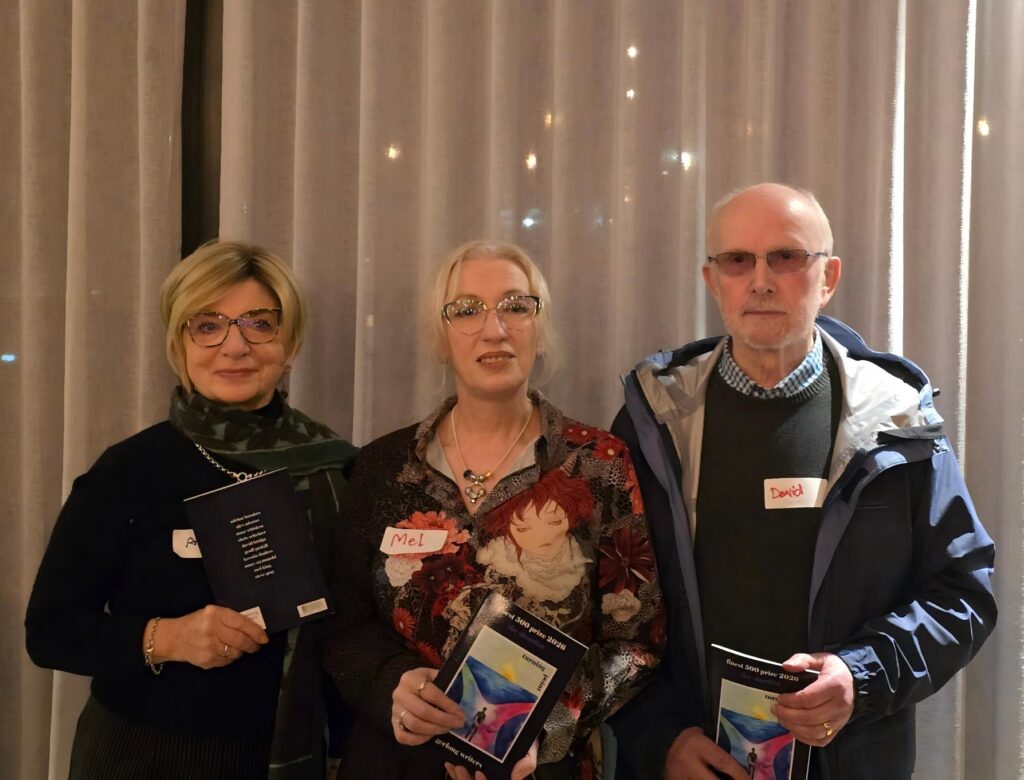
(L to R) AnneWhisken (Second Place), Mel King (First Place), David Bridge (Third Place)
The Finest 500 is an annual competition for members of Geelong Writers. Entry is free. This year, writers were invited to submit prose or poetry of up to 500 words in response to the theme “Turning Point”. Submissions were de-identified and forwarded to a prejudging panel comprised of Victoria Spicer, Dr Glenda MacNaughton and Guenter Sahr. Their task was to select a shortlist of 10 stories—a challenging task, and they achieved it.
The de-identified shortlist was then forwarded to Serena Parker, who accepted the difficult task of choosing the winner and place-getters. Her judging comments are provided below.
Congratulations to our Finest 500 2026 prize winners and the shortlisted writers. For those writers who didn’t make the shortlist this year, we appreciate the time and effort put into your submission, and we encourage you to keep writing! More competitions and opportunities to acknowledge your hard work in the future can be found at www.geelongwriters.org.au/competitions/. Writers who become members of Geelong Writers enjoy free entry to all our competitions and publications, so why not become a member today.
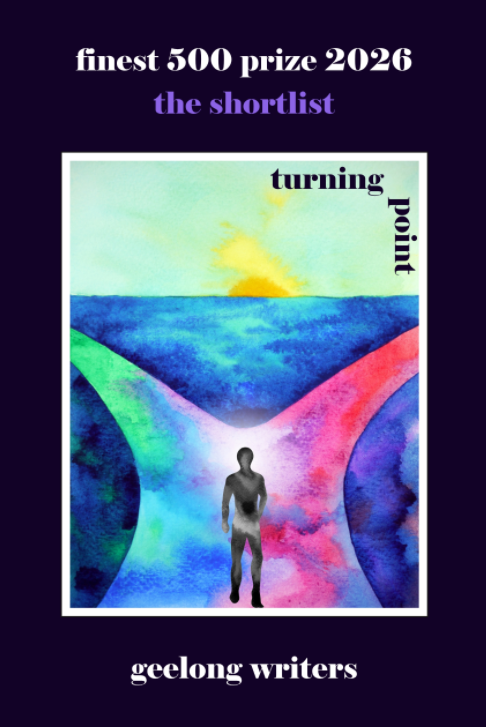
A copy of the Finest 500 2026 chapbook is now available for purchase at the Geelong Writers Publications TryBooking page

TERMS OF THE COMPETITION
- Entries can be fiction or non-fiction, any genre
- Give your work an original title (not included in the word count)
- Your name should not appear anywhere on your work as the pieces will be judged anonymously
- Entrants must be paid members of Geelong Writers
- Limit of one entry per member
- Our house style is Australian Standard: singular quotations and Australian spelling
JUDGE’S COMMENTS
The standard of submissions to the Finest 500 for 2026 was high, which made the job of judging them a pleasure and an honour, but also difficult. It was a blind judging process, and although guided by detailed criteria, there is always a subjective element to such a task. For me, depth and confidence in the story telling were also important.
There’s a lot to include in a mere five-hundred words. The story must meet the brief, be well-written and original, take the reader on a journey, craft a setting that resonates, introduce believable and interesting characters who are somehow changed at the end, and it must engage from the first line. A great deal to achieve, which serves to magnify the importance of every one of those five-hundred words.
Thank you to all the writers who submitted their work to this competition, you should be very proud. But my task was to offer up just three prize winners, and they are as follows:
First Prize
Names Not Yet Spoken by Mel King
This story is a reflection on one woman’s identity, written with an original conceptual approach on how that identity was informed. It confidently takes the reader on a journey through time, delivers a great character arc, flows well, and the powerful segues are clean, light and simple. A pleasure to read. Congratulations to the author.
Second Prize
Divine by Anne Whisken
This is the story of a woman in her last chapter reflecting on the life force within and the power it holds at her core. The vivid imagery and scene setting are tender, immersive and haunting. Congratulations to the author.
Third Prize
Leverage by David Bridge
On the surface, this is a story about a person forced into a much-needed career change. Underneath that story is the everyday tension between personal ethics and basic needs. A well-structured, metaphorical piece that casually yet definitively draws the character’s arc. Congratulations to the author.
Highly Commended
Ollie Meets his Turning Point by Steve Gray
This story is a comical and rhythmical frolic about a loud, chaotic family full of quirky individuals, and how one member is compelled into change to be heard above the din. Entertaining, colourful and memorable. Congratulations to the author.
Highly Commended
The Blanket by Mary Szymanski
A sensitive and reflective story on the ending of a relationship. Some lovely images used in this piece. It was well paced and engaging and left me curious to know more. Congratulations to the author.
Acknowledgments
Thank you to Guenter, Glenda and Victoria for providing such a well-considered short list, it wasn’t an easy task. And thank you to Geelong Writers Committee for trusting me to make the final judgement. Thanks must also go to Martin for his considerable administrative efforts and for compiling this chapbook. Lastly, thank you to the writers who submitted their work to this competition, the high standard speaks to the effectiveness and value of Geelong Writers, as well as the talent it helps to foster. Long may it continue.
Serena
(S. D. Hinton)
FIRST PLACE
Names Not Yet Spoken
Mel King
You’re Kellie Dawn, Kellie Doe, Smelly Kellie Jelly Face. You’re a lifetime of names not yet spoken, and when you grow up, you’ll fly a plane, write a book, go to Greece, go to Mars. You’ll fight robots, hunt ghosts, marry Danger Mouse, and live on a spaceship too, because you’re four years old, and you can do anything you want. Maybe you won’t have to settle for Danger Mouse. Maybe you’ll marry Doctor Who. Maybe you’ll be Doctor Who.
You’ve only been in prep for two weeks when they move you to grade one. You’re four-and-a-half, but they say you’re advanced. You’re proud and excited; they’re calling you good, and clever, and just for one night, you’re on top of the world.
You walk into a new classroom, with older kids who don’t much like you. It’s like being in trouble at home, but worse, because they’re all mad, and you don’t know why. You sit on the floor during art time, and you don’t realise you’re drawing on the floor, between the carpet tiles, a thin grey-lead line on the concrete. That shameful line – easily erased from the floor, but never from your memory. You’ve never vandalised anything before, but that’s what the teacher says you’ve done, and she snarls – she didn’t want them to send a baby into her class – that’s the name she uses, and it sticks.
You’re The Baby now, and Four Eyes, and the old familiar Smelly Kellie – and then you’re fourteen and sixteen and eighteen and they call you Grumpy, because you are, and Dolly because your uniforms don’t fit, and Pretty Please when they want you to do their homework, but you charge them money for that now. Fair’s fair.
You’re twenty-four, and thirty-four, and his names for you are shameful and insidious: Bitch, Cow, Psycho. They become normal eventually – lived in, like the tears and fractures and black eyes.
***
In the end, it’s a name that turns everything around, not an act of violence, not even a name spoken by him. Still, a scathing, hurtful name, ripe with fear and frustration, though spoken by a friend:
‘Statistic’.
Suddenly, you’re in motion. You’re four decades old, and today, you’re writing your own names. You’re Kellie No Longer of Him, Kellie the Unshackled, Kellie the Free, and you’re hurtling down a highway in a rented van, with your meagre collection of worldly possessions in just six boxes, and your cat, Snip Snip, in a borrowed cat-carrier. You crank the music, and give him a scratch under the chin, letting him bite you.
He’s having a tough day too.
You’re also Kellie the Broke – even the fuel in the tank was paid for with borrowed money. You’re in the red, impecunious, insolvent, and, as of this morning, between homes. But the sun is coming up over the water as you crest an unfamiliar hill, and glinting on the horizon ahead, you see an infinity of new names, just waiting for you to discover them.
SECOND PLACE
Divine
Anne Whisken
June felt the pull as her son’s car descended into a dip on the country road. A silver shiver slipped smooth into her body, calling her to be somewhere, something else. It had happened before, throughout her life: this tug, this twitch, but always she was too busy to acknowledge its presence, to hear its voice and follow it.
Now she had more bloody time than she had ever wanted.
The car powered up the rise and she turned her head to the side, her gaze settling on an old watercourse winding from higher on the peninsular across lower land towards the bay. It threaded through softly rolling paddocks and there was little to indicate its presence between the folds save for the sort of vegetation indicating damp ground – rushes and reeds, and cattle prints. There was no actual creek bed, yet somewhere down there was a rich artery thrumming with life. It ran beneath the road, and she had felt the call as they passed over it, a turning point, enticing her to join its journey.
Her son noted her turn and smiled. ‘Yeah, Mum. I know. Another one. We might find a way to get to it.’
‘What are these remnant things?’ thought June.
She had grown up with them on farms verging native forest – natural springs rising to the surface in wetter years, forming sudden little streams which ran on ancient runnels through forests and gentle clearings. Where paddocks had changed the landscape for grazing animals, the seasonal flows continued in the dips and turns, increasingly subterranean but plumbed on their unseen journey by crude dams sucking liquid from the vein.
Her father had taught her to carefully follow the bubbling rills, stepping gently and softly along fragile edges, past delicate maidenhair fern, bobbing orchids and tree roots reaching to shade deep pools where black fish darted.
She learned too the sudden jerk of their simple divining rods. Water, calling her down. Follow. Join me.
Since the stroke, June’s son came each week to drive her out across the peninsula, knowing her yearning to see the bush again. Not that there was a lot left – but enough, these dreaming tendrils. June struggled into her beloved old gumboots and then managed with her stick to clamber into damp places and sit on crumbling banks, happy to push her fingers into mud and weeds.
‘I will sink with you,’ she sang silently. ‘I will blend and melt, and you will take me where you rise and fall.’
A day came when her son knew it was time. He left June at nightfall near a little pool, gumboot shod and stick in hand. She turned just once to hug him, tears of joy and gratitude glistening her fallen smile before she clambered eagerly into the old watercourse to follow its invitation through dips and hollows deep into gnarled tree gullies.
The searchers found her gumboots near a reedy spring high on the ridge; her walking stick a little further on.
THIRD PLACE
Leverage
David Bridge
My school physics textbook explained that a screw utilises leverage along an inclined plane. My boss, Andrej Ivanovic, who termed himself a Refinance Specialist, also relied on leverage. He carried a crowbar. I was inclined to accommodate his ‘idiosyncrasies’ because it met the cost of living. Literally.
It is my experience that there comes a point when a screw refuses to be driven home any further. The wise man stops, fearing that either the screw head or driver will buckle, rendering one or both useless. Not all of us are wise. Some of us are desperate.
However frustrated I was with him, or myself for putting up with it, Andrej Ivanovic was not a person to cross. I recorded names, amounts and ‘Injections’ or ‘Withdrawals’ but had no idea of the ‘projects’ involved. I asked once for clarification but was firmly shut down, ‘None of your business. Keep your eyes on my books. Nothing else.’ I did exactly that.
The ‘Books’ in my opinion should have been computer files but he would have none of it. ‘Books, more difficult for taxman. Not easy to read.’
‘Easy to burn though,’ I said as a warning.
‘Just so,’ he replied, tapping his nose.
I did persuade him of the need for a lockable heavy metal wall cabinet for keeping the books secure. As anticipated, I got the job of fixing it to the wall. It came with bolts for securing it, but they relied on a solid wall, not wood studs and plaster board. I voiced concerns but Andrej knew better. ‘Heavy screws will do.’ On inspecting my work, he predictably insisted on driving in each screw to the point of near obliteration. I knew better than to say anything.
My instructions were to file documents on the lower shelves. He had uses for those higher up where only someone of his size could reach. Here, heavy boxes would come and go, often catching on the shelf lip. Noticing a gap opening up between the top of the cabinet and the wall, I was relieved to have my desk to one side in a corner.
Arriving early one morning to unlock, I found Andrej’s open van across the entrance. This was unusual enough for a cautious entry but the scene still caught me by surprise. He was upright but pinned to the wall by the toppled cabinet, one arm raised, hand grasping a box handle which was wedged against his throat. The colour of his face and a lack of pulse told me all I needed.
A peek inside other boxes sickened me. Gold watches, pens, cufflinks, rings, a hoard reminiscent of descriptions I had read in accounts of war spoils and the like. Emptying my desk, I gave thanks and decided that a career change was called for. I left as quickly as my shaking legs would carry me.
HIGHLY COMMENDED
Ollie Meets His Turning Point
Steve Gray
Ollie Pringle was the fourth child in a family that operated at maximum volume. The Pringles were not just large; they were functionally chaotic. His father was a tuba tuner, and his mother collected vintage alarm clocks, which frequently went off at the same time. His siblings were a whirlwind of activity: Barnaby was building a rocket in the shed, Mirabelle was attempting to learn ten languages simultaneously, and Pip, the third child, had never, not once, spoken a sentence that didn’t rhyme.
And then there was Ollie.
Ollie was eight years old, and he was the quiet corner of the Pringle hurricane. He wore beige sweaters to blend in with the couch. His favourite hobby was watching moss grow. Ollie didn’t just like quiet; he required it. When the rest of the Pringles were performing an impromptu kitchen-appliance orchestra, Ollie could be found in the garden, carefully placing pebbles in order of their smoothness.
He felt like a single, grey crayon in a box filled exclusively with neon-glitter ones. ‘I just don’t have the thing,’ he whispered one evening to his pet snail, Gordon.
The great turning point, the single moment that shifted the Pringle family axis, arrived on the Day of the Unexpected Capybara.
Their neighbour, a travelling zoologist with questionable judgment, had asked the Pringles to watch his pet capybara, ‘Sir Reginald’, for the weekend. Sir Reginald did not enjoy the sound of tuba tuning, fifteen languages, or rhythmic couplets. Within twenty minutes, the capybara was charging through the hallway, knocking over alarm clocks and scattering Barnaby’s rocket plans.
The house was a circus of shouting, clanging, and the scratching of capybara toes.
‘The beast is fast, we will not last!’ Pip shouted, hiding behind a sofa.
Ollie stood at the epicentre of the noise, utterly overwhelmed. It was too loud. It was too fast. It was too Pringle.
And then, his frustration hit its own resonance point. He didn’t scream. He didn’t join the chaos. Instead, Ollie did something he had never done before: he took control of the silence.
He grabbed a heavy metal mixing bowl and a wooden spoon, marched to the centre of the living room, and banged it once. It was the loudest sound the house had heard, a sound that stopped all other noise.
The capybara skidded to a halt. The family froze.
Ollie held up his hand. ‘Wait,’ he commanded, his voice surprisingly deep.
The house was perfectly silent for five whole seconds. Then, Ollie walked over to a stack of his father’s metal tubing, picked up a piece the Capybara had sniffed, and held it up. Sir Reginald snorted, then lay down, soothed by the smooth metal object.
The Pringles stared at Ollie. They hadn’t known he could be loud. Ollie stared back, realising that the quiet kid didn’t have to be invisible. He just had to know when to use the right kind of noise.
HIGHLY COMMENDED
The Blanket
Mary Szymanski
We were nearing the predictable evening coffee routine. You were telling me about Scotland. I listened and watched the wood fire embers glow like trouble. Your gift lay between us, a Harris Tweed blanket, grey and soft like your flecked hair. I thought it was beautiful until you said it would keep me warm when you were away. Again.
Warm as a cat, soft as imagined clouds, a true security blanket. I thanked you as sincerely as I could manage, speculating as to why I felt so irritated.
‘Coffee?’ I asked, needing to put some distance between us. How ironic, given your recent absence. You sighed and nodded tenderly.
It was cold in the kitchen, so I held my hands close to the gas stove as the coffee pot did its magic. I wondered how a flame could be so warm when it was the colour of melancholy. And then you were there beside me, stroking my hair lightly, reaching for cups and sugar. Another gift appeared: artisan chocolates.
‘Nothing like a spot of decadence,’ you said. I felt annoyed.
‘Lovely,’ I murmured, loading up the tray and holding it between us like a fence of sorts.
Back in the lounge, warm next to the fire, you told me the blanket was a steal.
‘No one in Scotland expects anyone to buy blankets in the middle of summer.’
‘You did well,’ I said as you reached for cigarettes. ‘I’ve just had the couches cleaned. Please don’t smoke. And my eyes are sore too.’ Why did I say that last bit?
All those gifts, and you weren’t even allowed a sneaky ciggie. But then, it wasn’t just you. It was things attached to you, the stuff you surrounded yourself with. That PA and his ever so happy demeanour. Whenever I rang your office he always demanded I have a nice day in that cheerful smug voice. I wanted to tell him to get stuffed. Your imported cigarettes and incessant gifts. The showy black Lexus LX570 in the driveway always blocking my car whenever you came around. I felt trapped knowing it was there.
‘You should have told me about your eyes,’ you said and I balked at the concern on your face.
I looked down and noticed my breath, shallow and quick. Was an intuitive plot about to escape, a plan that until now I had refused to acknowledge?
‘This isn’t working, is it?’ I said quietly, putting the onus on you. Should have known you’d answer a question with another question.
‘What do you mean?’ You leaned away from me. I kept my eyes down and waited.
After a stumble around the lounge, you sat alone on the awkward bentwood chair pushed up against the wall and forced your body against it. I watched as troubled fingers reached to your mouth and heard the small word ‘but’ escape through your hand. You stared at the Harris Tweed blanket next to me where answers were hidden deep in the weave.
SHORTLISTED
Ice Age
Kerstin Lindros
Rob grunts and pushes my arm away to wriggle into the passenger seat by himself. Man, I didn’t ask to be here. I just couldn’t say no when Helen rang about going up north to help Abbey with the kids. Uni assignments. Absolute emergency.
My brother doesn’t want to let go of his crutches. Now they stick out between our seats and my elbow keeps hitting them as I’m steering the Mercedes down the dark drive towards McPhersons Lane.
Our foggy breath hangs between our faces and the windscreen, and the moisture settles quickly on the glass. I tap the air con. ‘So I can see where we’re going,’ I quip.
‘It’ll warm up soon,’ I keep small-talking. Ungrateful old devil.
Rob braces himself and holds his knee when the front of the car rises and dips on the corrugation. I slow down.
‘Bloody Helen!’ he grumbles. ‘Leaving before the surgery? And asking my little brat brother to stay?’
‘School holidays. It’s no trouble.’
‘The teacher. How big of you. Buried the parents an’ haven’t heard from ya since.’
Rob can’t even look at me. His eyes are on the vanilla-scented tree that dangles from the mirror. He flicks it with his fingers. Probably hates the vanilla.
Now he throws me a narrow-eyed glance. ‘That smug face o’ yours takes me right back to the fields with Father. Hard yakka it was. And helping Mother with a baby. I was 13 when you dropped.’
‘Our dad was old school. Times were different then.’
‘Knew you’d say that. You escaped. University. I had to leave school and learn a proper job. Me ‘n’ Hels had to come back to the farm to support them. “There’s always machines and tractors to fix,” Father said. “Plen’y o’ work for you right here, Son.”’
I nod and stare at the illuminated bitumen before us. Words bend and twist in my head as the clock glares at me in blue―5:52am.
All I say is, ‘We’ll be at The Alfred by seven.’
Now I thread my hand through to the glove box to retrieve a bag of Minties. With his big farm hand he fishes one out, untwists the wrapper and mumbles something.
Together we suck and then start chewing. Rob folds his wrapper into a little boat with precision. He still does that. I was so proud when he taught me. I try to catch his eyes, but he closes them and keeps digging his teeth into the mint.
My phone rings and I tap the screen.
‘How are you boys?’
‘We’re doing fine, Helen.’
Rob offers a defiant yep.
I take over to reassure Helen. ‘And? How’s things up there?’
She talks about the zoo trip with Abbey and the kids and their fun plans for the rest of the week. My brother and I gasp and stare at each other.
‘I think we must have a serious talk with Helen when she’s back,’ I say later.
Rob nods. ‘Yes. We must.’
SHORTLISTED
Poppy
Geoff Gaskill
I own a red ceramic model of a poppy.
I received it as a gift when a project called Blood Swept Lands and Seas of Red that commemorated the centenary of the start of World War I was dismantled. The individual pieces were then sold off.
The whole installation consisted of 888,246 poppies, each representing a British or Colonial military fatality in the Great War, though its symbolism goes beyond that.
In its own way it marks for me a moment when my notion of World War I turned from words in a book to a small, but real-life moment of understanding about the awfulness of that event.
Like each of them, my poppy honours the memory of one ordinary man or woman, someone who might, under different circumstances, have contributed to the betterment of mankind.
My poppy is a manifestation of futility and the blight that humans inflict on themselves in the form of warfare.
If art is meant to educate, this little model of a flower does its job well in its uncomfortably subversive way. It does what I think all great art should do.
But that isn’t only why it became a turning moment for me.
There is a personal poignancy I associate with this flower. My mother’s first husband, Joseph, was killed at El Alamein sometime in 1942.
He is not my father, but his death marked a turning point in her life, when she became a war-widow.
I cannot imagine how she felt or how she would have had to accommodate her future when she received the news that he was missing in action—army-speak for killed.
During my childhood she never spoke of Joseph much. On those occasions she did, even decades after the event, I could hear the desolation in her voice. All she’d say was eight words—Joseph went to war. He never came back.
She never got to see his grave because he doesn’t have one. His memorial is a name on a wall. It’s the fate of soldiers who are known to have been in a theatre of conflict and yet no remains can be found to mark their one-time existence. In short, when the guns fell silent, there was not enough left to bury.
I struggled to get my mind around destruction so complete that not one thing was left to mark Joseph’s existence or his passing.
Apologists for war are fond of speaking the old lie—dulce et decorum est pro patria mori.
I look at my poppy and wonder where is the glory in a body being shredded that there is not a scrap left to mark one-time existence? And why are ordinary people represented by Joseph and my mother doomed to concomitant pain and sorrow?
I like to think of my poppy as a kind of hard copy of something called memory.
Lest we forget? The pity of war is that we do.
Correction.
We refuse to remember.
SHORTLISTED
The Choice
Chris Scheiner
It took only a few minutes for the machine guns to cut through Ali’s entire regiment as he crept under a scant canopy of shrubs. As screams ripple in his ears he lay mute with terror, waiting for death to claim him too, but the quiet afterwards is more horrifying.
The azure sky stretches on forever as Ali, covered in small bloody pieces of his fellow soldiers, looks up from the scorched crumbling earth and prays to Allah.
The dry earth is bleached white at the trench edge and Arthur buries his face in the dirt, not wanting to see the carnage around him. Gallipoli had sounded like a grand adventure, but the reality was vastly different. He wishes he was back in the shearing shed at home, waiting for Ma to bring some scones for morning tea – anywhere but here with the heat, the stench and the continual shelling.
The blast blew them both into a nearby trench, already a morgue of soldiers, and when the shattering concussion of the mortar faded, they clawed out from beneath the acrid dirt.
In stunned stillness, they lay not more than a few feet apart like two broken and discarded marionettes – fate slipping them a choice in this unpredictable and violent chaos.
Condemned eyes watch each other as two boys barely eighteen raise their weapons together, both fighting for their own God, Country and life.
With quiet incomprehensible words, but clear meaning, Ali drops his gun and slowly pulls out a string of prayer beads. He begins to cry softly. Arthur cautiously watches the enemy soldier but doesn’t lower his own weapon although he knows the Turk has acquiesced.
His head is still ringing from the mortar explosion and with metronomic precision his finger flickers on the trigger in time with his pounding heart. Crosshairs trained on the Turk’s head, Arthur wonders if God will forgive him if he pulls the trigger. He wonders, too, if this is something he will be able to live with.
The ringing clears and the sound of Ali’s gentle sobs splits something open in Arthur. His eyes shift and his finger slowly lifts. Arthur reaches down carefully and curls himself around Ali. He closes his eyes and is back home comforting his little brother after a bad dream. On soil that none of them wanted to fight over, they become a single motionless shadow lying amongst the broken corpses of their comrades.
As the guns continue to blast sharp through the air, they cradle each other on the border between life and death until the bright sun lowers and leaves them. As night creeps across the battlefield wordlessly Ali and Arthur part.
They both wonder if the world will ever right itself.
SHORTLISTED
Echo of Regional Summers Gone By
Alex Adorno
I hold my breath, turning off the main road into yester-years. My fears of being forgotten increase.
I park on the same street end my rear-view saw when leaving.
The pavement cracks where I’d spun on it as a child and, as an adult, I step surely over each fracture.
The fence I’d run sticks over as I rushed past, finally whitewashed. The rusted bus shelter I’d sit in to go to the market repainted forest green. Miss Davis on the corner has an iron table and chairs on her veranda, what did she do with the dog’s couch?
It’s been a while since we moved away, the warmth of sunshine foxtrotting with leaves.
I’m awkwardly tall for feeling so small, confronted with reverberations of histories known to few.
Would the park’s garden lake be filled with firework debris after Santa comes to town on his firetruck? One piece of sulphuric cardboard clutched close to my chest in wonder after shouting ‘MUM! I. TOUCHED. A. FIREWORK!!’
In a crowd of hundreds, children and adults interrupt and shush me, saying I’M the one being rude. Too wild, and too big for town at six. Unwanted, I persisted, determined to be friends with all of Christmas Eve.
Choir still carolling, antique bells in midnight of my mind. It’s Christmas somewhere, I guess. Walking past my favourite window chair at the library, the skate park, my old dance studio, the alternative health shop, down towards the supermarket.
Morning of the fireworks, I cried trying to pay for a chocolate I forgot was in my hand. I ran back when I realised. It wasn’t the first time, the cashier said my dad would cover it if I got stuck. In some ways, it was good. Small town, everyone knows everybody and where they belong, but … when they decide you don’t it can be hard to keep living there.
There’s my house, painted white and grey from the renovations when I was twelve though it used to be maroon, green, purple and cream. I don’t know who thought to put it together with the fleur-de-lis window we called ‘Yoda’ due to the afternoon shadow down the hallway.
When we left, it must have been July … I remember Christmas lights with two layers of socks and chill-bitten nose. Thirteen; the worst year to move away. What about the mayor’s husband who steals our Christmas biscuits? The summer reading program, I had a streak of winning!
But, no friends in town …
My old house has a family in it now, two grandparents and a child, an armchair to watch the world go by and I am part of that world now, passing by their windows interrupting time.
I used to get measured under the sapling out front, it was a race for height. Now, under the branches, we both became trees, roots deep in this place.
I’m glad we left, my roots were bound, transfer saved my life …
And still, my heart remains within the leaves.
SHORTLISTED
Natália, We Can’t Afford You Any More
Adrian Brookes
Highton, December 1st
‘Twenty-four days to Christmas.’ Tracey sighed and shook her head in a where-does-the-time-go kind of way. ‘And two new grandkids to buy presents for, not to mention paying off the pool for them all to play in. Oh, I had an idea for the party. We could give everyone one of those fancy little music boxes that play Christmas carols.’
‘Oh?’ Barry demurred. ‘More expense?’
‘Yes, but it’s only once a year. I was thinking: with things being so tight, we should reconsider what we’re giving to the mission.’
‘I’d wondered that, with prices going up everywhere. If we need the money for other things, I suppose the mission will just have to do without it.’
***
Brisbane
‘Seems everyone’s feeling the pinch,’ the missions director groaned, ‘what with the cost of living and Christmas coming up. Donations down by a third last month and this month’s looking even worse. It’s come to the point, I’m afraid.’
His wife frowned. ‘You mean, for the Timor-Leste project? Well, it’s hardly unexpected. The clinic’s been running on empty all year—falling apart from lack of maintenance and now they’re out of medicines. So you’re closing it?’
‘That’s what the board’s decided. No choice.’
‘Anybody else picking it up?’
‘We’ve asked around. Everyone’s in the same boat. Donations have plummeted. Cost of living. People can’t afford it.’
‘Oh, they could if they wanted to. They just want to cling to their little luxuries.’ She huffed. ‘Christmas! So that’s it for Dili.’
‘I’m afraid it is. Now I have to call Iris and tell her.’
***
Dili
Iris put the phone down, swallowed hard and stared through the window at the scavengers combing the rubbish dump. It was bound to come. When she’d heard of the new and camera-friendly Fiji project, she’d guessed it would one day come at the expense of this Dili backwater. With a sob she started to think how she’d break the news to the patients she’d so diligently tried to succour. Not the least of these would be Natália and her family.
***
Likisia
Natália’s father’s expression changed only in the tear that sprang from his eye. Natália, his Christmas baby! In her seven years of life she’d been the apple of his eye, the pretty smile that atoned for all the deprivations of that impoverished little land. But of all the emotions that churned his heart, surprise was not among them: the moment he’d dreaded had been pronounced.
***
Likisia, some weeks later
‘Ashes to ashes, dust to dust …’ Father Giraldo kept a tight grip on his voice. It wasn’t so much grief that threatened to unsteady it, though that was real enough; no, it was the screaming injustice of burying another victim of a sickness he knew to be fully treatable if only her life hadn’t hinged on the whims of rich foreigners. And even worse, the father’s anguish would be mixed with the appalling relief of having one less mouth to feed.
Divider Image by Clker-Free-Vector-Images from Pixabay