
Attribution: Phoebe Hancox
(Phoebe is a member of Geelong Writers. She is an Australian radio presenter and media creator who hosts the show Speakeasy on the Melbourne-based community student radio station 90.7 SYN FM. She broadcasts every second Tuesday at 5:00 PM. Her show prominently spotlights local arts, featuring segments on poetry, microfiction, and storytelling. Phoebe is also an ongoing contributor to Geelong Cereal.)
Publication of Responses
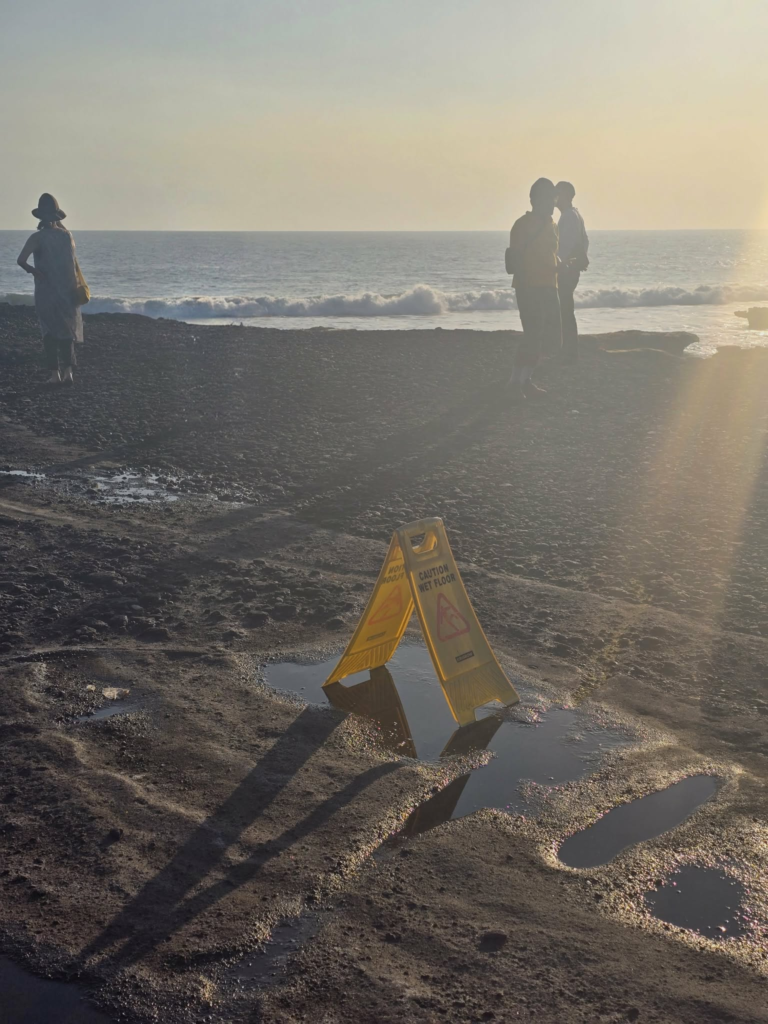
A big thank you to all the writers who took up the challenge of Ekphrastic Challenge #9 2026. Entries closed on Friday, 25 September, 2026. Participants managed to heed the cautionary sign, to avoid slippage and to spring into, well, spring with a wonderful and imaginative mix of responses. Your ongoing support is valued and appreciated.
Our next challenge (Ekphrastic Challenge #10 2026) is now open.
A reminder that when submitting your responses, please ensure you:
- specifically respond to the image
- give your submission a title
- take time to read and edit your entry before you submit it
- ensure your work complies with the Australian Standard house style: singular quotations and Australian spelling.
The following writers have had their response to Ekphrastic Challenge #9 2026 published below:
Mary Szymanski, Sandi James, John Heritage, Bruce Waddell, Steve Gray, Dulara Jayasekara, Glenyse Robins-Ward, Denise Main, Fran O’Mara, Ian Stewart, Ian Chisholm, Ian Henricus, Geoff Gaskill, Rhonda Hyder, Howard Osborne, David Bridge, Allan Barden, Julie Edmonds and David Jones.
Please, take the time to read and enjoy their responses.

The Caution Wet Floor Sign
The Caution Wet Floor Sign was bored with existence.
It wanted adventure and wanted a break
from the lights and the crowds at the big shopping centre.
Oh, to be near some water, an ocean or lake.
The Caution Wet Floor Sign escaped from the storeroom,
and furtively made it outside to the road
and jumped on a truck that was off to the seaside.
To a brand-new adventure, a brand-new abode.
The Caution Wet Floor Sign was super excited,
and jumped off the truck when it spotted the sea.
And it walked up and down on the rocks and the sand,
like a well-travelled tourist abundantly free.
The Caution Wet Floor Sign had fun while it lasted
but the pull of responsible signage ensued.
And finding a puddle ensconced in the pathway,
it stood to attention where it could be viewed.
The Caution Wet Floor Sign stood over the puddle,
protecting the public from dangerous trips,
resulting in breakages mighty horrendous.
Of wrists and of ankles and possibly hips.
The Caution Wet Floor Sign did see its first sunset.
Astonishing beauty of nature ablaze.
And while quietly sleeping the waves came in gently,
and carried the sign in the ocean for days.
The Caution Wet Floor Sign finally landed,
upon a small island congested with trash,
and began a new life known as coastal pollution,
awaiting humanity’s eventual crash.
Mary Szymanski
The Sunsets Warning
The sign.
The signs are there.
The sign knows something the water can’t say out loud.
Caution. As if a warning were ever enough. A small plastic sign won’t hold back what the whole shoreline has already agreed to. Stones softened by relentless permission, tide pools like open questions nobody’s answering. It stands guard over nothing. Are you afraid you are of the threshold?
Two shapes made one, foreheads closing the last inch of distance like a decision already made. Nobody warned them. Some collisions don’t come with signage, they arrive golden and unforeseen, dressed as romance, functioning as risk. How do we trust something that looks that beautiful?
Disconnected, a woman alone, hat pulled low, hands on hips, calculating how close is too close. She doesn’t see the sign. She’s reading the horizon instead, showing truth more reliably, offering no apology.
Wet floor. Does danger only count when it’s named? A small puddle amidst an ocean of pain. The whole ground is a hazard and nobody’s liable – not the ocean, not the light, not the shadows forgetting themselves in it. The rocks don’t need a warning. They’ve already been changed by every wave that’s ever arrived uninvited.
The focus remains on the sign. It’s the only honest thing in the frame – small, absurd, insisting on caution in a place that has never once asked permission. Everything else is just quietly, authentically, dangerously sure of itself.
Sandi James
Untitled
stair
at
the
clues
but
don’t
see
the
answers
John Heritage
The Rule of Law
A haibun
We have the pedants and the ignorant in society. A civil democratic society accepts the separation of powers into three streams, the legislative, the executive and the judiciary. These rules are universally applied with the exception of the dystopian world of Trump.
We, the subjects of the law, endeavour to follow all reasonable rules in an orderly manner for neighbourly harmony, in the name of the Law, as even the ignorant are expected to grasp the rules, whilst the pedantic have an overdeveloped sense of rules they reserve as an affectation of correctness in language. Your photograph captures their work and the uncertainty awaiting.
1
Take caution pedants
an evil doer misleads you
contrarian warns.
2
The ying and the yang –
the Right are ignorant as
the pendulum swings.
Bruce Waddell
Untitled
The smell of rot and wet ruin hung heavy in the air, a reminder of the black wall of water that had torn through Whun Hurm Cove exactly forty-eight hours ago. Half of the wooden boardwalk was splintered into toothpicks. Up on the highway, flashing sirens cast a steady, warning glow across the sand, accompanied by blaring loudspeakers repeating the evacuation order: The shoreline is unstable. High risk of secondary surges. Keep out.
But did anyone care? No.
I leaned against my rake, glaring at the shoreline. The sheer stupidity of it made my jaw ache. Right in front of a half-buried, overturned car, a guy in neon board shorts was setting up a bright yellow beach umbrella. He had to dig through layers of mud and broken cinder blocks to plant the pole, but he looked completely unbothered. Nearby, a group of five tourists posed for a selfie, throwing peace signs in front of a shattered resort lobby.
‘Hey, buddy!’ I yelled, pointing aggressively toward the sirens. ‘Didn’t you hear the sirens? The beach is closed! It’s dangerous!’
The guy with the umbrella barely looked up. ‘Relax, bro,’ he laughed, adjusting his sunglasses. ‘The sun is about to come out. Besides, the water looks totally fine now.’
‘It’s a disaster zone!’ I yelled back, but my voice was ignored.
Everywhere I looked, idiots were sunbathing next to debris or wading into water dark with toxic runoff. A child was building a sandcastle using a piece of a ruined roof. They had zero respect for nature, zero common sense, and absolutely no shame. I threw my hands up in complete frustration, turned my back on them, and walked away. If the ocean decided to reclaim the sand tonight, these fools would have to learn their lesson the hard way.
Steve Gray
Sea Glass
in that moment
the dust particles floated
and glowed
in the pathetic morning rays,
tiny dancers
I tried to count them all but they’d never stay still
the beach is best when barren and you can
feel the absence on your skin,
a smile lost to the wind
something so beautifully lonely
about the howling sound of rippled sand
and the golden grains of spiral shells
I put a cautious sign on where the
blunt-toothed shore
had broken up the floor,
wet sand and mud and crushed shells galore
I didn’t do it to salvage sand-caked feet from
blisters or scratches, sandy cuts,
I just wanted to keep them all away
like a magpie’s territory, you only knew me,
and so I let you only help me
pick up sea glass, driftwood, all the misfits like me
perfection is unattainable, and this
this feeling I could never attain on my own
but oh so attainable next to you
next to you
the dust pixies, they danced on my ribcage
and as the night darkened the ocean
turned to ink and tar
and one by one the streetlights sputtered out
so we lit up the flashlight moon
and tasted its silver between our teeth
we pretended the ink ocean was a sea monster
flailing kraken arms, falling on to sand
laughing and shrieking beyond its reach
the shoreline chasing our ankles
you made me a driftwood necklace that day
I made you glasses of the ocean to see
stained glass lenses of smooth sea glass
so when you got tired of the grey
you’d have colour at your fingertips
you’d have me
Dulara Jayasekara
Ebbs and Flow
From the balconies of the many buildings overlooking the shoreline of the popular beach, the sky looks so cloudy that even a smoky haze filters through. The scenery isn’t clear, but you can still see its beauty as if it were a bright, sunny day.
Nothing can compare to the two distinct aspects of those waves as they crash into the shore, whether it is clear or overcast, for they still reign supreme.
As the waves ebb and flow, whether the tide is high or low, their presence is visible to all. People walking along the high pathway look down at the workers, who are pondering the disruptions to their work. They are grateful that no one has been hurt by falling into the six-foot pit, which was filled with water the day before.
For two days, the storm sent the waves in a wild fury, so high that they wreaked havoc on the workers preparing the drainage pit, filling it and washing away all their hard work.
By another day, the pit will be clear to start afresh, but for now, the sand needs to absorb the remaining water. Then they could start all over and rebuild it.
So now, you, the battling waves, keep a low profile. Do your usual crashing into the shore, but keep it simple so the workers can complete their task, cover it over, and remove the danger, so that next time your big waves come thrashing through, they can get closer to the weedy dunes.
Glenyse Robins-Ward
Caution Wet Floor
Boyo Kelly, in tight overalls, his right foot and ankle encased in a heavy raised heel boot, limped to the cleaner’s storage. He hauled out the trolley loaded with buckets, mops, sign, ‘Caution. Wet Floor’ and pushed it to the lift and thirteenth floor. His foot throbbed despite taking pain killers. Pain, from the uncorrected club foot he was born with, was constant.
He believed it was the reason his young mother left him, a baby of six months, with his grandfather, and never returned. Grandfather Kel named him Boyo and taught him to manage the affliction with no medical treatment or schooling, but gave him wide beaches, high and low tides for paddling through puddles, swimming with his dog and the security of being loved. Kel, a proud man, taught him what he needed to know to get on with life in their remote beach shack and become independent.
When Kel died, Boyo couldn’t afford to stay in the rented shack; grief stricken, he travelled to the nearest town to seek his mother and work. On his days off from cleaning, he searched the streets armed with a grainy photo of a young woman with long braids and asked people if they recognised her. Nobody did, but he kept hoping and trying.
After placing sign, Caution Wet Floor, he had the wondrous ability to take leave of his body and in a hazy dreamy distance see Kel’s shack and imagine a world beyond mopping wet floors. Each payday he checked his bank account against the deposit for the overlooked, for-sale shack. When the longing gripped like a cramp, he would whisper encouragement, ‘One day it will come, when I’ll return home to where the ebbing tide leaves pools of water mirroring sea, sky and my shack on the hill.’
Denise Main
Evening Love Song
Our twilight’s tide is a humming symphony
Which sings the sentience of our bodies,
Our dreams, our draught of togetherness.
The ripple of memory is a tuneful whispering
Of all that we are, all that is important,
All that is precious in this measure of time.
There is no other showing, no other place
We need touch. Our weighted breaths pulse
The external pivot of our understanding.
We loiter along the slippery shoreline’s
Stacked ocean buttress: separator
Of all that teeming unknowable scaled life;
Seaweed embossed podium for our eyes
Composing their horizon’s dimming rim.
As day melds into our night’s entwined path
The wind weaves the skeins of our sapient,
Thinly disguised intentions: our mutual
Offering of love above the waves’ slow crescendos;
The ocean punctuating the fitful silence beyond
Our society. From within the hush of ourselves
Arises the serene sense of great kindness
Distilled on the salted air: a rich echo
For these comported lifetime years
Of our decorously poised counterpoint.
Fran O’Mara
Ubiquitous Water
Samuel Taylor Coleridge’s ancient mariner observed it. Three people on a beach observe it. It’s everywhere. Its horizon seems endless.
Take notice of the sign. It is late afternoon there. A time of closing, of ending. The atmosphere, uncannily calm, holds no warning. It is there, though, in black on yellow, on the sign.
As the atmosphere changes, becomes charged with the destructive power of carbon dioxide, of methane, the floor on which we stand – our solid earth – will feel the force of the change. One metre higher? Ten?
Janus-faced is water. Fifty percent of us is water. Essential. Dehydration means death. It commands our respect. We must remember that its anger balances its gift. Destructive hail. Flooding rain. Rising sea. I hear my younger family, the youth of the world. ‘Do something about it, won’t you.’
Ian Stewart
A Cautionary Tale
While on school holidays at their beach house, one evening during dinner, the topic of stupid teenage pranks during holidays was mentioned.
‘Funny how street signs are turned upside down, maybe give-way signs or worse, a stop sign, often appear lying horizontal on a nearby nature strip.’
‘Typical dad. Lighten up. They’re just bored kids having fun,’ the fifteen-year-old twins protested.
‘What if a motorist is killed because a stop sign was removed? Call that fun?’ their father replied.
‘We only meant, like, harmless fun. Yair, stuff that’s over the top or dangerous; you’re right, that’s serious,’ Jack admitted.
The boys later quietly reflected. They wanted to show their father that an original, yet safe prank, was possible. They brainstormed. A day at the beach, then later, a visit to Maccas and they had the answer. The following day they returned to their favourite hang-out; Jack wore his hiking backpack. Tucked around the corner out of sight by the toilets, they found what they were looking for.
Two days later, seated at breakfast, the aroma of bacon, eggs and percolating coffee lingered as they ate. Jack asked his father, ‘Were you and mum down the beach yesterday?’
‘Well, yes. Late yesterday afternoon, we were on ‘our’ beach enjoying the sunset. The tide was out; a small pool remained on the beach, beside it, a warning sign, CAUTION WET FLOOR. We laughed out loud. So original, yet harmless. Doubtless, an inventive mind at work there.’
‘It was me and Harry.’
‘Where did the sign come from?’
‘Maccas,’ Harry answered.
‘Do you realise, that’s stealing?’
Their brows furrowed, their mouths pursed in puzzlement.
‘Aw, Dad. Give us a break? You said it was clever, original and harmless.’
‘It’s still stealing. That sign goes back immediately after breakfast.’
Ian Chisholm
The Weight of Memory
It was heard first.
The roar that could be heard all about the world
Like an impatient, determined anger.
Before the earth and all its roots trembled.
The smell.
The smell of air from far away, suddenly in their nostrils,
A wall of shock for the senses.
The smell
Of water, and of wet earth. Of danger.
Of answered panic
and a deep need for truth of survival.
Of time.
And of time not passing … just echoing.
And …
In that instant it takes for a hand to sweep
Those inconsequential insects from a glass pane,
They were gone.
Without a thought of heaven or hell.
There was simply a quick moment of
Up … Down.
If they were unlucky.
Our people were there.
Not as toffs. Not like British Raj.
Just simple, humble white people.
Normal people.
Like Richard, who kept returning,
Moved by a need to touch something
Greater than himself.
To touch the Spirit of the Himalayas.
Surely one of the Spirits of the Earth.
I hope they were sleeping.
But no, the weren’t. Of course they weren’t.
They were further down.
We think. Perhaps.
We cannot imagine what it was like
To turn and see
The awakened mad dragon
As it snaked and galloped around the corner
In an impossible frenzy of madness.
And all we watchers, us,
Left behind, here.
Left here to forever remember
Those we kissed at the airport
And said, Be careful now. Enjoy yourself.
See you in a month.
* *
Long after the unsurpassable shock has passed.
Even after the claw of grief has released its grip,
We will still pause, perhaps gather somewhere …
At the home where we grew together.
At the place we used to play and sit about.
At the beach that they loved to wander …
Ian Henricus
Footprint
In the real world such things shouldn’t happen.
The walkers stared. As did the surfers who’d finished their early morning routine and sat on the sand, shivering.
The centre of attention wasn’t at the council sign, but at what looked like the bloody big footprint that it straddled.
Sometime during the night’s rain or since the last high tide, the impression of the footprint had filled with water.
One of the early morning walkers joked, ‘It looks like something out of a Spielberg movie.’
Others close by nodded, turning their heads to make out the shape.
‘I guess,’ someone else commented, dubiously.
‘Like some sea creature,’ the first added.
‘Hmmmm,’ murmured the second. ‘But as Freud said, sometimes a cigar is just a cigar.’
‘Oh, for Heaven’s sake!’ declared the first in a tone that brooked no dissent. ‘It looks like some sort of dinosaur has walked up the beach …’
The second commentator scoffed.
‘Well, maybe I can’t identify the exact creature, but something seriously big made that print,’ the first added. ‘And if it is, that means it’s probably still out there.’ He pointed to the ocean.
Everyone looked towards the water. The blue sky above and the white caps crumpling as they approached the shore made for a peaceful, picture-postcard scene.
‘I wonder if the surfers saw anything?’ #1 began.
At that moment they all heard a cry and turned their faces to watch as a surfer fell from his board.
‘Did you see that?’ asked #2.
‘Oh, come on!’ said another, the words dying on his lips.
They all saw the water darken around the now-riderless surfboard as it tumbled over in the waves, only stopping once it bumped into the sand at their feet.
In the real world such things shouldn’t happen.
Geoff Gaskill
Four Strangers
There was a moment that morning when four lives intersected. Four complete strangers connected on an otherwise empty beach. The power of each life circumstance slipped past, unnoticed by the others, each impacting deeply on the individual.
Flora had finally acted on her decision to leave her husband of twenty-six years. She enjoyed this moment of release as she walked her new neighbourhood beach.
Kenneth noticed the woman and kept his eyes on her surreptitiously as he approached. Would she notice, wonder at his agitation? Would she be able to tell what he had done? Guilt was written across his face. Nervously, afraid of looking guilty, he lifted his head high. It wasn’t his fault that he was burdened with a wife who deliberately antagonised him. He couldn’t be blamed for losing his temper. He may have given her a black eye last night, but she was more responsible for the damage done. He would go back to the house. Everything would be alright. No one need know.
Thomas soaked in the atmosphere of his surroundings. He had arrived at his decision. The new job was exciting in its challenges. He would go ahead, make the move. It was a big step to re-establish his little family in the big city. He wondered how fourteen-year-old Joshy would take to the idea of yet another re-location. He would go home now and tell Caroline he’d decided.
Deep in their thoughts, no-one noticed the placard left after the beach party last night. Mike’s joke stealing the sign from the cleaner and placing it in the middle of the party action, had not been appreciated when Scotty tripped over it. A knife had been pulled. Mike’s parents now stood over his hospital bed awaiting the prognosis.
Four lives overlapping. One moment in time.
Rhonda Hyder
Sad Reflection
It only wanted to be like the sea
Just a puddle, left after the rain
It was water, not salty, it is true
Sad reflection, shallow not deep
But on the dunes, by the beach
Being that close, and yet so far
Such irony, someone left a sign
As if spillage, one should avoid
Should one step in and get wet
A health and safety thing, I bet
And made the puddle annoyed
Feeling someone crossed a line
How low could one set the bar
Yet if nearer it might just reach
As a dream, not too long a leap
Join the tide, be part of a view
Not suffer this longing and pain
And yet it was not meant to be
Howard Osborne
Ashes on the Edge
Simon shielded his eyes from the low evening sun angling across the beach below as he tried to make out the figure in a sun hat paused on the cliff edge. Close by, Jayden pointed to a yellow plastic A frame sign standing on the puddled rock surface proclaiming ‘Caution: Wet Floor’.
‘Some joke, eh?’ he yelled, pointing.
‘Hilarious,’ replied Simon. ‘They’ll love that in Emergency when some old idiot comes in with a cracked hip from falling on the bog floor.’
‘You’re no fun anymore. Who’s the girl?’
‘Just what I was wondering – seems a bit preoccupied. I think I’ll go and charm her out of it, while you go and collect your mop and bucket.’
‘More likely need a shovel to clean up your crap. Spare her. This is where you’d come to get away from the likes of you.’
‘Says the guy with an odd taste in toilet humour.’ Simon was already walking leaving the exchange behind.
‘Nice evening for it,’ he ventured as he drew level. The girl pivoted towards him and he could see she was about his age and clasping a container in her hands. She was decidedly attractive and somehow familiar.
‘Simon, isn’t it?’
Taken aback he refocused. ‘You’re Marion’s friend.’ He recalled a conversation about cremating a dead pet and then beating an awkward retreat.
‘I used to walk Bobby here, she enjoyed it. I thought it a good place to spread her ashes. You can stay if you want.’
‘Er, no. I think it’s a personal moment. I’ll leave you to it.’ Turning hurriedly, he almost bumped into Jayden who knew of the previous meeting.
‘Clean up on aisle three,’ Jayden sniggered. ‘I told you I’d need a shovel.’
David Bridge
Happy Respite
They awoke on the Saturday morning to thick, dark-grey, cumulonimbus clouds and heavy rain lashing the house. Bill was still fast asleep when Mary’s phone beeped. The text read: Heavy rain has caused all kids’ sports to be cancelled today. Mary read it aloud with some glee, waking Bill from his stupor.
Bill was similarly delighted when he checked the daily weather report. Great, he thought, no mowing lawns or weeding today, I’ll get in the full Geelong-Hawthorn match this afternoon!
Mary said, ‘What a relief, we can avoid driving to the oval in this weather negotiating all those blasted potholes. Also the never-ending 40-kilometre roadworks that have been there for weeks on end. Can you imagine what driving around them today would be like? The potholes on our roads are a disgrace and dangerous!’
They had enjoyed two coffees in the quiet before the kids, Andrea and David, had ventured into the kitchen. Both were pleased not to be playing football and netball in such conditions and even more pleased when mum suggested bacon and scrambled eggs in the living room while watching ‘Rage’ on TV.
Mary did the cooking while Bill rushed out to Pakington Street to get the Saturday ‘Age’ newspaper and some bread from the ‘Born and Bread’ bakehouse.
While the kids bummed around all day playing computer games, reading and being glued to their mobile phones, Bill blissfully read his newspaper from beginning to end until the footy started in the early afternoon. Mary watched a morning movie on TV before the football started. She then spent the remainder of the day pottering about and reading her latest book club book while lounging on the bed.
The rain continued to fall heavily.
Nobody cared one iota.
Allan Barden
The Reunion
A loner, she was the eldest of five cousins; now time had swept them from childhood and carried them to the edges of each other’s lives, even though they’d promised to stay close and keep in touch. She couldn’t face them. Distraught about their grandmother’s death and her own recent medical diagnosis, she wanted these few days to be over. The naturalness of childhood nattering was gone. Awkwardness filled the gap. What to say? Not much in common anymore. Except their childhood holidays spent with their grandmother, Nan. Plenty to reminisce about.
Happy memories. But their communication was stilted. And silence rang between them.
They had become strangers. Nan’s death had saddened them. And reunited them; they couldn’t have imagined this uncomfortable unfamiliarity. Nan had outlived her children. She had bequeathed everything, including her house, to her grandchildren for their families to enjoy holidays by the sea. How to navigate all this without arguing? Saying hurtful words and tarnishing cherished memories. The tension suggested that one poorly chosen comment could spark an argument.
Until one of them said, ‘Let’s go to the pub!’
Banal banter bounced between them. Gradually they relaxed. And shared about their lives. And discussed what to do with Nan’s house and belongings. They decided to honour Nan’s wishes and keep her house. And sort through her belongings over time. There was no urgency.
They vowed to keep in contact, confirmed contact details and promised to meet here in the summer. Stay a few days. They farewelled each other with hope. And a niggle of doubt.
‘Wait!’
And the eldest blurted out her diagnosis. Shock and concern were expressed. The cousins embraced her. Comforted her. The awkwardness dissipated. Childhood familiarity warmed.
‘We’ll help you!’ they promised.
And they did.
And she convalesced by the sea.
Julie Edmonds
Hope
Weaned from puddles of past
I look into the future
a recollection of recent rain
the haze of what is now
Hope’s golden ray delights me
lights the path ahead
so cleansed
detritus, discarded events
washed into the sea below
Strangers gaze, upon different futures
divided perspective of individuals
they divine the metamorphosis
from past through present to future
into that golden ray of hope
David Jones
Separator Image: Clker-Free-Vector-Images from Pixabay