
Video by mariamargarit1998 from Pixabay
Publication of Responses
A big thank you to all the writers who took up the challenge of Ekphrastic Challenge #5 2026. Entries closed on Monday, 25 May, 2026. Participants proved to have sturdy sea legs and strong stomachs as they braced themselves against the churn—indeed, it appears all had a swell of a time (sorry!)—and provided a wonderful, imaginative and fun mix of responses. Your ongoing support is valued and appreciated.
Our next challenge (Ekphrastic Challenge #6 2026) is now open. Please note that this is a special “Winter Solstice” Challenge. The challenge is a response a word (NADIR) and not an image. Also, the word count is 182 words exactly (excluding title) and the closing date is earlier (19 June 2026) than previously challenges.
The following writers have had their response to Ekphrastic Challenge #5 2026 published below:
Jenny Lynch, Jim Fyfe, Adam Stone, Kerstin Lindros, Alan Cobham, Ian Henricus, Allan Barden, Fran O’Mara, Rhonda Hyder, Denise Main, Jenny Eddy, Raylene Hewer, Howard Osborne, Ian Stewart, David Bridge, Geoff Gaskill, Vicky Meng, Mary Szymanski, John Heritage, Glen Donaldson, Dulara Jayasekara, Glenyse Robins-Ward, Russ Abbott, Kanyanta Chikesengi, Julie Edmonds and Ian Chisholm.
Please, take the time to read and enjoy their responses.

The Owl and the Kitty-cat
[Apologies to Edward Lear]
The Owl and the Kitty-cat went to sea
in a refurbished Greenpeace boat,
They took some Kwells to combat the swells,
But the tablets got stuck in their throats.
The Owl looked up to the Gods above,
And prayed as he fell to his knees.
Oh, precious Kitty! Oh, Kitty, my dear,
Just find me some water, please,
Oh please!
Oh please!
Just find me some water, please!
Kitty said to the Owl, ‘We should throw in the towel!
There isn’t a drop we can drink!
There’s only salt water … I don’t think we oughta,
But should we? Oh, what do you think?’
They scooped water up, used their hands as a cup,
And the tablets dislodged and washed down.
But the Kitty fell in, the splash made a din
And the poor little Kitty did drown,
Did drown!
Did drown!
The poor little Kitty did drown.
‘RIP little Kitty, it’s such a great pity,
Alone, I must row the high seas.
When everything fails, I must save the Blue Whales.’
And he conquered his quest with great ease.
He mastered that boat, kept the damned thing afloat,
As he rowed with some runcible oars.
And all on his own, with some great courage shown,
Saved the whales the whole world adores,
Adores,
Adores
Saved the whales the whole world adores.
Jenny Lynch
Bob ‘n Duncan
‘Bob, can you hear me? Bob! Where are you?’
‘I’m glubbing swallowing water, globit. Over here, Duncan.’
‘Here? Where the—glocking hell, now I’m doing it—is here, Bob? I know you’re there, but where?’
’Duncan, glub, look at the channel marker, I’m glugging there.’
‘This side, Bob, or the other globbing side?’
‘Duncan, the red one!! Glub it. I’m near the glucking red one.’
‘Can you see a green one, Bob? I’m closer to the glorking green one. If we get between the two we can glubbing swim to shore’
‘Can you see any shore lights, Duncan? Which glubbing way is shore?’
‘Bob, just glerking focus. The glugging green light, starboard, is on your left heading in. If we glub glub stay between them we’ll be seen by a globbing boat. So swim back past the red light to the other side and you’ll see me and the green glogging light too. That’s it. I glubby hear you splashing, Bob. I gluggy see you now. Over here for glucks sake. Thank God!’
‘Look, it’s a light coming this way. It’s a yacht. Hope they glugging see us. Start waving, Duncan. And yell globbing LOUD!’
‘Hey!! Look out, Bob, they’re glucking not stopping.’
(Indistinct voices over music) ‘Yes, Braydon is at Grammar this year. It’s Bryson’s old school and …’ ‘Totally. What can you do? He told our Jasmin you’re getting him an Audi TT if he completes Year 12 …’ ‘So worth it darling …’
‘Duncan!! RGYC. Is that the boat name? Where the glub are you? What the glug was that? Was that you, Duncan? I felt that. Don’t play glucking games! Is that another boat? There’s something … Don’t do that! I slurping felt that again. Was that a …? Duncan! Are you still there??’
Aarrghlup…..
Jim Fyfe
By Water
This story begins by water. In fact, it begins and ends by water. A raging ocean and an uncompromising stretch of coastline. A merciless great expanse.
Old Ben knows it all too well. He has spent his entire life in its presence. He was born in Queenscliff, after his Fisherman father moved from Tasmania with his wife. Along with his father, a young Ben was involved in the failed rescue of passengers and crew from SS Cheviot when it came aground near Port Nepean. In their hopelessly inadequate lifeboat, they were simply unable to get through the Heads due to a south-westerly gale that had whipped up the sea into a treacherous frenzy.
Some of the surviving passengers were able to be rescued early the following morning, but Ben has never gotten over those who perished. How useless he felt. He knows it has taken something from him, though he can’t imagine living anywhere else. He’s anchored to this place. It’s not difficult to see the physical effect it has had on him. With his cushion bush beard and wild eyebrows shaped like seahorses, his eyes carry the water of one hundred seas. His skin is pockmarked with one thousand good deeds.
With a worn and knowing gait, Ben’s shoulders droop with the weight of too much debris, too many bodies washed up. He walks the narrow, rocky path lined with tussock grass and daisy bush, down to a remote part of the beach. He picks a sprig of saltbush, rubs it absent-mindedly between his thick, leathery thumb and forefinger, and brings it to his mouth, where he chews it to a pulp, then spits it out with intention.
He knows they are there. He feels their presence. The ghosts of souls lost at sea.
Adam Stone
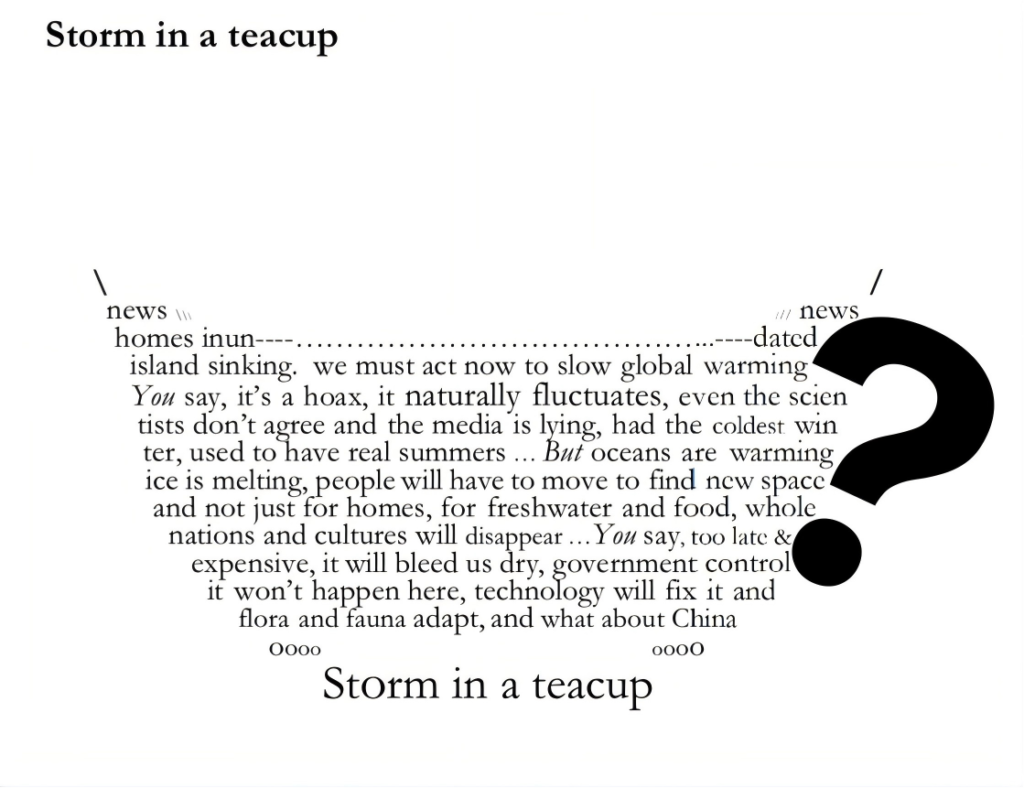
Kerstin Lindros
Swimming
Have I ever told you that my father doesn’t like me very much? He hardly ever talks to me. The other day, he stopped me in the passage and said, ‘Boy?’ and just walked on. Was he just checking my sex?
Anyway, two months later he tells me he’s taking me fishing. We’re out there a long time, no luck, getting dark now, big rolling breakers suddenly from nowhere, boat rocking, me screaming. Thunder roaring and lightning flashing, he grabs me and throws me overboard!
I scream for help, and he simply yells, ‘Boy, swim to that boy (what’s he talking about?) over there with the flashing light,’ as he starts the motor, and roars off. Again, I get that sort of feeling that he doesn’t really like me. Anyway, I plough through the rollers and get to this thing he calls a boy, clamber onto it, a rock’n’roll experience. On this strange ‘rocking horse’ is written Desperation Buoy—now I get it—but I’ve got to get off this thing and reach the shore. I succeed with the help of some large breakers bashing me through the shallows. Eventually staggered home to be met by my father who simply nodded at me as he puffed on his pipe, but looking very surprised!
A year later he told me to come to golf with him to be his caddy. Again I was somewhat concerned about the word caddy, and so I checked in my dictionary to find out that it was someone who carries a golfer’s clubs, but all I remember is swimming back home and thinking that there is something similar about fishing and golf! Believe it or not, I finished up at university on a swimming scholarship!!
Alan Cobham
Darlin’, You’re My Wish Come True
I could fall into water thick as marmalade jam
I’d swim and I’d sink until I’d cry,
But you’d send me a buoy so I’d know my way out
I’d see your lovin’ light before I’d die.
Never thought I’d find one to care for me so,
I only thought I’d find what I knew
You’re the one who took hold and you never let go
Darlin’, you are my wish that’s come true.
When my heart’s turnin’ empty and I’ve nowhere to go,
You’re the one who will sit next to me
Your words and your workings are all that I need
To know of the home you are to me.
Never thought I would say all these words in my heart,
Never though I’d have any clue
But you listen to me like I listen to you
Darlin’, you are my wish that’s come true.
I could hold every hand and steal kisses in the dark
But it would not be as true as your touch,
It’s beneath our own roof that your love is the spark
You’re the soul that I reach for and clutch.
Never thought I could hear a song that’s so sweet
Le langage de l’amour, parlez-vous?
Only hoped I could find a sweet lover so complete
Darlin’, you are my wish that’s come true.
I could think of all the ways that life could go wrong
And wonder at the point of it all
But you talk to me of simple things and how I belong
You’re the dance and the sway at the ball.
Never thought I could wish for the world to be young
I only hoped that some luck would ensue
Never thought that your name would be the first on my tongue
Darlin’, you are my wish that’s come true.
Ian Henricus
Just a Wave Away
Recently, while driving the backroads of country Victoria, I noted that many drivers still lift a finger from the steering wheel or give a small wave as a form of greeting or acknowledgement. It reminded me of my days as a small boy when I often accompanied my grandfather on his supervisory rounds of public works road workers who maintained rural roads along the north east and east coast of Tasmania. Back then, it was almost expected that drivers on country roads would acknowledge each other with a raised finger, a nod or a wave. It didn’t matter if you knew the people or not.
Initially, I used to wonder at how many people my grandfather seemed to know among other drivers and farmers along the way. He seemed to know people wherever we went. I puzzled at how he had the time to have made so many friends and acquaintances in so many out of the way areas. I soon realised that he knew only a few of these people, yet the waving hand or raised finger was always reciprocated. It was a custom that rural people shared.
Nowadays, it seems that this is a practice not shared by road users, especially by non-rural folk. Life is faster now, roads are busier and many drivers appear wrapped up in their own thoughts and often avoid eye contact. Even on country roads the old habit is becoming less common.
Yet, I still notice it from time to time, especially among older drivers or those in country areas. Whatever the reasons for the decline in this practice, my boyhood rural experience prevails. Sometimes, without thinking, I will raise my hand or finger to acknowledge other drivers. Perhaps my penchant for doing so can make the road feel a little friendlier.
Allan Barden
Fragmented Winter
Through these fractured moments of winter
An aching flash of warning light
Arcs off my marbled mind
Midway this journey my entailed vessel
Is pining rudderless and blind
My crazed spume of thoughts entombed
In fog of clanging time’s splinters
No misty season this for soft berths
Cold is the wind off Louttit Bay
Enraging the ocean to a graven
Frenzy of black swamping waves
Seagull notes scratch and clash
Across my brain yanking memory’s
Strings jagged as crystal bergs
Land-cleaved my mind lurches in mistimed
Vision of small ice spears hanging from bent
Branched gums on the near freezing Otway
Range with louring sleety rain
Scourging the sullen sodden sky
Of imagined beckoning buoy’s
Fragmented winter chimes
And a lean wind flays the keen heave
Of unctuous ocean’s penumbral surface
Hissing its perfidious memes of solace
In chasmic depths of spectral-eyed fish
Jettison life’s cargo from wave-wrenched
Jetty and bend towards felt littoral freedom
Along pier planks to Point Grey and leave
My day’s canopy of discontent
Wrapped in this winter’s pelt
Fran O’Mara
Lost at Sea
When I came to after the explosion there was no sign left of the boat. Flotsam had already been dispersed by the storm. I was alive! In those last few seconds, I had jumped clear. Alone now, confused, struggling against the elements to keep my head above the turbulent waterline.
Squally waves and still brooding rain filled my ears with riotous, meaningless noise, but I could still recognise the loud, discordant sound of my own lungs gasping for air. Icy Atlantic waters tossed me about in a cataclysm of angry water.
Daylight was already beginning to fade when I felt something brush against my leg. Shark? I remembered these creatures could smell blood from a great distance. Mentally, I searched for an injury and bleeding. Nothing!
Battling to stay afloat was depleting my energy. Despair at the descending of nightfall engulfed me until I glimpsed the light in the growing darkness. A shipping lane marker? Ships! Thoughts of a giant liner coming at me from out of the night were horrendous. The tethered buoy offered comparative safety and support.
After minutes of fruitless effort, my spirit began to fade. The weight of my body and the mad, sporadic violence of the waves began to pull me under. I took my last breath and began to sink, down, down. I looked upwards for a final glimpse of the world.
Then I saw them … two sets of legs thrashing in the circle of the lantern’s light directly above me. No air in my lungs, willpower alone propelled me to the surface. To my amazement I saw two figures cleaving to the shipping lamp. I recognized them immediately! It was Kate Winslet and Leo DiCaprio clinging desperately to the light. In her fist, Kate held fast to the Heart of the Ocean.
Rhonda Hyder
Go, Going, Gone.
He packed fishing gear into the boat ready to go. I watched him going towards the churning currents of the Rip. The white hull lifted and dipped as it was safely steered for the waters beyond, until it was gone. Gone, lost from sight, and he, from me.
The car headlights pierced the blackness and sea-mist like two rapiers. The base of the Point Lonsdale lighthouse eerily emerged in its beams. The torch’s sliver of light lit the steep sandy slope as I climbed to the sound of waves roaring and crashing over reef and rocks. Flood tide was sweeping in.
I stood beneath the lighthouse, scanning the shifting velvety black-green vastness where sky and sea merged, searching through binocculars for the anchored light, a bobbing red and white beacon. It appeared, lifting and swaying in the heaving peaks and troughs, blinking like a star in a sea of night, a bright flash of cheeful defiance against the ocean’s formidable elements.
‘There you are, my star so bright,’ I murmured into the wind, ‘my guiding light, my ray of hope and calm in the chaos of my grieving mind.’ I fixed my eyes on its flashing message of hope and resilience in this place of wild solitude. The wind sang a song of longing in my ears, sending a keening rush to my lips for my lost fisherman, a man of the sea. In my mind’s eye he is cheerfully waving as he let go the rope at the mooring and steered away into the sunshine of a summer’s day. He had gone fishing on that summer’s day, and never came back. His going left me alone, grieving, seeking solace from the sea he loved, his resting place, and the light of a bobbing red and white beacon.
Denise Main
In the Deep
I lean back and let my weary eyes close. Vivid pictures flash in my mind’s eye.
Murky grey waves crashing up and down. Whitecaps bobbing wildly in the ocean and the wind howling around my ears. In the distance I can see a beacon; my lifeline to safety, if I can only reach it and hang on. But my body is so tired, aching arms and legs don’t want to move.
It’s my worst nightmare.
Water is engulfing me, dragging me down to a watery grave. Goosebumps from the chilling water cover my body.
I drag my eyes open. I’m still in the bath—the wrong place to nod off!
Jenny Eddy
Fishing Charter
He’d wanted to catch ‘the big one’
Had wanted it all his life
And he finally had his chance
With this expensive gift from his wife
A ‘Day Out on the Water’
On a boat well equipped for the sea
An old salt for a captain
And a paying party of three
The promise was ‘Great fishing’
Huge marlin caught with ease
And if by chance, you don’t succeed
You’d get one from his deep freeze
The day dawned less than pleasant
The sea extremely rough
When the promised gourmet lunch was served
Just the smell was more than enough
Slipping and sliding, on the deck
As the mighty boat was tossed
The giant seas, and strongest breeze
Meant sight of land was lost
The other two paying ‘fishermen’
Were changing from green to red
Not fishing—leaning over the side
Feeding the fish instead
However, he persevered
Determined to succeed
Till the captain signalled homeward
And the other ‘fishers’ agreed
The captain turned his trusty boat
T’wards the coast he knew so well
Bravely fighting the wind, the rain
And unrelenting swell
When the coast came into sight
They all gave a sigh of relief
The three inexperienced land-lubbers
Had had times of disbelief
The captain lit a cigarette
Before sticking his head out the cabin to see
The lit end of his fag blew into his eye
(The wind had such ferocity)
He gripped his eye, with a scream
Unable to see—to steer
Our reluctant hero grabbed the wheel
As the others froze with fear
He never did catch ‘the big one’
But has a great fishing story
How he ‘single-handedly’ saved men and boat
And covered himself in glory
Raylene Hewer
Job For Life
So lonely and cold, but that’s how it is
Out here, in the deep, me and the sea
Anchored to the seabed, a job for life
A light in the dark that shows the way
Powered by sunlight, earlier in the day
The wreck below me, a result of strife
A wartime casualty, a troubled history
I’ve many cousins, from here to Cadiz
The hulk on the seabed, a military ship
All those lives lost are still down there
A story that now hardly ever gets told
And better than all the tales I may tell
All around me, a dark grey rising swell
Maybe I’ll be retired now that I’m old
But be vigilant, as you must stay aware
And on your sonar, look out for a blip
I’m made with an installed solar panel
There are other buoys, older than me
Yet few are lit, some still having a bell
In coastal waters, strong currents flow
But I stay here, just so all might know
The danger and the fears I might quell
So all should avoid this area of the sea
Even right here, in the English Channel
Howard Osborne
Leaving
Now I know lonely nights for all the while my heart is whisp’ring
Some other harbour lights will steal your love from me.
‘Harbour Lights’
Hugh Williams Jimmy Kennedy 1937
I’m thinking back, rememb’ring how it was
Those halcyon days of Spring and Summer love
Our souls at once were perfectly entwined
Too soon the victim of the flighty dove
One last kiss, one cursory good-bye
A night of squalls, your ship soon out of sight
Did you make it safely o’er those seas?
Atop those waves, a single beacon light
The light I see, there bobbing on the swell
If only it could light you back to me
And I, another chance, would promise all
The depth of my commitment you might see
The bobbing light, vulnerable, insecure
Will it go on? Will my love endure?
Ian Stewart
Long Range Forecast
It was the middle of the night when the alarm woke me signalling an update. I had dozed off, lulled by the looping image of waves and the bobbing light of the transponder buoy recorded years ago on that distant sea.
The message feed outlined that Dragonfly was on time and on target, something I confirmed from the telemetry report from my own instrumentation. Soon, if the atmospheric scoops deployed successfully, the early hydrocarbon analysis would suggest the degree of any change from those obtained nearly three decades ago by the Huygens landing.
I looked across to the images of peaks and valleys taken at that time together with the shining liquid flows along drainage canals fed by the northern sea. Close-ups of the final landing site showed the dry riverbed with its boulders of frozen methane just outside of the polar region where UV penetrated sufficiently to heat the orange soup that might someday yield life. What would today’s weather forecast be? I idly speculated: ‘Cloudy, -179 °C with possible showers of natural gas.’ Inhospitable but not unlike conditions on Earth billions of years ago.
Soon the PR machine would be swinging into action stimulating speculation about the origins of life and how Titan might prove to be a testing ground for current theories about how we came to be. Not that any of us would be around to get full proof, given that the sun would need to blossom into a red giant before Jupiter warmed sufficiently to promote a livelier brew.
Leave it to the glamour of the fly boys and girls to our moon and beyond and exploitation of lunar minerals to provide the big dollars. As long as we biologists and chemists get fed and the real work gets done.
David Bridge
Oinops Pontos
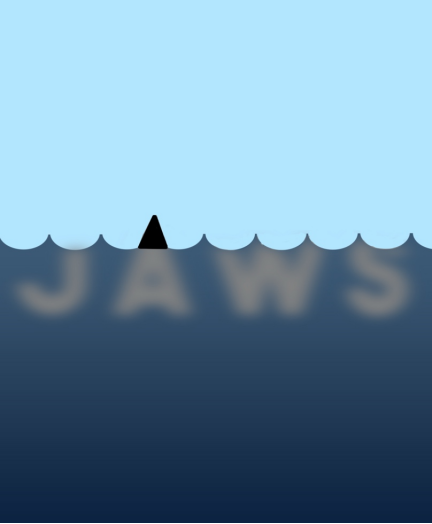
Kai hated deep water. There was something terrifying below a surface he could see and in the unknown depths he couldn’t. He conceded his illogicality when the doctor said, ‘Shark attacks are rare. It’s safer in the water than it is driving or flying.’
But one look at the rolling waves or when Kai heard the lonesome clang of a buoy out on the water and he heard the other sound, that of the thing that wanted to obliterate him leaving nothing but a memory dark and evil.
Daaaa Dum …
Daaaa Dum …
Daa Dum.
Daaaaaaaa Dum …
Da Dum, Da Dum, Da Dum …
Thalassophobia, the doctor called it. ‘It’s an intense, persistent fear of deep, dark, or vast bodies of water, like oceans or lakes.’
During family holidays at the beach, Kai felt his chest tighten. He sweated and saw large unknown black shadowy somethings beneath the water’s surface.
Despite the doctor’s reassurances Kai knew what he knew. He avoided boats, even those tied to jetties. He never went fishing when his dad said, ‘We’ll have a good time. And we’ll be able to eat what we catch.’
As for jetties, they were something else. Between the cracks in the walkway, Kai could see waves sloshing into the pylons. He shuddered at how they disappeared into the inky blackness of the water.
‘You don’t know what you’re missing,’ his father told him, fishing rod and bait bucket in hand.
Kai baulked because he knew exactly what he was missing. That something stalking him was just waiting the opportunity for Kai to drop his guard, to take one too many fatal steps out on the jetty or into one of those fragile things called boats.
And when he did …
Daaaa Dum …
Geoff Gaskill
Late Night Calls
Seagulls.
Or perhaps not.
No chips, no popcorn.
Only the angulated sound of the ongoing movie.
Going forever and ever.
Among the deepest of tragedy,
there is the photon of light.
The segment of words.
The adieu, the intervention.
To come to sense.
To children, to family.
All while the deep blue sea,
swallows you with guilt.
Sirens didn’t go off,
it shook your existence.
Leave
Deserted on the fringe of a room.
Children’s room?
Bedroom?
Why is the lagoon so dark,
so deep.
Because it’s not,
It’s the great open ocean.
Vicky Meng
Inland
I like inland, don’t like the sea.
All that water, it really scares me.
I could love you, if you ran aground.
But you’re sailing and I’m heading,
I’m going inland, I’m going crazy,
but that doesn’t scare me.
I like dreaming, not reality.
All that thinking, sure as hell wears me down.
I could love you better, if you weren’t around.
So keep on sailing, ’cos I’m heading,
I’m going inland, I’m going to do some dreaming.
And it doesn’t scare me.
I don’t scare easily.
And you like scheming, without honesty.
Are you sinking, alone on the high sea?
And could I love you, if you went and drowned?
You keep on sailing. You’ll never reach that beacon.
You’re going nowhere, I’m going inland.
And it doesn’t scare me.
I don’t scare easily.
Mary Szymanski
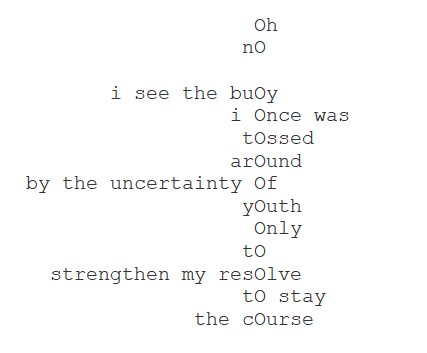
John Heritage
Bait
The ocean at night is not black; it is a bruised, suffocating purple that swallows light like a hungry throat. In the center of this void sat Buoy 10-74. Its rhythmic, amber pulse was the only heartbeat for a thousand miles, a lonely strobe cutting through the salt spray.
Elias sat in his skiff, his engine dead. He watched the buoy. Clang. Pulse. Clang. Pulse. The sound was hollow, like a hammer hitting a coffin lid underwater. It was supposed to warn sailors of the reef, but there was no reef here. The charts showed only a four-mile drop into the abyss.
Then, the rhythm changed.
The buoy didn’t just bob; it jerked. Something beneath the surface had snagged the heavy mooring chain. Elias gripped the gunwale, his knuckles white. In the next amber flash, he saw it: a hand. It was pale, translucent, and far too large to be human, its fingers wrapping around the rusted metal base.
Pulse. The hand was gone. Pulse. A face stared back. It was a bloated, featureless mask of white flesh, pressed against the buoy’s light housing. It had no eyes, only deep, weeping pits that seemed to drink the amber glow.
The buoy began to sink. Not slowly, but with a violent, purposeful tug. The light dipped below the waterline, illuminating the sea from beneath. For a terrifying second, Elias saw the silhouette—a sprawling, multi-limbed shadow miles wide, rising from the crushing depths. The buoy was merely a lure, and he had been sitting in the middle of the trap.
As the light finally winked out, a wet, heavy weight landed on the edge of his boat. The skiff tipped. In the total darkness, Elias heard the sound of something cold and dripping exhaling right against his ear.
Glen Donaldson
Ember and Sea
the smell of the sea lulls me;
froth-lipped waves suck at the boards,
pushing and pulling, drifting,
I smell the smell of brine, of fish,
of a chill in the air that’s cold as bones
my dreams drift alongside me,
undisturbed by the frigid fingers
of wind and storm
the gentle sea spray picks up
into stinging lashes of salt and mist,
coagulating into crystals on my bare neck
suddenly the toothy foam of the waves
churns harder, stronger, and the boat
begins to rock like children on a seesaw
until my eyes open to two lanterns
shining brightly in the dark
waves fall and swell
from either side of my vision
rising precariously high—the faint light glitters
across the roiling waves,
deep as ink and twice as dark,
so dark it might as well be
the fabric of the night sky draped across
our mortal realm, void of starlight
blinking twice I see—
what was mistook for lanterns
are in fact lamplight eyes
searching the dark
for lost souls like me
I see the burning flame
of curiosity reflected
in those eyes as is in mine,
feel the amber heat of it as if it
were an ember glowing inside me,
I tend to it and with my oar
glide closer, perilously
until the shadowed sky reveals
yet another shadow to me;
gone, like chased rainbows, never
truly meant to be found,
for in doing so,
you’ll surely be drowned
Dulara Jayasekara
Shadows in the Night
Along the winding coastline, a mystery surrounds Alison Cove, a small inlet at the edge of the bay. All the residents hear a sweet sound echoing from dusk to dawn. Most of the time, when they look through their binoculars, they see only a beacon on a large square block.
The sweet sound echoes only when the block is covered with salty ocean water. As it dries during the calmer season, the echoes disappear until the ocean comes a calling.
Drifting and swaying across the glassy, rippling ocean, shining a light for all to see. Waves crash high and low around, washing over, sometimes covering, other times hiding from those far in the distance.
From dusk to dawn, as the sky grows grey and lifeless, it can be a little frightening when the light dims and goes unseen. From dusk to dawn, it casts shadows in the night as a warning to the ships that pass by. Even if the light goes out, its red reflectors will still serve as a guiding light for those who approach, shining as they pass by.
Bobbing up and down, happy in its solitude, doing its job and creating a vision for those who see it and pass by.
Glenyse Robins-Ward
The Captain
The waves were short and lumpy, a typical Mediterranean storm surge created by larger storms along the African coast.
The Captain knew that once he rounded the red buoy ahead he was within a few nautical miles of his home port on the Greek Island of Lefkada, where he and his sailing boat would find shelter. He had spent most of his life sailing, starting as crew and eventually owning numerous boats, each one larger than the previous.
However, the Captain knew that as his body continued to protest against the battering that these storms dished out, it wouldn’t be long before he had to move ashore. This could well be his last voyage.
As he was processing these unwelcome thoughts, there came a voice that startled him.
‘OK, Captain, times up. You have been in the Hydrotherapy pool a long time. Are you ready to drop anchor?’
He looked up to see the Sister beside the pool, accompanied by a young nurse.
‘Captain, this Susan, a trainee nurse assigned to help you.’
Susan said to the Captain in a stern clinical voice, ‘Robert, pass me your toy boat and I’ll get you out of the bath, dressed and into bed.’
The Captain became very angry.
The Sister pulled the nurse aside. ‘Nurse, if your going to work with Dementia patients, you will need to treat them with dignity and respect.’ The Sister turned to Robert and said, ‘Captain, sail your boat over to me. I’ll put it in its berth, and we will get you ready to go to the Yacht club.’ She turned to the new nurse. ‘Susan, that is how you get the best out of your patient.’
The Captain and the nurse became sailing friends until he found his final island anchorage.
Russ Abbott
The Buoy Refuses to Drown
Out there—
where the sea forgets its manners,
where waves rise like courtroom verdicts,
a small red buoy keeps blinking
against the mouth of the storm.
Blink.
Blink again.
As if saying:
I am still here.
The ocean hates this.
You can tell
by the way it throws its whole body
against that little tower of light.
Dark water climbing over dark water,
trying to swallow the signal whole.
But the buoy answers every assault
the same way:
Blink.
Blink again.
I think survival often looks like this:
not triumph,
not glory,
just a stubborn pulse in impossible weather.
Somewhere tonight,
someone is sitting alone in a rented room
trying not to disappear.
Somebody is rehearsing courage
in the mirror of a train window.
Somebody is carrying a secret
so bright it terrifies them.
And still—
Blink.
Blink again.
The sea does not care what you call yourself.
It only tests whether your light
can endure pressure;
whether loneliness can be survived
without becoming cruelty.
The buoy knows something
the drowning world keeps forgetting:
that persistence is its own kind of prayer.
So it burns there
in the blue-black violence,
subtle as a heartbeat,
small as a forbidden hope,
refusing extinction.
Blink.
Blink again.
And somewhere far beyond the frame,
a lost ship changes course
because even the faintest light
can teach the dark
how to loosen its grip.
Kanyanta Chikesengi
UG-EC
(Unidentified Glowing-Eyed Creature)
It wasn’t there. And then it was.
From beneath the surface, they saw it. An unidentified, glowing-eyed creature. Tossing above them. A phenomenon never seen or heard of before. Sea creatures gathered, fin flapping, bubbles of curiosity. Fear. Brave creatures ventured closer. Some circumnavigated it without finding evidence of weapons, baited hooks, nets, or the elimination of poisonous waste.
Fear diminished as the UG-EC didn’t try to harm them. Or investigate them like the human creatures that once visited—peering at them. Protrusions on their backs, surrounded by bubbles. Pointing unfamiliar objects at them. The UG-EC continued ignoring them. Unchanged. Tossing to the rhythm of the sea.
Once, an unusual event occurred. The UG-EC made eye contact with a human creature heaved by the sea, clinging to it, legs dangling, a tempting morsel. But more human creatures arrived, guided by the UG-EC and took the clinging, dangling, human creature away before it became a sea creature’s snack. Unphased, the Unidentified Glowing-Eyed Creature continued tossing. Curiosity of the brave overtook. An expedition to the surface was planned.
‘We need a committee.’ A young, enthusiastic ray announced.
They debated about why they needed a committee to plan their venture to the surface; they’d all been there before. They knew the way. And so, it went on …
Despite the barnacles, the UG-EC is unchanged. Still yielding to the waves. Oblivious to the sea creatures’ ongoing debate about the committee. Until it occurred to them that the UG-EC still hadn’t attempted to change, harm, or communicate with them. It was familiar now. They accepted its presence and forgot about it.
A visiting whale stopped. Pondered the Unidentified Glowing-Eyed Creature.
And consulted the now older and wiser ray.
‘It’s been here a long time,’ the ray said. ‘It belongs. Just like each of us.’
Julie Edmonds
Overwhelmed
The sudden shock. It’s as if the large bony hands holding me down will never release me. I gasp for air; I gulp in salt water. My eyes sting. I see bubbles bouncing erratically; I close my eyes. I don’t know what has happened to me, but I know that I’m in terrible danger.
My lungs are screaming. Instinctively, I gasp for air but succeed only in swallowing more salt water. A chill grabs my chest. A shadowy shape hovers above me. I feel its roughness as it brushes against my side. Although being tossed like undies in a washing machine, I struggle harder to find what I desperately need: oxygen.
In blind panic, now gulping salt water with every intake, I flail my legs and arms wildly. My chest is about to burst; with all my might, I push against what seems like a wavering steel canopy preventing me from reaching the surface. With every exhausting, desperate effort, I fail. Terror grips my gut and twists it mercilessly. I feel death’s cold breath forcing me back from my objective.
One last frantic upward push, using every muscle and sinew in my body, I break free of the barrier holding me down. I gasp for air. My lungs fill. I open my stinging eyes. A massive wall of water smashes me and I am again swirling downward. Unexpectedly, I break the surface again. But it’s dark. I force myself to breathe, my eyes strain to penetrate the inky wall ahead.
Suddenly, to the right, a dash of colour. Red, I think. Bobbing. It’s gone. There, again. A marker? A buoy? A rescue boat? I must reach it. Try … harder … Harder … I can’t … force … myself … I jerk wake from this suffocating nightmare, trembling.
Ian Chisholm
Divider Image by AliceUrbanDruid from Pixabay
Guenter
What an engaging range of wonderful reponses to the prompt.