
We publish below responses to the Geelong Writers’ October 2025 Ekphrastic Challenge
We asked readers to use this image below (Hurry, by Jan Price) as a prompt to write an original poem or original piece of prose (fiction or non-fiction) specifically written in response to this image, using 300 words or less. We asked that each submission be submitted with a title of the author’s choosing (the title is not included in the word count).
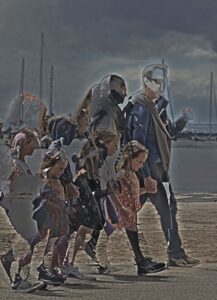
Hurry (image by Jan Price)
Congratulations to the following 22 contributors for their submissions:
Howard Osborne Scott Hunt John Margetts Steve Grey
John Heritage Mary Szymanski Glenyse Robins-Ward
Geoff Gaskill Denise Main Ian Chisholm Adam Stone
Allan Barden Gail Griffin AB Russell Abbott
Hilary Guest Bev Blaskett David Bridge Julie Edmonds
Catherine Mahar Ian Stewart Fran O’Mara
Again, the image evoked a variety of original responses; some views were through a camera lens, and some of the pieces displayed overlapping twin themes. There was a mix of the light hearted, the down to earth, the tragic and several may send a shiver down your spine.
All were written in a race against the clock.
The Geelong Writers Ekphrastic Challenge team thanks all contributors for their creative efforts.
⏰⏰⏰⏰⏰⏰⏰⏰⏰⏰⏰
The time has come
The time has come and we must hurry
With no excuses to delay our leaving
Now our path is lit by the pale moon
The family’s safety is ever paramount
And so every lost minute may count
Sad that we won’t be returning soon
It’s understandable we’re all grieving
Let no-one seeing us think we scurry
The time has come and we are as one
A steady walk for all at a steady pace
For us it’s a few miles along the shore
There’s a boat that can take us away
And know tomorrow is another day
I’m sorry my children, but this is war
We must get going to a better place
Hopefully afar when we see the sun
The time has come and we are all kin
And travelling light, no bags to carry
Just focus on this path we must take
As we must leave all suffering behind
Hoping that we’ll meet someone kind
And there will be friendships to make
Move along now, as we mustn’t tarry
And a new life for us will soon begin
by Howard Osborne
⏰⏰⏰⏰⏰⏰⏰⏰⏰⏰⏰
Exodus
The searing heat made his eyes feel like they’d shrunk in their sockets. His throat felt like he’d swallowed sand. For three days and three nights he’d led his family across the desert and away from the Reckoning.
“Head East toward the sea,” the old man at the souk had said. “In 3 days there’ll be a ship leaving. A man wearing a yellow beanie will be waiting. There’ll be a place for you and your family.”
He didn’t know if he could trust the old man. But what choice did he have? He gave the old man everything he had.
“Three days. Don’t be late.”
So for three days and three nights they fled the death and destruction reaped upon their home by the Reckoning. Family, friends, neighbours; all dead. The Reckoning had been ruthless, determined to leave no trace of their kind.
So they fled with nothing but the clothes on their backs and the slightest glimmer of hope in their souls.
He looked across at his wife and kids. A knot formed in his chest. If his body could have spared the fluid he’d have shed a tear. How they must be suffering. God knows he was. But for three days and three nights they’d not complained once. They just pushed on. Toward the sea.
Then, just as he felt all hope fading, something in the air shifted. In the distance a silver sliver upon the horizon shimmered.
Each step was hell, but each step took them closer to a vision. The sea. A fishing trawler. A rowboat on the beach. A man wearing a yellow beanie, smoking a cigarette.
A laugh jumped from his throat like a trapped frog.
For the first time in months he felt the glow of something pure and golden.
Hope.
by Scott Hunt
⏰⏰⏰⏰⏰⏰⏰⏰⏰⏰⏰
Hurry
Mother and father, two daughters never heard of the Table of Maims.
Mother’s hijab billowed revealing trainers and lower legs. Husband frowning, hurrying his flock along. The tiny Iranian coastal port racketed with noise of cranes, sirens, laboring diesels. Waters polluted, rainbow oil slick gleaming beside the wharves. Somewhere ahead an agent waited, ready to grab the envelope of tattered notes, usher them on board, get underway. Hurry, hurry!
The Scholars knew of the Table. Cultural appropriation, smiled their Emir cynically. Pay the ransom at the rate specified in your Table of Maims, and they won’t suffer the loss, it’s your choice.
Give us an example.
Well, loss of a leg, $93,080; Shattered pelvis, $88,750.
You cannot be serious.
They’re your rules, it’s fair! By the way we take only cash, Chinese Yuan.
Not dollars?
US dollars, you’re kidding, right!
Agent pockets cash after counting, hurries them aboard, boat departs. Mobile call, contract complete.
by John Margetts
⏰⏰⏰⏰⏰⏰⏰⏰⏰⏰⏰
The Gathering
The canvas dominated the wall, an imposing testament to Neil’s vision. The Gathering, as he called it, was a strangely haunting image. It depicted a family walking by a waterfront, their forms rendered in a ghostlike fashion. The figures seemed to deliberately cram the space, their transparent bodies overlapping and pressing against each other, somehow like layers of sorrow.
No one was really sure why Neil had painted the piece so large; its scale was almost unsettling, given the ephemeral nature of the subjects. But all he would say, with a cryptic smile, was that it “emphasised the main idea.” That main idea, he later explained, was the enduring burden carried by immigrants, the weight of their plight.
This was true even for this particular family, who had arrived with solid funding, whose patriarch was due to start a business in a few weeks, ready to grasp the lauded opportunities of their new home.
The painting’s silent grief hung heavy in the room. The figures all adrift, yet compressed together, suggesting that a common destiny somehow bound them. They walked with solid intent, which contrasted sharply with their own pallid, shadowy figures.
Little did they realise the loss they would soon suffer. The painting was a prediction Neil couldn’t explain, a premonition of tragedy that made the ghostlike representations not just an artistic choice, but a terrible, frozen fact.
All we knew was that its ghostlike appearance, use of colour and action in the figures soon built a haunting presence, one that none of us was happy about, yet for Neil, this was to be the first piece in a long while that caught the viewer’s attention and rekindled his visual storytelling prowess. A haunting image, let’s hope the art prize judges think so as well.
by Steve Gray
⏰⏰⏰⏰⏰⏰⏰⏰⏰⏰⏰
purpose
what to choose
first
the destination
or
the boat to take
us
decisions we make
now
may affect the rest
of our lives
by John Heritage
⏰⏰⏰⏰⏰⏰⏰⏰⏰⏰⏰
A million miles
We walk fast cos there’s a storm coming and the car is a million miles away. That’s what dad says, a million miles away.
When I look at mum she seems a million miles away. My sisters hurry. Like dad says to do. We usually do what dad says. It’s quieter that way, no arguments and no chit chat.
‘We don’t need all this chit chat. Just get on with it.’ He always says. So that’s what we do, we’re quiet and we get on with it.
This old couple walked passed us earlier, when the sun was still out on one side of the sky and the clouds on the other side of the sky. The old man said, ‘What a beautiful family.’ And mum and dad thanked them. Then we all smiled.
Later I said, ‘Are you going to get old like them one day?’ Mum and dad didn’t answer me and then the clouds got worse. And we hurried back to the car.
‘Hurry,’ says dad, so we hurry. And poor mum with her broken wrist that she did at work when she fell down. Fractured, the doctor said. I didn’t know that word but I do now.
When mum was talking to a friend at the shops the other day, she said, ‘Yeah, it’s fractured. Just like our family.’ And she did this little laugh but I don’t think she thought it was funny.
So we hurry and then there are big drops of rain and dad grabs my little sister’s hand and pulls her along with her tiny feet going a million miles an hour. And I can’t tell if mum’s crying or if it’s the big drops of rain. So I concentrate on walking real fast cos that’s what we’ve got to do.
by Mary Szymanski
⏰⏰⏰⏰⏰⏰⏰⏰⏰⏰⏰
The Rushtons
As a family, they often went on a morning walk. The townspeople would wave to us as we strolled past each of the properties. They were given the nickname of ‘The Rushtons’ by Freddie Moses.
Jim Warrington had been in the armed forces for a number of years when he fell for the beautiful Maria. Not long after they married, they had the first of their eight children over ten years, which included two sets of twins.
Due to his army background, he believed in a fitness regimen. Each morning before school, he would march his family to the foreshore for a brisk walk.
When Jim discovered that his family had been given the nickname and learned about it from his neighbour, Henry, he was not amused. He had only heard the name Rushton around the circus scene, and his family was definitely not a circus troop.
They were a quiet, refined, and proud family who believed in taking a daily walk as part of their fitness and health regimen. Time was of the essence, as their work and schooling were almost essential parts of their lives.
Over time, Jim warmed up to the idea of having a nickname, but made it clear to Freddie that if he spread anything else about the family, he, too, would need to become a member of the walking regimen.
To Jim’s surprise, Freddie took up Jim’s offer of walking, and soon he had plenty of extra walkers from his family joining in.
Sometime later, Freddie and Jim formed their family groups into a regular walking group, which was, of course, named ‘The Rushtons’ Sea Walking Group.’ Now Jim and his family have been relieved of being called ‘The Rushtons’ as almost all the town’s people have become members of the walking group.
by Glenyse Robins-Ward
⏰⏰⏰⏰⏰⏰⏰⏰⏰⏰⏰
No hurry
As matters turned out, and despite everything going on around them, dad’s optimistic morning mantra was always, ‘Don’t hurry. We have each other. That’s what being family means.’
Mum held the hands of the little ones who were too young to know another’s touch. She drew as much comfort from the feel of her children’s skin as they did from her.
Their parents had always taught the children that God is love. ‘Only men are sinful. Do not let your heart be corrupted by thinking otherwise. Allowing bad thoughts means it is only a short step before your soul becomes lost.’
‘Where are we going?’ the smallest of the children seemed to ask every few steps.
Instead of answering, dad told them, ‘We are a family, we must trust in each other. God has His eternity just as we have ours. Only in love will you see His face.’
Each night, sleep proved elusive. Danger did not permit it. The nights swallowed the certainty that, in the end, all would be well. Instead, the darkness spawned memories of rude and rough men, as well as the now-familiar daily sound of gunfire, explosions, dust, collapsing buildings–and the screams of the dying.
What sort of human being, dad asked himself, takes delight in making children afraid? How can anyone call themselves human if they put fear in the hearts of the innocent?
It was a stupid question, and he scoffed at himself for being naïve. Because these men with their guns and bombs are not human. They are blasphemers.
Even mum and dad weren’t immune from waking suddenly with cries of incomprehension and terror.
Then one day, one of the elder children dared ask, Has God abandoned us?
Mum and dad looked at each other. Out of the mouths of babes … Was this a possibility?
by Geoff Gaskill
⏰⏰⏰⏰⏰⏰⏰⏰⏰⏰⏰
Hurry
‘We’re going to see a shipwreck called the Holyhead,’ Emily chanted.
‘You can’t see it stupid, it’s where it was wrecked,’ James scoffed.
‘Hurry, before flood tide,’ father urged.
*
On a wild February day in 1890 flood tide arrived at the Heads with huge swells. The keeper, stationed in the wooden light house, saw the barque Holyhead approach the treacherous narrow entrance. The signal lamps shone brightly, but the ship still missed deep-water stays and anchor hold. The ship crashed, grinding itself aground onto Lonsdale reef.
‘Hurry,’ the keeper yelled to his mate, ‘ride like the wind, ring the Queenscliff Wreck Bell.’
The Wreck Bell rang. Hurry, it tolled, summoning the rescue crew of Fisherman’s Flat. In the heavy swell they bravely rowed for the entrance and the stricken Holyhead.
Settlers in Point Lonsdale heard the cry, ‘wreck on the reef.’ Menfolk with a kite breeches, and buoy rescue system, rushed across the dunes, down to the reef and listing barque. Anxious mothers, clutching their children’s hands, hurried to the shore; older boys and girls ran barefoot along the sands.
‘Water is filling the hold, I fear the ship is lost,’ the captain hollered to his crew. The townsfolk, using a Woodbridge Davis Kite, sent a breeches buoy from the shore to the ship while the crew in the lifeboat prepared a line and hoist for stranded sailors the breeches buoy couldn’t reach. All were saved, but the Holyhead was lost to the Lonsdale reef and sea, as previously was the iron barque George Roper.
***
‘Dad, there’s a picture of Holyhead on the reef.’
‘Yes, despite her fate, she looks grand in full sail.’
‘Let’s hurry, it looks like rain,’ Mother said.
‘Goodbye, Holyhead. Say hello to George Roper.’ Emily called into the wind and hurried after them.
by Denise Main
⏰⏰⏰⏰⏰⏰⏰⏰⏰⏰⏰
A Day Out
This Sunday in December was their special Christmas treat; a family outing on the PS Hygeia, a pleasure steamer built thirty years earlier, taking passengers to Queenscliff and back to Port Melbourne.
Stepping on board, they were amazed at the luxurious interior, elaborate electric light fittings, the dining rooms, the large dance floor, the orchestra. They lunched aboard.
All the way to Mornington, Sorrento and Queenscliff in only two hours.
After embarking, father chose to visit the Light House, mother immersed herself in the clear warm water of the ladies’ sea baths, then she sat in the park admiring the latest fashions strolling by. The girls discarded their shoes and stockings to feel the soft sand between their toes and to chase the seagulls from dunes to cool shallows, laughing joyously, disregarding saturated hems clinging to bare legs.
Ignoring pale damp sand stubbornly clinging to their now damp dresses, they built sandcastles with tall towers and dug deep moats. They admired them and added more.
Horn blasts sounded it was time to board.
Father called, ‘Girls, we must leave. Hurry now!’
Together, they walked along the sand and from the beach. They saw Hygeia’s sleek pale grey silhouette waiting beside the wharf, wispy smoke rising from the two buff-coloured chimneys. Another blast, more urgent.
They hastened, holding hands. Their shoes clattered loudly on the path. The mass of day trippers jostled to embark for the journey home.
‘My darling girls, the state of your finest Sunday clothes tells me you have spent your day well.’
‘Yes mother,’ they chorused. Thank you and father for such a wonderful day.’
With the steamer’s gentle rocking, the pleasant strains of music and their sheer exhaustion, the girls, slumped in their seats and soon were asleep.
by Ian Chisholm
⏰⏰⏰⏰⏰⏰⏰⏰⏰⏰⏰
Go, Man, Go!
Go, man, go! A father times his six-year-old son to get from home to the milk bar for milk and bread and back again.
Quick, before they’re gone.
A woman gives birth to her first child at age sixteen.
We need a decision by close of business tomorrow.
A couple arrange their wedding with one hundred guests in ten weeks.
Don’t be late.
A man wakes early and wonders if there is a way he can do without sleep so he can get more done.
Time is of the essence.
How many times has he broken the speed limit and had to run for the train?
Have you left yet? (I’m on my way)
A woman died on a Monday, and she was all ashes by Friday.
Can you make the deadline?
The married couple buys a sofa that they can’t afford, but the sale price is sooo good!
Today only.
She was late to work, again. She had to work through her lunch break and then work back just to keep her head above water. She needs another day.
tomorrow can’t come quick enough.
A meat slicing machine degloves a young girl in the first week of a new job.
Time waits for no one.
On a family road trip, the six-year-old boy says, ‘I need to wee,’ to which his father replies, ‘Can you hang on, buddy? We’re making good time.’ A faint smell of urine soon permeates the car.
Are we there yet?
An aggressive tumour gets him. Cancer in fast forward, like a cassette, whirring, high-pitched, nonsensical.
Here one day, gone the next.
Go, man, go.
Go, man.
by Adam Stone
⏰⏰⏰⏰⏰⏰⏰⏰⏰⏰⏰
Her groundhog days
The alarm goes off at 6 am.
She’s already awake, mind ticking through lunches, uniforms, work issues. Jug on, toast in, shoes at the back door. She calls out two names, the urgency intensifying. Cereal bowls, toothbrushes, hair ties, water bottles. The wall clock seemingly ticking faster.
By 7.30 am she’s out the door with youngest clinging to her arm, the eldest sulking about music lessons. She forgets the lunches. Back in to fetch them. Out again. Walks the little one to school. Runs for the tram. It wheezes to a stop as she reaches the platform. She squeezes in, pressed between backpacks and briefcases. The smell of coffee permeates the tram. Scrolls through work emails.
At her desk by 8.45 am. The computer hums, the phone rings, someone asks for ‘a helping hand’. She answers with her practised smile, tapping out replies between sips of coffee now cold. Meetings, deadlines, budgets. Somewhere between lunch and 3pm she remembers she hasn’t consumed any water.
By 5 pm she’s running again – tram, supermarket. Bananas, bread, milk, mince, pasta. The checkout beeps. She bags, pays, lifts, hauls. She checks her phone. After school care to collect youngest.
At home, the kitchen smells of toast and jam. Clothes and homework spread across the dining table. She stirs the pot, wipes the table, turns the TV down, the washing machine on.
Dinner at 7.00 pm, dishes by 7.30 pm, bills to pay. She types her password wrong twice.
By 9.00 pm she’s folding laundry she doesn’t remember washing. All quiet now except for the fridge humming and clock ticking. She sits, breathes, tries to think of nothing. Tomorrow’s ‘things’ interrupting her thoughts.
In bed by 10 pm. Wakes at 3 am, dreaming Leon is there. He isn’t. ‘I’m coping love,’ she whispers. ‘But it’s tough going.’
The alarm goes off at 6 am.
by Allan Barden
⏰⏰⏰⏰⏰⏰⏰⏰⏰⏰⏰
That Wild Ride
The height of summer. Beach towels spread. Parallel to each other. Thongs cast aside on blistering hot sand. Colourful umbrellas here and there. White and suntanned bodies glossy with coconut oil. Sizzling in the heat. Children down by the shallows. Plastic buckets and spades. Sand castles being made. Moats filling up with the incoming tide. Squeals of delight from some little ones. Shrieks of laughter from others. Caught by surprise. Knee-deep paddlers, and swimmers further out, enjoying the water’s calm and coolness. Picture perfect.
A rogue wave appears. Out of nowhere it rises high above the others. Body surfers waste no time catching it. They ride it into shore where it swamps those paddling. Unannounced, it sweeps them off their feet. The castle makers are flattened. Screams and wails of ‘Mummy! Daddy!’ fill the air. Chaos reigns.
‘Where is she?’ I hear myself ask aloud. Scanning the unfolding scene, I see arms flailing and a body, face down in the shallows. It’s her. I reach down and turn her over. I lift her up out of the water. Carry her onto the sand and lay her on her back. Start giving her mouth-to-mouth.
A tap on my shoulder precedes a voice saying, ‘We’ve got this now.’ I back off and stand away. Lifesavers have appeared. One leaves to go and call 000. Another asks what has happened.
‘She has epilepsy,’ I tell him.
The ambulance arrives pretty quickly afterwards. She and I are loaded into the back. In the front, the paramedics alert Accident and Emergency we’re on our way with a patient. Bound for intensive care. Holding my sister’s hand, I keep telling her everything’s okay.
Every time I hear any ambulance siren en route to an incident, I remember that wild ride from Bondi Beach to Saint Vincent’s Hospital.
by Gail Griffin
⏰⏰⏰⏰⏰⏰⏰⏰⏰⏰⏰
No time for title
Gotta do this
Gotta do that
Seems we’re in
a race like a rat
Gotta be here
Gotta be there
Can’t seem to shake
a thousand yard stare
Wouldn’t mind a spell
but ain’t hearing no bell
Yes, I’m fine
Can’t you tell?
Don’t stop
Attend this
Attend that
Do everything,
Feel nothing
Do everything, feel nothing
by AB
⏰⏰⏰⏰⏰⏰⏰⏰⏰⏰⏰
Hurry, we need to set sail
They hurried along the pontoon to their catamaran and quickly got under way. Nick, son Jono, Nick’s partner Maria and her daughter Sophie had sailed together for the past five years to an abandoned island resort that Nick had bought, 80km from the east coast of America.
Nick and Maria realised that the Government was out of control, troops were sweeping people off the streets and into detention centres. The family spent their free time making the island a secure, safe, sustainable and permanent haven to escape the chaos.
Nick beached the cat that was large enough for temporary accommodation. The resort was eventually ready for full time living. The island retained its abandoned appearance by design. They had scuttled an old iron ferry on a sand bank at the bay’s entrance to discourage unwelcome visitors.
A solar installation was the beating heart and an electric powered desalination plant supplied fresh water. The loving group flourished, working and playing together, the now young adults fell in love giving birth to two children.
However, one day an event threatened to demolish their ideal lifestyle.
As the family were collecting bird eggs on the northern cliffs, Nick looked down and realised that a sailboat had foundered on the reef below and was disintegrating in the heavy swell. Two people were washed up on the small beach, one deceased. The other, a woman, was alive but exhausted.
Nick wanted to do a rescue. Maria, forever the thinking partner, said,
“Nick wait! When we rescue her, our story will be on every news and social media site. This life we have now will be ended.”
The family searched for other options.
Reader: What would you do?
by Russell Abbott
⏰⏰⏰⏰⏰⏰⏰⏰⏰⏰⏰
A Place of Safety
You must choose one toy
to take with you
on the train.
Will you take Teddy or Donkey?
You will have a little case
with food for the journey,
and one toy.
Your sister will look after you.
We cannot come
but we hope to – expect to
come later to see you.
Why not take Teddy?
Here, see, I will cuddle him;
when you cuddle him
it will be like me
hugging you.
Hug me!
Now
you must go.
by Hilary Guest
⏰⏰⏰⏰⏰⏰⏰⏰⏰⏰⏰
The human race
Hurry in store while stocks last!
Get yourself ahead of the pack.
You’ve run out of credit in the past,
But just think of all you still lack.
Hurry to claim your place in the sun
Or they’ll find someone younger than you.
Tool up with AI so you won’t be outdone
Plan ahead and embrace the new.
Hurry to find your soul mate
You don’t want to be left on the shelf
Biologically, you have a best-before date
Make hay…! Replicate yourself!
Hurry to get your foot in the door,
The property ladder won’t wait.
Juggle three jobs and save a bit more,
Secure the best interest rate.
Hurry to meet the deadline,
You’ll be working through the night.
If you don’t want to join the breadline
You will have to get this right.
Hurry back home through the peak hour mess.
Put your feet up and turn on the news.
Use the remote if there’s too much distress
And relax with whatever you choose.
Hurry to unsee what can’t be forgotten
Be glad that you’re not in that place.
Those people deliberately made everything rotten;
You’ve your own first world problems to face.
You hurry in dreams you forget upon waking
Thankfully, none of that’s real!
Seize the day! Now, while it’s there for the taking!
Speed through life and you won’t have to feel.
by Bev Blaskett
⏰⏰⏰⏰⏰⏰⏰⏰⏰⏰⏰
Iteration
Striding they come, out of the ether,
Real or recollection?
Exposures overlapping themselves and the world beyond.
Hands clasped, absorbed in the way forward,
Are they so caught up in their conversation
That they miss the gathering storm?
Am I the unwitting director of this cinematic piece,
This motion blur of existence, moment layered on moment?
Leading to what?
The adults clearly know more about life’s script,
Clothed against what future frames hold,
While the girls seem absorbed, gaze downcast,
Searching perhaps for the cracks where monsters lurk.
The narrative ripples, past fades into present,
Life’s pattern repeating,
Though all of us unreliable witnesses,
Caught up in a multiplicity of experience,
Perspectives constantly shifting,
Until the rain falls.
by David Bridge
⏰⏰⏰⏰⏰⏰⏰⏰⏰⏰⏰
Bushfire, January 1966
Staying with Nan on the family farm, in a weatherboard house by the Gellibrand River—nearest town forty miles away—one landline phone. Nan didn’t drive. Her sons lived nearby.
Heat buzzed like tinnitus—bending the air—cows gathered by the river; some in it. Birds sensing danger left. We languished on the verandah, icy poles melting before we could finish them; the thrum of the water pump pulsing each ominous moment. Beneath the rain tank, a feral cat and kittens sheltered warily. Food and water offerings received with paw swipes and growling. Unease connected all life that day.
A sudden wind swirled the smell of smoke. Its taste. And ash. We leapt up; nervous eyes scanned the sky. We anxiously watched a thick cloud of black smoke just behind the hill. FIRE! The men could see that my uncle’s house was in danger. They gathered at the dangerous area. The CFA arrived in trucks containing hundreds of gallons of water. I helped the women extinguish sparks with wet hessian bags. The smoke cloud darkened and grew. Flames flared. I was frightened. Our EVACUATION PLAN was almost enacted, but the wind changed! Relief heaved amongst us.
Exhausted, smoke-smudged, with fire-reddened eyes, we gathered ‘round the kitchen table, sipping tea in silent reflection. A fan whirred air across a bowl of water.
Disaster had confronted us. Clearly defined and accepted roles, a plan enacted with decisiveness, determination, and cooperation. The efficiency and promptness of the CFA, and the luck of a wind change, saved us: the cows, the feral cat and kittens.
One hayshed lost. And fences. Loss of wildlife; unknown.
Cows’ welfare checked at afternoon milking. Birds gradually returned.
Summer holidays ended. We left reluctantly.
Nan, a lonely figure, waved goodbye.
This event’s recorded in my grade 4 test book.
by Julie Edmonds
⏰⏰⏰⏰⏰⏰⏰⏰⏰⏰⏰
Arrival
The weather was glorious, the sun shone and glittered on the leaves and waves. We had left home early, dressed in our finest, us girls with our best frocks and sensible shoes, Mum and Dad in their good clothes and sensible shoes. Little Minna didn’t want to come. I stay, she said, I no go.
We walked to the harbour in big strides, dragging Minna with us, eager to have our day. We were going on the ferry to have lunch with Nan and spend the day with her. We loved our Nan, funny and generous. She always made special biscuits for us girls. We would take the biscuits outside while the adults talked, their conversation a background drone to our play.
The ferry was a bit crowded and Dad said, perhaps we should wait until the next one. We shouted in chorus, no, we want to go on this one, to see Nan. Minna said, not go, but we did.
The wind came up halfway across the bay. It was colder than we had planned for and us girls shivered in the cabin. Dad looked out at the water and got his worried look.
The ferry started to list halfway across the bay. There were not enough life vests for us children and Mum and Dad bundled us into adult vests. They laughed and said, we’ll be fine, we can swim, but Dad had his worried look still, and I suddenly felt the waves, the wind, even the sun, had become our enemies.
We didn’t see Nan or have biscuits or walk home in the gathering dusk that day. We still walk along the dock, hand in hand, still rushing to our end but never quite arriving, neither here nor there, part substance, part faded memory.
by Catherine Mahar
⏰⏰⏰⏰⏰⏰⏰⏰⏰⏰⏰
The moving image
(Judith Wright – Poetry Collection)
Quick
Mother, father urging
I’m coming, she says
Her image moves from here to there
Trying to be in two places at once
Siblings blurred, rushing
The shutter speed can’t keep up
O, think instead of a still shot
Think of peace-filled contemplation
Think of thinking and not of helter-skelter
Hang on! Catch your breath! Wait …
The world will not disintegrate
The destination will be there still
All your hopes can yet be fulfilled
by Ian Stewart
⏰⏰⏰⏰⏰⏰⏰⏰⏰⏰⏰
‘No Hay Caminos, Hay Que Caminar…’ – Luigi Nono
(There are no roads, you have to walk)
Know there are no highways
Low ways, delineated rock and sway railways
Crisp sided pathways, failed paydays
Impossibly far away starred skyways
The grand granulated imploring archways
Hurry! Hurry! We must not phase.
Hurry! Hurry! We must not glaze.
Hurry! Hurry! Raze the maze.
Noh masquerades of slated tirades
Slow cavalcades along shaded promenades
Lisped betrayals of retrograde ambuscades
Improbably brocaded displays of centuries fails
The bland superannuated arrays of jaded days
Hurry! Hurry! We have our ways.
Hurry! Hurry! We must thread the leys.
Hurry! Hurry! Phrase the praise.
No hay caminos! Avail the sails
Flowed breaths’ blow countervailed status grails
Wisps of haze invade descried clayed laneways
Implausibly narrated charades delay the scales
The strand’s supernal conclave imploringly brays
Hurry! Hurry! We invade the dais.
Hurry! Hurry! We declaim QUE ESTAY.
Hurry! Hurry! Caminos no hay.
Hurry! Hurry! Pray we are not prey
by Fran O’Mara
Leave a Reply