
We publish below selected responses to the Geelong Writers Ekphrastic Challenge for June, 2025.
This image is titled Turning Point, in view of the winter solstice, marking the shortest day.
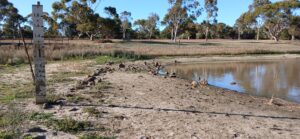
We thank all those who accepted our invitation to submit, in up to 300 words, an original response to this image ‘Turning Point’.
We publish below the work of the following contributors, and congratulate them on their varied submissions on this theme.
We hope you enjoy these diverse responses, and that you appreciate the extra sunlight as the days slowly lengthen …
Congratulations to these contributing authors:
David Jones AB Denise Main Allan Barden
Guenter Sahr Gail Griffin Howard Osborne Ian Stewart
David Bridge Phoebe Hancox John Margetts Steve Gray
John Heritage Mary Szymanski Adam Stone Julie Edmonds
Stanley Billing Russell Abbott Glenyse Robins-Ward
Geoff Gaskill Deb Lucas Hilary Guest Bev Blaskett

The pause
Patiently I wait
time means nothing to me
it never has
You sit in the distance
but not today
strange, as today I reflect the peace that you desire
Have you left in fear
as you know, I can claim that distance
claim you
Swallow the ground upon which you dwell
the earth you spoil
your greedy fingers to clutch life
Futile attempt
even as your mark of history shows
you do not listen
do not learn
Is this your nature
to not learn from the past
as mine is to lie-in-wait
until that point, on which I turn
David Jones
Turning point
[The year is 2125. The world is a free range shit fight – society has been bowled over after Trump Jr Jr’s reign in the second half of the previous century. History destroyed, sects around the world are free to make up their own past. An old man duly obliges a young’n in their sect.]
Old man: Now this here photo is of an old watering hole – in the past we’d bring our minotaurs here for a drink.
Boy: Wow, so minotaurs were really real?
Old man: You betcha. Had a real feisty one myself. Used to ride around for days, collecting treasures and deleting the wokeness.
Boy: Cooool! Did it have a name?
Old man: I called it Freedom-a-taur, cos that’s what we was about.
Boy: What happened to it?
Old man: Well it got sick from the disease and passed away. We made sure it didn’t go to waste though.
Boy: What?
Old man: Never mind. Anyway, you see that stick with the measurements on it? That’s how we used to measure the minotaurs. The bigger the minotaur you had, the bigger the man you’d be.
Boy: How big was Freedom-a-taur?
Old man: Oh big, got up to 1.5m. I was third in command to the Chief King of Western America.
Boy: Whoooaa
Old man: That’s right. Ok that’s enough for today junior. I got to go above ground and dilute some juice from the trash for dinner. You be good now.
AB
Turning point
‘To everything turn, turn, turn.
‘There is a season, turn, turn, turn.
‘And a time to every purpose,’ she sang softly, as if in prayer.
Autumn hadn’t turned.
She dragged on the dry and cracked working boots that hadn’t squelched through sodden ground since her child was born. He didn’t know rain.
Washing spun wildly on the line like a flurry of colourful flags beckoning a late Autumn break.
Turn, turn, turn.
With her battered hat pulled low to block out the glaring sun and dazzling blue skies, she lowered her head, turned, turned away.
With each footstep her boots crunched noisily along the baked, cracked path and through the crisp grass to the house dam. It had shrunk to a mere muddy puddle, exposing bleached remnants previously hidden beneath its cool, brown waters.
Turn, turn, away.
Turn, turn from the empty paddocks, drying to nothing, stretching to the cloudless horizon, trees waiting, breathlessly.
Sheep and cattle gone. Seed lies dormant. Puffs of soil drift aimlessly to ridge at the fence line.
He had gone, droving the long paddock. He left with their breeding flock and dogs.
She had turned away.
The rumble of tyres and the squeal of brakes in the house drive outdid the protesting shrieks of cockatoos. The child on her hip waved, she smiled as the water tanker driver climbed from the truck. The old dog barked, tail wagging furiously. Water for their near empty tanks.
Turn, turn, turn. Water, glorious water.
‘Goin’ to rain they say. Cold front with rain ready to rip up the Bight in next few days. Keep ya bloody fingers crossed,’ he laughed as he downed the dregs from his cuppa.
She turned, found a smile, ‘maybe a beautiful turning point; hope on the horizon, eh?’
Denise Main
Leaving home: a turning point
There comes a time in many young lives when the horizon begins to pull. For some, it’s a quiet itch. For others, a constant restlessness. Growing up in a small country town he always felt that tug, even if he didn’t yet understand it. The familiar ebb and flow of country life, of paddocks, dirt roads, extended family and the same faces at the footy or cricket shaped his childhood. But as adulthood approached, he realised the very things that made life steady were starting to hold him back.
The decision to leave wasn’t made in a single moment. It gathered slowly through dreaming, encouragement from city friends, and the realisation that work, education and sport held more promise in the city. He realised that staying in his small town would limit his life chances and corral his dreams.
Arriving in the city felt like stepping into another world. The pace was faster, the noise constant. But there was excitement: lectures filled with new ideas, teammates who tested him, and the chance to reinvent himself away from the assumptions of home. The silence of country mornings, the birdlife and Oyster Bay were sometimes missed, but not enough to turn back.
He learned quickly: how to navigate bus timetables, manage night school with work and sport and connect with new people, including a girlfriend. It all seemed to fit. He stayed hopeful, driven, and never once gave in to homesickness. Gradually, the city felt less foreign. He found his own spots, his own people, his own rhythm.
That move was a true turning point – not just gaining opportunity, but resilience. The city asked more of him, and in return, gave more back. His roots remain in the country, but now the branches of his life stretch far beyond its borders.
Allan Barden
Turning point
The pendulum gyrates its journey
annually around the sun.
Desiccated bricks of tessellated curled soil abrade
the endless searing sky oppressing flat plains
to be reborn again
after the rains
Guenter Sahr
A writer’s drought
‘You asked me how the writing’s going? It’s not,’ she answered.
‘What do you mean it’s not?’
‘It’s like art imitating life,’
‘And that means what, exactly?’
‘Well, right now, I’m experiencing writers’ block and you, the drought.’
With that response, he couldn’t help but laugh. ‘Are you saying that they’re on a par with one another?’
‘Maybe not “on a par”, as you say, but they do have a lot in common.’
‘And how’s that?’ he asked.
‘Both farming and writing are labour-intensive. Labours of love. We approach them with hope. Anticipation. Expectancy. We plant the seed, it germinates and, all else being equal, we harvest the fruit of our labours. You yield food. I produce stories. Sometimes we’re rewarded. Other times, we fail. You, because of droughts. Floods. Beyond your control. Me, because of rejection by publishers. Leaving me high and dry. Nevertheless, we have this inbuilt responsibility.’
‘Point made. The good thing is, though, we persevere. We’re resilient. We bounce back. We have to. We’re stewards of the land. It’s incumbent upon me as a sixth generational farmer. And you? It’s your advocacy for us that’s essential.’
‘Yeah, no sense in wallowing in self-pity. Making excuses or procrastinating.’
‘Spoken like a true farmer’s wife,’ he said, reaching out to hug her, saying, ‘I’ve got enough faith to believe that, despite the harshest of times, there’ll be a turning point. Mother Nature isn’t done with us yet.’
‘Talking of turning points…’
Unexpectedly, she broke away from his grasp, saying, ‘Sorry. Gotta go.’ Running over to her laptop, she punched in her password and turned to add, ‘I’ve just had a flood of ideas.’
‘A metaphor?’ he laughed.
‘Absolutely. Floods invariably follow droughts, don’t they?’
‘Indeed they do,’ he agreed, walking over and planting a kiss on her forehead.
Gail Griffin
Drought
The ground is hot and dry, its throat now rasping
Aching for the water so near yet so far, to return
Now withdrawn, as if shrunk away and apologetic
It has left much of what was submerged, exposed
Almost unidentifiable, and pale in the sun’s glare
A humbled lake, its water now turgid and shallow
Waiting and hoping for renewal by welcome rains
To become deep again, slaking the ground’s thirst
And regain pride in a fragile identity, recently lost
Celebrating, in the arms of earth’s warm embrace
Yet it knows that such revels could be short lived
As fortunes seem to change ever more frequently
A mystery, to be explained in this changing world
Howard Osborne
A crisis unfolds
The water has been beaten back by cloudless, dry skies. Its sad, unruffled surface appeals to the firmament for relief, but all it receives is a smiling reflection of the blue emptiness.
A depth measure, implanted in soil some meters from the water’s edge, confidently predicts a possible happy level of 1.8 meters. The best that flooding has ever done is five hundred and thirty centimeters below that. How long ago was this achieved? Perhaps years.
A line of rocks, placed by some joyous visitor who wished to mark a happier water level, now looks on forlornly at the pool’s retreating edge.
The vista is of public land, going by the presence of a bench seat in the central shadow. Surrounding grass is brown There are no visitors just now.
Is what we see a portent of things to come? Will the pool be gone soon, like the parkland’s visitors? Will the greensward be forever brown? Will the gay, laughing gums become skeletons? Beware, you readers. Our climate is ganging up on us – we who treat our home, our planet, with unheeding profligacy.
‘Core of My Heart’, Dorothea Mackellar’s 1911 poem, tells of the vicissitudes and changes this land experienced then. She had every confidence.
Core of my heart, my country!
Land of the rainbow gold,
For flood and fire and famine
She pays us back threefold.
Over the thirsty paddocks,
Watch, after many days,
The filmy veil of greenness
That thickens as we gaze …
An opal-hearted country,
A wilful, lavish land
All you who have not loved her,
You will not understand
A wilful, lavish land indeed. If only we could see our folly for what it is and act, paying her back threefold as is our moral duty.
Ian Stewart
Changing fortunes
The ‘Turning Point’ supply and recreation vehicle hung in geosynchronous orbit over the southern continent, its bar unoccupied except for a server and a uniformed customer who was staring at an array of old photographs mounted along the walls.
‘So, what’s with this one?’ She pointed to an image of a mud smeared depth gauge on a riverbank. The server, a small man of advancing years, paused wiping tables long enough to point to the caption, ‘It’s ‘The Turning Point,’ when the water stopped rising and saved Captain Banard’s business.’
‘Captain Banard?’
‘Banard Engineering. They built the early colonisation ships. This was the first.’ Encouraged by a look of vague interest from his audience, he began a more animated narrative. ‘He’d invested millions in new hydrogen engines. Needed a ton of water, but he got more than he bargained for. Floods of ’51 – you’d be too young to remember. Nearly swamped the site but it stopped just short. Sucked up some rare minerals too, if I remember right. Solved the last part of the puzzle. Least, that’s what my old man said, I was only young at the time.’
‘Not something they covered in the Academy. Anyway, hydro-drive is old school now – very few ships with it left. ‘Fact, this one’s the last in the fleet, this sector. Which is really why I’m here.’
‘Gunna put her in a museum at last eh. I’d hoped I’d be in the job long enough to see it happen.’
‘Museum? Nope. My orders are to take her to the scrapyard which put in the winning bid.’
‘But this is The ‘Turning Point,’ the original.’
‘’Fraid that’s the nature of turning points, they can go either way – glory or hell. At least this one’s seen both sides. Better get your kit together.’
David Bridge
In the water
In the water
Was a rubber duck
An empty can of RedBull
And a toy firetruck
Buried in the mud
Was a pack of cards
A USB-C charger
And a poster of some St Bernards
In the water
Was a collection of things
Taken by the flood
Unexpected for spring
I have to wonder if people knew
Their prized possessions were missing
If they planned on replacing their items
Or reclaim them through some floodwater fishing
Phoebe Hancox
Turning point
You try to tell me it’s not a tough gig being a frog. Really! Ndip.
Sorry, gotta take this call. Gimme a moment. (Aside – Yep, that’s right, yep go with that! Can’t, I’m on another call – later. Back)
So … tough gig. That Shakespeare did us frogs in bigtime. Get this –
Eye of newt and toe of frog,
Wool of bat and tongue of dog,
Adder’s fork and blindworm’s sting,
Lizard’s leg and howlet’s wing
Shakespeare attempted literary extinction, and mark you, at the hand of three witches no less! Our species thrown under a bus for the sake of a toe!
Now take a look at this dam over here. Level’s down a bit you’ll notice. Long dry of course so a few sheep might go thirsty, domestic use might be compromised too – all very inconvenient.
But for us that’s a death sentence. The gap between ground cover and safe waters widens each day. Out in the open, predators pick us off while we make the transit. Might only be metres to you, but that’s our equivalent of the Death Zone on Mt Everest.
And we are only one species under the pump. Tanya gave it a good crack until party politics ran her into the fence, Murray Watt has lined up to join his thirteen predecessors (that’s right, there have been thirteen Ministers for the environment since the year 2000). Us frogs wish the Fixer luck He’s gunna need it. Ndip. Whoops, sorry, call again.
(Aside: Yep, oh, ok. So hold the political commentary? Right. Back)
Sorry again. Frogs have bosses too, Kermits we call ’em. Don’t want me stirring the pot. All politics, innit?
Oh. Want a good read? Try The Celebrated Jumping Frog of Calaveras County, Mark Twain’s offering on us frogs.
John Margetts
Solstice ash
The riverbed cracked like bone beneath our feet—dry, as if it too had wept itself empty.
Winter came not with snow, but silence, godless and without reason.
The solstice sun, pale and crooked, hung like an old wound in the sky.
We held hands like bruises.
We held out.
The child asked why the trees no longer whispered.
We lied—they’re sleeping.
But the trees were dead. They screamed before they went.
You heard them too, didn’t you?
That brittle music in the marrow of the wind.
Marks on the doorframe. Three.
Then two.
You said time was a spiral, not a line.
I said nonsense is the new order of things.
Still, we drew bold inferences from frost—
a rabbit’s last leap, a boot print that ended mid-stride.
The drought taught us thirst. The cold taught us cruelty.
The dark? The dark taught us nothing.
It only listened.
We burned the cradle.
We buried the name.
We broke and called it love.
Your mouth full of dirt. Mine full of prayer.
Neither of us spoke.
Both of us screamed.
The sky refused our offerings.
Even death, it seemed, had gone missing.
Only the earth remembers—
the blood,
the marks,
the child.
And it does not forgive.
Steve Gray
Turning point
my doctor
gave me a feeling
for the future
he applied
a pressure bandage
that slowed the flow
of blood
to my muscles
pressure is applied
to cast doubt
on climate change
until doubt
becomes a way of life
chanting stops
once scientific facts
now opinions
a prophet needed before profit
to lead us off
what’s become a well-worn track
John Heritage
Dad says it’s the drought
He’s excited about the ice cream, one covered with chocolate, like a wetsuit. The lake at the park is nearly dry. Dad says it’s the drought. No ducks, no grass or anything fun to do so they’re going to the shop instead.
‘Put your hat on, Michael. You’ll get burnt,’ says Mum. Pretends he hasn’t heard, keeps walking, dragging his feet. His sister up ahead, wearing her hat all perfect and correct. He kicks dust at her. It clouds around his feet, missing its mark by miles.
‘Michael. Hat. Now.’
He puts the hat on, ignoring Mum as though it was his idea.
‘Leave him be,’ says Dad.
Michael walks faster, pushes past his sister and trips like it’s an accident, shoulder into shoulder. He marches on, ignoring her stumble. Has to get to the car so they can get to the shop where the ice creams are.
‘Michael, get back here,’ Dad bellows and Michael wonders what happened to ‘leave him be’ and all that. What a joke. He turns around.
‘Why did you do that?’ Dad demands.
‘It was an accident.’
‘Apologise. Look at her hat.’
Michael looks at the hat, a dust impregnated footprint across the rim. It looks kind of cool. He didn’t stomp on it.
‘It was an accident,’ he insists, watching his sister’s desolate face assessing the injured hat apparently ready for burial. Dad holds her hand, encasing the doll-like digits like he’s holding a flower.
‘Sorry,’ Michael says to his sister’s feet and pats her hair like he’s patting a dog.
‘It’s okay,’ she squeaks then bursts out crying. Dad picks her up and she sniffs a lot.
Michael feels bad.
‘Okay, let’s go or the shop’ll be closed,’ says Mum.
‘What’s a drought, Dad?’ asks Michael as he sprints to the car.
Mary Szymanski
Michael
Michael was a nice guy. I thought so, and I imagine everyone else in the office shared my opinion.
We were in our twenties, and Michael was a few years younger than me. He was tall-ish, with hunched shoulders, giving the impression he didn’t want to appear too tall. He had a gentle way about him and a bashfulness that carried a vulnerable air. Words sometimes eluded him, resulting in a hint of a stammer and slow, careful speech. He played local footy and was a staunch Richmond fan in the AFL, so he could always contribute to office chatter about the footy, which was plentiful.
Michael resigned from his job for reasons I can’t recall. Nor can I remember what he went on to do, though I have a vague memory he moved on to something completely different. We didn’t stay in touch, and within a couple of years, I had also left the company.
Some years later, I heard through the grapevine that Michael was on the missing persons list. Then, a few months after that, he was found. It had been a particularly long, hot, dry summer. Large parts of rural Victoria had been in drought, and with water catchments receding, someone had noticed the roof of a car jutting out above the waterline in a dam on a remote property in the North-West.
Along with a few old work colleagues, I went to Michael’s funeral. Sadly, but not surprisingly, the ‘why’ and ‘what happened’ went unanswered. The overriding feeling was that it was a waste of a life. Admittedly, I knew very little of his background, or his mindset. I just knew him as a nice guy.
I occasionally think of Michael; I hope he knew that people liked him.
Adam Stone
Two anecdotes
1: New South Wales
From Mungo to Pooncarie. We stopped and stood—the weight of silence; a dense, blue sky wrapped around us its blanket of heat. Landowners, we couldn’t see or hear. I imagined them waiting for a cloud, a sign of rain, to revive this vast stretch of land, devoid of livestock and vegetation.
We visited the Pooncarie café. On the banks of the Darling River, just dust. And mud. The café lady showed us the yabby she’d rescued. It was in her aquarium.
A gesture of kindness that’s probably futile. But significant.
A life was valued and respected. Compassion.
And she told us the pub was closed. There wasn’t enough water to flush the toilets.
A traveller from Melbourne stopped. His truck was stacked with cartons of bottled water. He delivered them to the homesteads, the café. Anyone. ‘City people haven’t forgotten you,’ he said. He funded each trip and the purchase of water packs.
We drove back to Mungo, confronted by the reality of drought and the kindness of people.
2: Queensland
We stopped at the Toompine pub. Cries, like those of a newborn baby, greeted us. Not human. Two lambs—triplets—were born that morning. One died. The ewe, dehydrated and skeletal, was too weak to care for them. Someone delivered the lambs to the pub. I still have the video I took, and the lambs’ mournful bleating reminds me of the reality of drought. I wonder about the consequences for the sheep farmer and their family.
We had coffee with the publican, who told us about the suicides around the area. Monotone voice. Despair in his eyes.
We’d skirted the edge of drought. Been touched by its reality. Enough to never forget it. And we turned towards home in silent reflection.
Julie Edmonds
Liquid gold
The last few years have been such terrible pain
Thought I’d never again, see such beautiful rain
Wife and kids left, sadly they had to move out
Near lost the farm too, bad bastard of a drought
Rain has arrived just in time, or I would have sold
The water running through my fingers is liquid gold
Before that thunderstorm came life was rather grim
Dam is full now and I’ll celebrate by having a swim
Can breathe a sigh of relief as I watch my animals drink
Was drowning without water, fortunately now I’ll not sink
In a few days the parched ground will be covered in grass
Wife and kids will come home, be back to normal at last
So many animals around here had no way to survive
Couple of my neighbours lost all and committed suicide
I’m a tough old bugger but the drought near had my measure
Rain eventually came and I guess it’s better late than never
Was going to celebrate with a beer but doubt that I oughta
Anyhow nothing will beat the taste of this lovely rainwater
Had very little hay left, think perhaps about only half a bale
Never thought I’d ever be celebrating by drinking Adam’s Ale
Farm’s been in the family for generations, it’s in the blood
Tonight, I may act like a big old pig and roll round in the mud
All around the district tonight will be the sounds of celebration
Thanking Mother Nature and dear old God for the precipitation
People have been breaking down, suffering from Mental Health
This rain is a Godsend and near as important as breath itself
Fires, droughts and floods are all sent to obviously alarm us
But we’ll tough it out because the whole world needs us farmers
Stanley G Billing
All rights reserved
The dark room, a turning point
Katherine was born beautiful, her mother saw how Katherine’s photogenic beauty would serve then both well. Mother groomed Katherine for modelling as soon as her daughter had taken her first steps. Firstly modelling children’s clothing, toys and catalogue work. In her teens Katherine continued modelling teenage products and became the face of a range of popular teen cosmetics. In her twenties her mother continued to manage her daughter.
As the years rolled on Katherine passed her prime as a model. She managed her own dwindling career. She realised that she would either slide down into the world of “Adult” work or leave the industry altogether. That was difficult as Katherine had no experience other than modelling.
Her Grandfather passed and left everything to her, his house and enough money to allow her to quit modelling. She modernised the old house. Once finished, Katherine opened up the large backyard shed which she had ignored since moving in, the structure looked daunting.
On opening the shed she found a fully equiped studio and a working Darkroom. Katherine also found her Grandfather’s portfolio. She never realised what an excellent photographer he was. Her creative side took flight; Katherine knew her Darkroom would be a turning point in her life.
She studied photography online, experimented taking and developing black and white photos with great success. Katherine, now “K”, her professional photographer’s name, went back into the modelling industry, this time behind the lens. Her driving passion was to capture behind-the-scenes images, revealing the dark side of the industry. The joy, the tears, the desperation, and the manipulation of those girls and women caught in glare of the photographer’s lights.
“K” became a renowned photographer for her gritty images. She started her own galley showcasing her highly acclaimed work and sold every print on display.
Russell Abbott
Subsided
Henry’s wondrous times of days gone by when the water was deep and reaching for the sky. He looked at the level stick that was showing its wear and tear, to the point where the water level rose when the floods covered the land.
But that was a few weeks ago when the rain poured down for seven dark and dreary days, Henry had moved his family to the higher land’s summer hut and without a peek of blue in the sky, the rain tumbled down.
A few days later, as the sun began to shine and the skies became blue without a cloud to be seen, all had settled down and it was now time for the recovery to take place. Poor Henry was devastated again for he had been through this before.
One day turned into two, and then a week, leading into a months before those fields became a touch of green, showing no signs of those awful floods which have subsided months ago, leaving a small lake and the level stick that showed where the floods had been.
Henry and his family had come down from the summer hut to commence the clean up before the heat of the summer would send them back to the coolness of the summer hut. It had been a few years since the last drought, but the heat will come, absorbing what water is left, unless the skies open up again like they did a few months ago.
The circle of life from flood to drought was all that Henry had known for most of his life as he had lived on that land since he was born and so did his forefathers but yet they coped all because they had built that summer house many years before.
Glenyse Robins-Ward
The fine line
It’s a fine line between pleasure and pain.
That’s what poets–like Dorothea Mackellar, among thousands of others–have noted. Sadomasochists have felt the same.
Pleasure and pain.
In this land of milk and honey, the difference between the two can be measured in a matter of a few short days or weeks. Between a high-water mark and an empty dam, about rolling green pastures and brown, tessellated-dry waterholes, stories abound, and thousands of words are written.
However, there is one seven-letter word that straddles the line between the two extremes–drought.
It is in drought where life, slow and painful crawls towards a waiting game that only the most resilient will win.
Even the strongest get lost among those seven letters. Beneath the pumpkin yellow sky, the way forward is iron hard. The very air crackles with heat and, in silence, turns its back on prayer. A poet noted, as flies to wanton boys are we to the gods;
They kill us for their sport.
In drought, there is nothing to do but wait.
Be patient.
Watch.
Survive.
The gods of dearth and plenty are fickle and play their game. Day in, day out they sport till, hungry eyes dare lift heavenward.
There’s a pleasure in anticipating the coming rain.
Every woman and man on the land, even as they work and play among desiccated grasses and the dried husks of sheep carcasses, must worship at the altar of the gods of dearth and plenty. Why they do it?
They see what others don’t.
They know the seasons. They understand profit and loss–mostly loss. They count the cost to themselves and the nation in uncountable dry waterholes.
It’s a fine line between pleasure and pain.
Geoff Gaskill
I don’t know enough
I don’t know enough
I don’t know how, to explain it
holding edges of concepts
like moisture in the air
flirting arid ground
just out of reach
smelling the scent
of petrichor teasing
the edges and cracks
longing for the splosh, splosh
salivating for that sound
turning into rhythm
turning from brown
into the softness of pink
absorbing
I lay in the earth
dormant like a seed
verdant as youth.
Deb Lucas
Paradox
The stench was pungent; we smelt it before we reached the gates. Some of the guys threw up. Like a slaughterhouse, but these were humans – or what had once been. The dead and the dying, all mixed up, skeletons stacked like cordwood, scrawny, hollow-eyed figures propped against walls, or crawling laboriously at our feet. We were just young; I was twenty at the time, never been out of the States. Mistakes were made: we gave them chocolate bars, whatever we had, but their stomachs rebelled after so long without food. Some of them died because of what we did. We didn’t understand. There was no preparation for what we would find.
At the time the solution – for those who survived – was to find a place where they could go. A country that could be theirs alone, where they could live without persecution. The precedent was there, in the bible. There was guilt, also, that we had allowed this to happen in a civilised country, to people who had lived like us, business people, professionals, homemakers, children. They should suffer no more. I did not understand, then, how useful it would be to have a strong, albeit small country of allies in the middle of those we thought of as alien, our potential enemies.
But there were people living there, embedded for a thousand years, people who were cleared out without thought or compassion, like so much detritus. In that camp, I was filled with the righteous anger of youth. I believed in the promised land: a safe haven for the refugees. I am an old man now, yet the sights and smells of that day have never left me. I had no idea that this would be the trigger for the endless horrors to come.
Hilary Guest
Sentinel
What mischief maker placed me here?
Was my siting a trick, mockery or perversion?
Maybe I am to castigate Nature on Her cruelty, or to elicit a miracle from God.
Perhaps I am here as proof to State or Shire, to make a case for drought relief.
Against all logic, I do not occupy the lowest point.
Although arbitrary and misleading, I remain, standing guard.
Real estate agents may curse me, but I am witness to inconvenient truth;
Prospective home-buyers can count on me.
In my youth, school children swam to touch my base; birds would visit and spatter.
Now they and the depths have ebbed, and I await their uncertain return.
Here I am anchored, rusting, a definite has-been, abandoned; yet I endure.
I am collective memory;
Witness to elemental caprice and power;
Bound together with mortal fears and hopes;
Stalwart memorial to life and loss:
All that once was and all that is yet to come.
Bev Blaskett
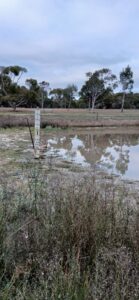
Past the turning point? (B. Blaskett)
Denise Main
I am currently a member of Queenscliff Seaside Scribes and Rip Writers groups and wish to become a member of the Geelong Writers I will forward my application for the next year.
I am very interested in your activities and events and have written a response to the June Ekphrastic Challenge and plan to submit if eligible.
Ekphrastic Coordinator
Hi, Denise, thank you for your interest. You are very welcome! I have sent you an email from the ekphrastic email address. Best wishes, Bev