
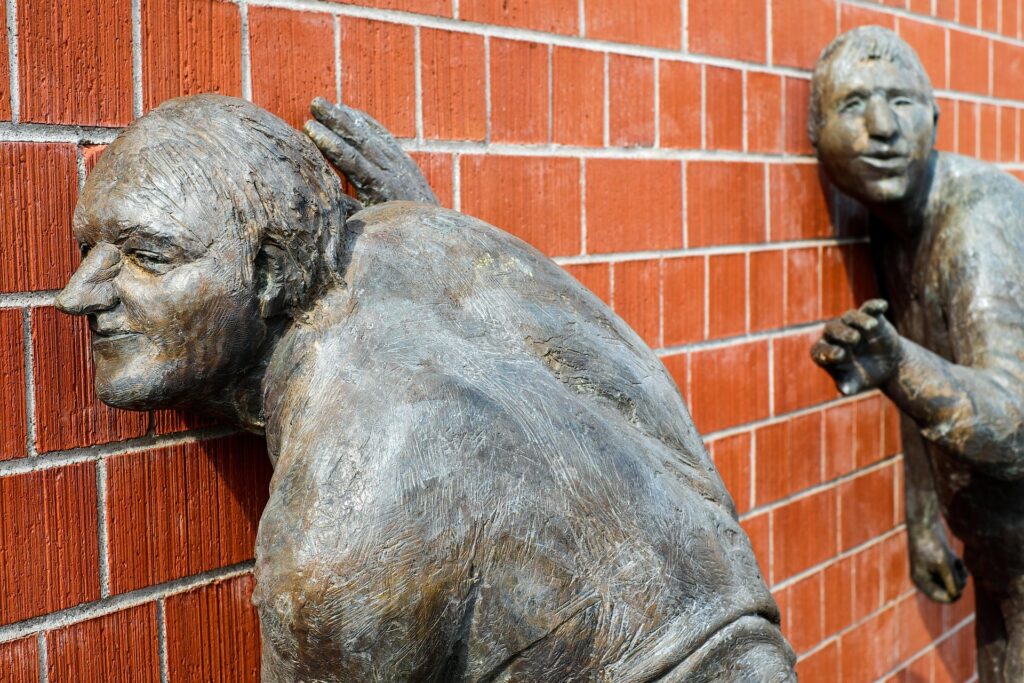
Attribution: Image by Couleur from Pixabay.
Publication of Responses
A big thank you to all the writers who took up the challenge of Ekphrastic Challenge #2 2026. Entries closed on Sunday, 25 February, 2026. Again, we received a wonderful range of imaginative, thought-provoking responses to the provided image. Many commented that it was indeed a challenge. Your ongoing support is valued and appreciated.
Our next challenge (Ekphrastic Challenge #3 2026) is now open.
A reminder that when submitting your responses, please ensure:
- you specifically respond to the image
- you take time to read and edit your entry before you submit it
- you ensure your work complies with the Australian Standard house style: singular quotations and Australian spelling.
The following writers have had their response to Ekphrastic Challenge #2 2026 published below:
Coral Reeve, David Bridge, Ian Stewart, Christine Scheiner, Dulara Jayasekara, Kerstin Lindros, Jenny Eddy, Fran O’Mara, Rhonda Hyder, Allan Barden, Denise Main, Ian Chisholm, Julie Edmonds, Adam Stone, Ian Henricus, John Heritage, Howard Osborne, Mary Szymanski, Glenyse Robins-Ward, Catherine Mahar, Scott Hunt, Stan Billing, Steve Gray, Russell Abbott, Glen Donaldson, Jean Pearce, Alan Cobham, Geoff Gaskill, Jenny Lynch, Robin Purdey and Joanna Desborough.
Please, take the time to read and enjoy their responses.

Aural Perception
A: I can hear them!
B: How? They’ve put the final brick in the wall.
A: I just put my ear here …
B: Here?
A: No. Here but wait. I CAN hear them.
B: I said how? There is nobody. THERE is nobody. There. Is. No. Body.
A: There is bodies. They aren’t nobody. They are bodies.
B: Don’t you mean there is somebodies?
A: You know what I mean.
B. No. I don’t think I do. I still can’t hear them.
A: Move your head up. No. That’s too far.
B: Here?
A: No. Lower.
B. Oh wait. I think I can hear them.
A: No, you can’t hear them.
B: But you just said you could hear them there.
A: They’ve removed the final brick in the wall.
B: Argh … Sooo, now WE can hear them?
A: No. We will never hear them.
Coral Reeve
Ancient Walls, Modern Fears
Of Pyramus and Thisbe let me first relate
The story of their love and families sad hate.
(Shakespeare twice borrowed Ovid’s tale,
So, I’m hoping you won’t find this stale)
Their situation, you’ll recall,
Required communication through a wall,
Sweet whispered plans made via a crack,
Led onto tragedy caused by a lack of understanding,
Where more openness, less fears,
Might have prevented many tears.
You may say this would never happen here today,
With social media holding such a sway on people’s lives.
Yet, in extremes of isolation, or exposure, who thrives?
Many voices, or one, can we tell lies from truth?
And, importantly, is youth imperilled more or less
By open access, or by none?
Maybe there’s a place for legislation to protect the young,
But it can be a trap to block communication and tempts rebellion,
Or worse – for suicide is common still and mental illness
Has no easy one pill answer, though the government purse
Might wish it so.
Just saying no and relying on a ban
Fails to engage, makes matters worse,
Whereas, discussion can relieve our fears,
Not nurse them.
No easy answer then, walls are double sided:
Whether of stone or hidden beneath the skin,
They keep us secure, but also lock us in.
Some of our freedom is surrendered to the state,
Because of what we fear is lurking at the gate.
If we listen but do not speak
When toxic sentiment harms the weak,
Or bigots persecute religion, racial mix,
Spray painting poison, soiling bricks,
Then our inaction aids intimidation spread about
When, instead, we need to drown it out.
Of course, a shouting match is rarely edifying,
And protest disruption can be trying,
Yet truth requires exposure to the light,
Preventing tragedy is surely worth the fight.
David Bridge
Can Your Hear It?
Walls don’t have ears – they have eavesdroppers. Standing under the eaves, the sneak, avoiding drops of rain should they fall from the guttering, will apply his ear to the wall in the hope of hearing juicy gossip or perhaps words leading to financial gain.
Our cast brass listeners must have been ‘at it’ for so long that they have become frozen. Persistence hasn’t paid off.
The bricks are laid in the English Bond style, but their appearance suggests that they have been laid on edge rather than in the usual way, broad side down. Although this would give the wall lesser thickness, it is still a brick wall. Our eavesdroppers would have great difficulty picking up conversation through such a wall. No wonder they are simply frozen images.
Listening at the wall
Two figures, faces earnest
Their tin ears will not prevail
Ian Stewart
Did You Hear
You could spend a lifetime hoping to never hear some words. Words that can peel you wide open with grief. A grief that dismantles who you have been your whole life and then changes you into a completely different person.
A stark memory of exactly where you were and what you were doing, when those words were spoken, can still bring you to your knees years after they were uttered. You can try to not listen, but it doesn’t stop each word hitting your skull like a brick has been hurled at you. Scream, cry, run, and the words will still echo and bounce about in your brain.
Red and blue lights softly flicker through the curtains
The gentle touch of the policewoman folds around your wrist
Words keep spilling from her mouth
Illogical hope spreads through you
The words must be wrong
Your heart beats a little faster
Words jumble
Your head lightens
You try to hear only what you want to hear, not the truth
The words sit in your belly like a stone
The stone grows into someone you don’t recognise
A mother’s grief is infinite and edgeless
Did you hear about the boy who was killed after he was pushed onto the train tracks?
Christine Scheiner
The Stone Man
I was beginning to think I was being followed.
Wet leaves crunched under my feet, their scent seeping into my pores, a combination of earth and morning drizzle, and the sticky green scent of leaves crushed and torn into sticky leafy juice. I was on a morning walk, as per routine, and I paused where I stood, footpath cluttered with sprinklings of yellow leaves that stuck to the soles of my boots.
There, across the road, was the old man. I was not a particularly creative person, I don’t think, my imagination dry and occasionally spurting the dust of an idea, so “the old man” had stuck.
He sat on your typical bench of rust-spotted green metal, legs rooted in the green grass of the park. Next to him was an ordinary middle-aged woman, steadfastly immersed in a book, her lemon coloured overcoat like a spike of brightness in the gloom, a shade brighter than the yellow leaves I stood upon. Her head lifted, for a moment, and I could see the flicker of a frown pass between her eyebrows as she turned her head to look at the old man, or rather, straight through him. She stared to the point of rudeness, but didn’t seem to see him at the same time.
The old man had a troublesome edge of a smirk on his lips, hooked nose and stringy combed hair flat against his scalp.
I blinked, and suddenly he seemed a statue—not just motionless, but made of metal than bone, a rusted iron-bronze colour that appeared to have a thousand scratches, his features becoming roughly etched stone, and I sucked in a gasp as his stone coloured eyes rolled around to face me, unnerving rictus of a smile still fixed.
I blinked again and he was gone.
Dulara Jayasekara
Eavesdropping
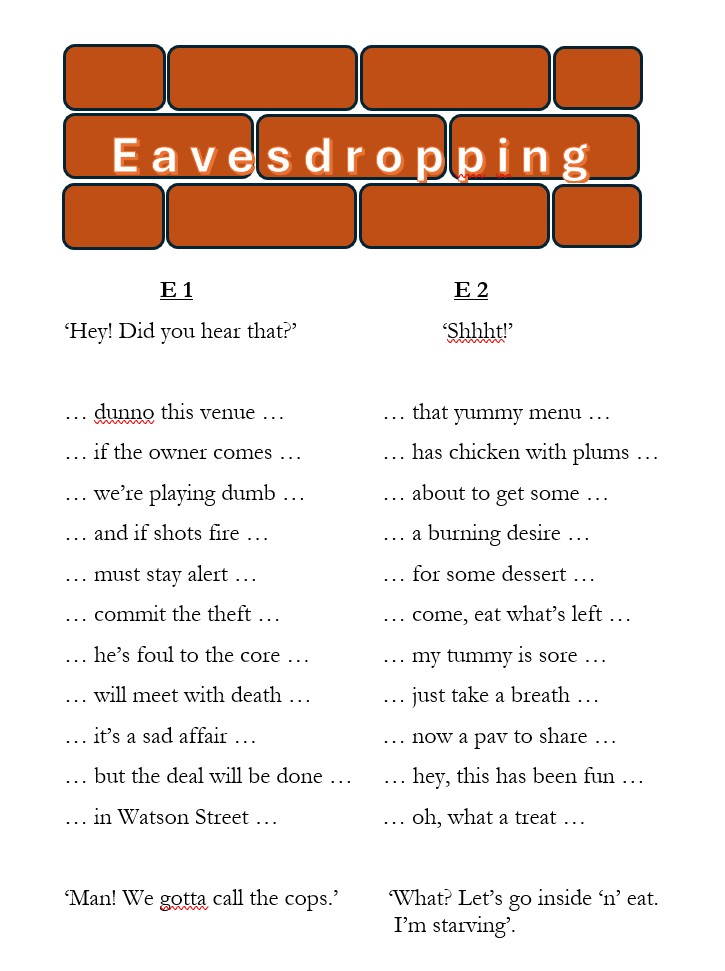
Kerstin Lindros
The Great Escape
Herman: ‘Shhhhhh … can you hear that, Boris? Can you hear that sound?’
Boris presses his head hard up against the wall: ‘No, I can hear nothing.’
Herman groans: ‘Listen harder, can’t you hear the tap, tap?’
Boris looks doubtful: ‘Hmm, maybe, just a little.’
Herman fist pumps the air: Yes, I’m sure it’s them, finally digging their way out.’
Boris frowns, a contemplative crevice splits his monobrow: ‘I think it sounds like a motorbike revving. You know we watched that old black and white movie the other night? The one where Steve McQueen rides his bike to freedom. It sounds just like that.’
Herman rolls his eyes heavenward: ‘Have you lost your marbles, Boris? Steve McQueen made that movie over forty years ago.’
Boris claps his hands: ‘Yes, it could be marbles! The noise sounds just like marbles dropping out of someone’s pocket.’
Herman: ‘No, no, no, no! I think you have rocks for brains, Boris. Let me explain for you. Our comrades have been in prison for a long time. Finally, they are digging their way to freedom and we will be here to collect them when they break through the wall.’ Herman shrugs his shoulders. ‘It’s just a simple plan and simple plans always work well.’
Boris: ‘Ah, this is good, this is good and do you think they will have Steve McQueen with them?’
Herman: ‘Yes, yes you do have rocks for brains. How has it taken me so long to realise this?’
Jenny Eddy
Hidden Rain Of Notes Beyond The Whispering Wall
(Mozart Piano Concerto #12.3 Rondeau: Allegretto)
The rain of notes blends in an ever-weaving tinkle
Of playful bells
Reaching across our layered years,
Our walled silence.
All day sparkling chimes whisper about our ears
Easing our hearts’ wrinkles,
Lost in our purloined time.
We press into the vibrating air
Between wall and ear,
Aching to be that child
To knowingly sit and caress the keys
Growing fingers so lithesome
they run and tease and linger
With pulsating rhythm and rhyme.
There, beyond our circle of bricked-in pain
Nothing is what we think it seems:
The perfection of each spatter of rain
Falling in its appointed place;
The touch of each anointed note tracing
Its path between our ageing faces and childish dreams.
Fran O’Mara
Promises Kept
At six years old Alice met Tony, six years her senior. That day Tony promised to marry her.
Eighteen-year-old Alice saw the new red brick house in the court. Tony promised he would buy the house for her one day. Moving in two years later Alice, pregnant, was the happiest she had ever been.
Adoring husband Tony was a loving father to their only child. They wanted for nothing. Tony suggested they relocate to a newer, more modern home. Alice refused. This was where she belonged. She was happy.
Tony promised he would never leave Mikey behind, always taking him along on his sporting and camping activities. He kept his promises. Promises were important to Tony.
Tony spoiled Alice each birthday; breakfast in bed, yellow flowers on the tray alongside tickets for an elaborate family holiday sometime in the year ahead and a renewal of his promise to treat her in the same way every birthday for the rest of her life.
He promised to always be there for her. She believed him, trusted him. Tony always kept his promises.
That was why when it came, the blow was devastating.
A car accident took the lives of her husband and teenage son. Alice was alone.
She buried them in the quiet cemetery south of town. The future looked bleak.
Weeks later, on the evening before her fortieth birthday Alice wept as she went to bed alone.
On the south side of town freshly turned earth trembled slightly. Tony had broken free of the coffin and now faced the weight of earth above him. It was early daylight before the pair reached their destination, yellow flowers in hand.
Alice slept late after a disturbed night. She woke to a sound from outside …
Or maybe she didn’t wake at all!
Rhonda Hyder
Small Town Whispers
Larry delivered bread each morning as he had done for years. In the post-war years, it was normal for the baker to step into kitchens, place loaves on tables and exchange pleasantries. By mid-day his work was done.
Later, people would say this was how the whispers began. That Larry had too much access. He was too familiar. He lingered. He knew whose husbands were away during the day and whose were not. None of this was ever said outright, just presented as concern and whispered speculation, ‘I don’t like to say anything, but …’.
It was said Larry had affairs with women along his run. What most people didn’t know, or chose not to know, was how the story began.
There was a woman in town who had taken an interest in Larry. She was not young or foolish. She flirted when he came by and stood close. When he didn’t respond in kind, she smiled anyway, but something hardened.
She didn’t accuse him directly. There was no evidence. Instead, she wondered aloud. Asked questions letting others draw conclusions. By the time the story circled back, it no longer belonged to any one person and quickly became a small town fact.
There was no confrontation and no proof offered or demanded. People stopped meeting Larry’s eye. Women felt uncomfortable around him. In the pub men made jokes, then stopped. Silence was enough.
In a small community reputation isn’t owned but held at the pleasure of others. Closeness can easily be confused with intimacy and familiarity with permission.
Eventually, Larry left town. Some said it was guilt, others thought pride. No one mentioned mental fatigue. To be known in a town and then to be known differently can be a demoralising thing. Small towns can wound quickly, quietly and efficiently.
Allan Barden
Tuning In
The cell door opened, guard’s gruff voice echoed, door clanged shut, the other bunk creaked. Blue didn’t turn on his bunk to acknowledge the new inmate and lose the thread of what he heard that morning when the guard turned his back.
During the dark days of Blue’s long sentence, he had no visitors or anyone who cared. He had lost touch with life outside, fearing he was losing his mind. One day on yard exercise, almost blacking out, he staggered against the prison wall, his shaven head and ear pressed hard against the warm red brick. His eyes widened, the wall hummed a surreal recital of bass vibrations, structural squeaks, creaks and percussion of pings, thumps and bangs. His huge hands, gnarled and scarred from bricklaying brushed over the surface, searching for clay type, sun or kiln baked, patterns and texture.
‘Move on,’ yelled the guard. Blue struggled away, with the sounds ringing in his head. His once sleepless, yearning nights were now filled with dreams of tuning into the wall. At every chance he put his ear to the wall; sometimes there were high pitched strings, booming organ pipes, other times, whispered voices singing, muffled sighs. His fingers discovered mortar gaps through which he squinted at blurred trees, skies and freedom.
One night, sounds of sobbing fractured his dreams.
‘No good crying, mate,’ Blue said irritably, wide awake. ‘Won’t get ya anywhere. Ya gotta find somethin’ to take ya mind of life behind bars.’
‘What do you do?’
‘My business mate. But if ya don’t do somethin’, ya mind’ll go.’
‘Who’s to care.’
‘Me, your cell mate.’
Silence.
‘If you can keep a secret, try my way. Practise tuning in on the cell wall, then join me on the outside prison wall, I’ll show ya the real thing.’
Denise Main
I Hear Music
Long ago, on a faraway island called Sonorious, in the middle of a Minor Sea, there was a village named Stoneway. When the prevailing Ill Wind That Blew Good reached a certain pitch, the hills came alive with the sound of music, as did the very walls of the village. Time after time, stone faced locals were granted the gift of perfect pitch if they could detect and identify the right wave lengths transmitted in certain sequences. Then they had to repeat the sounds, phrase by phrase, in correct sequence to the adjudicator, to be admitted to the society of sound Sonorious musical citizens, and join the choir of Perfect Pitch Sonorians. Nobody was barred from putting their ear and voice to the test.
Phraser and Pulsate were young aspirants, who immediately responded to the next suitable Ill Wind, by each pressing an ear to Stoneway’s First Wall of Keys.
Excitedly, Phraser sang out, ‘I hear music. I shall follow it wherever it goes. It’s in the key of G.’
Pulsate rasped in a lower key, ‘This wavering wailing wall is in D minor. How sad, yet how sublime, I note.’
‘There goes a passing fifth, waving a tremolo for emphasis,’ responded Phaser.
‘Now I’m getting a series of semitones. Not sure I can separate or replicate them,’ moaned Pulsate.
A passing stranger stood fascinated, watching these two intense individuals. He noted their ears hugged the wall, their faces a score of contrapuntal expressions that changed with an irregular beat. Even the walls have ears, immediately came to his mind, but here, it was the locals who had ears to the walls. Why? he asked himself. Either the walls could speak, or the two stoney faced Stonewegians who so fascinated him were of unsound mind.
Ian Chisholm
Soundscape Memories
After her husband’s death, she stayed on the family farm where they had raised four children. Silence was the soundscape of her life. The radio became her companion, held close to her ear in bed each night. Each morning. Listening to the news. She ate lunch listening to the afternoon serial. I’d watched the intensity of her listening, the crinkle when something amused her. A flimsy lock on her bedroom door, a psychological shield against the unknown causes of sounds that pierced the pitch-black nights. Until the familiar causes of daylight sounds returned. The radio. The kettle. A cow. A bird. The water pump. Dogs barking. Gravel crunching beneath car tyres, announcing welcome visitors. The soundscape changed when we arrived. She loved playing cards, Scrabble, and board games; there was chatter, laughter, and bickering. We ate lunch and listened to the radio news. And the serial too. In silence! She was our maternal grandmother, a listener, not a talker. We called her Nan. I think about Nan most days. I listen to the same radio station. The same music announces the news.
My radio belonged to our paternal Grandad, then Dad. I remember the sounds that characterised them, like Grandad’s wheezy chuckle. And Dad’s. And the buzz and beep soundscape of the ICU as machines kept people alive, including Dad. Weeks after ICU, Dad and I listened to the cricket on the radio (now mine). The sound of an ordinary summer day. It was the day before Dad died. The silence of death is impenetrable. We talked to Dad anyway, between tears and giggles.
Now death separates us from Dad, Grandad, and Nan. But soundscape memories are poignant reminders of the warmth of those people, the realities they faced and the relationships we shared.
Julie Edmonds
Folsom Prison Blues
Lenny and Joe weren’t bad men, not at their core, just scammers, always out to make a quick buck. They had a knack for getting caught, though. They were regular attendees at the Colusa County Court, and eventually they were sentenced to a stint at Folsom State Prison.
Lenny was the older of the two. He was heavier set than Joe, who had fallen from the back of a moving truck as a child and was blind in one eye. That accident perhaps explained his simple nature.
A scam that the brothers had running in prison came undone when a guard handled a library book Lenny was delivering to an inmate. The Grapes of Wrath seemed awfully light – a pouch of Drum tobacco was found in the hollowed-out pages.
The brothers were confined to an adjoining yard for 48 hours, without privileges.
Joe was beside himself. He knew his favourite country artist, Johnny Cash, was coming to play at the prison. He pleaded with the warden, ‘P-p-please, Mister Warden, sir, I j-j-just wanna see Johnny.’
The warden had been under pressure from the prison board to reduce prisoner numbers. He had to think creatively.
‘No, son, you were warned. And if you try to listen through the brick wall, you’ll meet your maker. You hear me, boys? No listening.’
*
‘Y-y-you sure, Lenny? Warden said we shouldn’t listen.’
‘It’ll be okay, Joe. You hear that?’
With their ears and minds melting into the wall, they felt the bass-baritone of The Man in Black. They heard the inmates’ cheers.
‘I h-hear it, Lenny, I h-hear it!’
The warden had ordered the brothers to be bronzed on the spot as soon as they transgressed. The last thing they heard was, I’m stuck in Folsom Prison, and time keeps draggin’ on …
Adam Stone
The Ambassador
In the innocent days, when the world was so bright
When taunts came like barbs to the soul
He came without bidding, and wrapped in his arms,
Spread ointment to make me be whole.
He became a companion, a trusted bronze shield
A spokesman for things I was lesser for
He stepped into light and placed me in shadow
Stood forth and became my ambassador
Sigh …
Such dangerous moments, short skirts running high
I didn’t know things I was ready for
He wiped away tears, even joined in good cheers,
It’s okay, for I’m your ambassador.
When I saw her first stare, I was nailed to the chair
My heart now wrapped in intrigue
My man said now wait, mayhap, hesitate
Perhaps you are out of her league?
Her curves spoke of danger, her face from a manger
Is this what I’m destined to ache for?
It’s true you have needs and a great deal of seeds
Be careful of shame, said ambassador
Is this my true path? My destiny writ?
Where’s courage at laughter that stings?
For I dream, I imagine, look ahead in fair question
At forks on the road yet unseen.
My hands are still strong, I can pull things apart
Is this the real life I am bound for?
Could I be the one? Is it my turn to fly?
Maybe next time, said my great ambassador.
But he did me a favour, for I stand in one piece
He’s a part of me now like a nose.
He’s needing reminding of all his past falls,
He’s there for the wrestle and pose.
He’s arguing now, he’ll argue forever
Better angels I need to look out for
Don’t be a fool, this was never the rule!
I’d argue it’s not, dear ambassador.
Ian Henricus
Stonewall
listening to you
i feel
connected
to something
so much bigger
John Heritage
Liminal Whispers
Encroaching on others’ secrets
Of those who shall not be seen
Invisible, just on the other side
Such as when listening at a wall
Trying to overhear what is said
Whispers in the liminal spaces
But if discovered, and exposed
There is always a price to pay
It could be just a mere rebuke
Or punishment, in some cases
Even be turned into grey stone
Transfixed, melded into brick
And now they shall hear it all
Never able to repeat or share
Forever only liminal whispers
Howard Osborne
Make Like a Statue
Be still and make like a statue, brother.
Be armoured in bronze for protection.
We will listen to the walls and linger with dread.
Listen in terror for warnings.
If it takes an eternity, wait, be still, brother.
Hear the poltergeist caught within the autumn hedge of brick.
Causing private affray and forcing us from home.
Tinkering with pipes so loud and strident.
Disembowelling cupboards of their contents.
Be perfectly still, brother.
Be bronze and brave if you can.
With an ear to the wall.
And fright in our hollow hearts.
Unable to flee our camouflage.
We couldn’t escape the mischief, brother.
The frightful noise and hallway footsteps.
The haunting that drove us outside to this.
Expanding and contracting with heat and cold.
No longer recognised by the restless presence.
We hope, we pray.
Can you hear it, brother?
Between the brick, the lathe and plaster.
Plotting anger and mayhem.
We make like statues forever.
Then all might see our fear and crouch.
Listen to the walls and wait, brother.
Make like a statue, be still.
Mary Szymanski
Never Ending Wall
Noah woke up in the middle of the night, lathered in sweat. He had been told to build a wall and could only take one person with him. Noah chose his only son, Jack, to be that person, and although Jack was only ten, he was strong and tall for his age.
The wall would never end in width or height, and after he finished it, he and his son became trapped on the other side. The last thing he remembered of his former life was the kiss he gave his wife.
Can you hear me? It’s been so long since we spoke. Why are you ignoring me? Don’t you know that I am on the other side of the wall?
When I built that damn wall, I didn’t think that we wouldn’t be able to get back to the other side.
I have been calling out to you every day for a decade or two, at the same time that we had our last kiss before I started to build this damn wall. All I think about is when you will be mine again.
Jack, our son, is here to keep me company. He has gotten so big, and he couldn’t believe it when the wall went up so fast; it seemed to have grown wings. No windows or doors, and too high to climb over.
Heaven is the only one who knows when it will come down. But it doesn’t stop me from calling out to you each and every day in the hope that the wall will accidentally fall down, and I can once again see you and give you that long-overdue kiss.
Glenyse Robins-Ward
Gone to the Pub
Bill and Steve had long planned a getaway from the nursing home, so wrongly called Golden Years. Ha!
They pitted themselves against the nursing home staff in their boyish and hilarious game as secret agents. It was tight and needed precision planning.
The nurses at the nursing station were mostly occupied with paperwork, but they would sometimes suddenly and hawkishly glance around to survey their territory. The personal care assistants moved swiftly along the hallways, glancing in and out of rooms, and the damned busybody cleaners noticed anything out of the ordinary.
Bill had found a narrow gap between two fence palings in the side garden; if he stood in just the right spot he could see visitors coding themselves into the front door. Steve sat in the foyer, pretending to doze, as a visitor coded herself out.
He creaked to his feet and grabbed the door in the last three seconds of its swing. He jammed a small wad of newspaper in the crack so it looked closed when she turned back to check.
Bill limped back as fast as he could through the building toward the front door. ‘Where are you off to in such a hurry, Bill?’
‘Need a piss, mate,’ said Bill.
Then they were out. Out, out, oh, glorious out. Oh, the hilarity. Nobody could tell them what to do.
It was only a block to the pub. There were weeds and cracks in the pavement, and an alley to cross, but they held each other up, forging toward the pub. They could see the welcoming sign and smell the paradise of sweaty blokes drinking beer in a dark and noisy bar. A few pints, and a shout at the footy on the telly, and for a little while they were men again.
Catherine Mahar
Whispers
We called it the whisper wall. We’d press our cheeks against the rough brick and whisper our secrets. And the wall would whisper back. Countless secrets lived within that wall. We’d marvel at how the wall stood tall under the weight of so many secrets.
My best mate Jez and I had been meeting at the wall ever since we were kids. Every day after school. Until time took over and we grew up. Got girlfriends. Got married. Had kids. Got divorced. Moved away. Moved back.
But every time we found ourselves back in the old town together we’d visit the wall. After a few beers at the pub we could never resist listening to the old secrets the wall had to share. Giggle like we were little kids all over again.
For sixty years Jez and I had been sharing secrets. He knew all of my secrets. I knew all of his.
At least I thought so.
Until one day Jez was gone. Hung himself in his shed. Seemed there was one secret he couldn’t keep anymore. A secret he couldn’t share.
After the funeral I went back to the wall.
The wall would know.
He would have told the wall.
I pushed my ear against the familiar rasp of brick against tender skin. I closed my eyes. And listened.
Countless secrets swirled and shushed like a distant ocean. I reached in, searching for the secret that killed Jez.
Then Jez’s voice emerged from the soup of secrets. It was unmistakable. He was speaking to me.
‘Dave, I know you’re listening. I’m sorry. He never loved me. I know that now. He only ever hurt me. I think you always knew but I could never tell you. Forgive me.’
I removed my ear from the wall.
And wept.
Scott Hunt
Is Statue Bro?
Two kiwi burglars were thick as bricks
In and out of jail, just a pair of half wits
Used to be hardest men we had known
Were hard as rocks with hearts of stone
Getting on, eyesight fading and moving slow
One saw a blur ahead, asked ‘Is statue bro?’
Sneaking around the house, clutching the wall
Knew they could possibly crack up if one did fall
Ears up to the wall listening before the theft
Not much point though, both are stone-deaf
Looked very much alike, actually the dead spit
So slow, birds even sat on them to take a shit
Whilst in jail they fed them Viagra, the pair of fools
Doctor recommended them, for hardened criminals
Went to a beauty parlor and naturally didn’t pay
Still covered in clay and minerals as they ran away
Their father was hard too, both were his clone
Psychopathic stare of theirs, and cold as stone
Only know the one way to win an argument
I tell you bro they hit hard, fists like cement
Judge told them, one day they would stumble
And then, their whole life was bound to crumble
Neither was any good at all at the romantic caper
Girls said, kissing them, was like kissing sandpaper
Someone reported them, cops caught them in the act
Dogs cocked their legs on them once they were tracked
Coppers hurled them in to the back of the Police lorry
Said, ‘You rock apes won’t last long out at the Quarry.’
Stan Billing
Listening to Mel
I muttered to Gary, ‘There’s one thing I can’t stand, and that’s listening to prattle, you know, people going on and on about some topic I don’t care for.’ Jean listened to Mel; she was always one to have a whinge, her form of prattle. Mel thought that Jean was the kettle calling a black kettle black. Well, words to that effect, Mel knew she got that kind of jumbled.
Jean went on, ‘Yeah, they go on, no one cares, and where does it get ya, nowhere.’ Mel sighed. Jean looked over, and there was a brief silence. Thinking that she had overstepped the mark, Jean smiled, ‘Now, Mel, what about you then? What’s happening over your way then?’
Mel raised both eyebrows in a hurry, ‘Well, now that you mention it, Barry’s not well, Ian’s cracked it with me, kids hey, what the hell do you do. But Barry’s my big concern, fatigued and out of breath.’
Jean enquired further, ‘That doesn’t sound too good, has he seen a Doctor?’ Mel smiled. ‘For goodness sakes, Jean, he’s a bloody male, it’s like sending him to buy a Valiant, he’s a Ford boy through and through, freakin’ stubborn.’
Jean nodded, ‘Yeah, I guess so, does he still have a good appetite?’ – ‘Yeah, nah, it’s on and off, if he’s had a busy day, he just nibbles on crap then at meal time, he picks out the bits he wants and leaves the rest. But he’s always been a picky eater.’
Jean says smartly, ‘Listen, I think you need to do yourselves a favour and get him to a Doctor because it sounds serious to me.’ – ‘Well, listen to you, Dr Jean, maybe I’ll just book him in myself and go from there.’ – ‘Could be good …’ – ‘Yeah.’
Steve Gray
The Mural
A father took his young son to the Smithsonian Museum for his first visit. ‘What’s that Dad?’ The father replied, ‘That’s a Mural or 3D sculpture, son. It depicts a scene from history and these exhibits around us are statues and portraits of famous historical people.’
They were joined by a guide. ‘Hello Mr. Ford. The 3D mural we are standing beside shows men trying to escape the 1863 Port Angles, Washington floods. The sign explains in detail the floods and the artist’s interpretation of a scene from this devastating event.’
‘That was the year you were born, son!’
‘The statues and the sculptured heads called busts are of men and women who have made a difference to the US in their lifetime. Murals and statues are found all over the world, including the countryside where battles and natural disasters took place.
‘Statues in towns remind us of local heroes and often the town’s villains. The murals and statues help us remember the past.’
The guide said, ‘Step this way. Here are portraits of famous Americans such as Ben Franklin, Thomas Edison, Samuel Morse and Charles Goodyear to name a few.’
The Father thanked the guide as he escorted his son out of the building.
The guide replied.
‘Thank you Mr. Ford and nice to meet you Henry. You never know, maybe in the future I will be showing someone your portrait up there.’
Russell Abbott
The Never Retired Gossips of Historic Gaslight Alley
Harvey and Henry had been bronze fixtures of the “Historic Gaslight Alley” for eighty-two years. Their pose was permanent: knees slightly bent, ears turned, leaning eagerly toward a perfectly built brick wall. To the tourists, they represented The Gossips. To Harvey and Henry, they were just two old men with a front-row seat to the most scandalous plumbing in the city.
Then, the rhythm changed.
‘Do you hear that, Henry?’ Harvey vibrated as a heavy bass line thudded through the masonry. ‘It sounds like a wet rhythmic slapping. Someone’s either making artisanal pasta or the neighbour has finally lost his mind.’
Henry, whose metal brow was perpetually furrowed, groaned. ‘It’s amorous, Harvey. Pure, unadulterated passion. And it’s right against my left pinky finger.’
A high-pitched squeal echoed through the bricks, followed by a breathless, ‘Oh, Francois! Not the spatula!’
‘The spatula?’ Harvey’s bronze eyes widened. ‘In my day, a spatula was for pancakes, not … whatever Francois is doing. Is that a goat? I hear a bleat.’
‘That’s just Francois’s lung capacity giving out,’ Henry sighed.
The wall began to shudder. Dust shook loose from the mortar. A rhythmic thump-thump-thump synchronised perfectly with the beating of a pigeon’s wings on Harvey’s head. The sounds intensified into a crescendo of frantic whimpering and the unmistakable clatter of a fallen floor lamp.
‘They’re reaching the summit!’ Henry hissed. ‘Steady your rivets, boy!’
Suddenly, a muffled voice cried out, ‘I’ve never felt so alive!’ followed by the sound of a heavy body hitting the floor. Then, silence.
‘Is he dead?’ Henry whispered.
‘No,’ Harvey replied, catching the scent of singed hair through a vent. ‘He just found out the hard way that wall isn’t load-bearing.’
Glen Donaldson
The Other Side
I want to know the secret to happiness.
They told me there was someone who could tell me.
All my life I’ve been waiting.
Can you tell me?
Who is they? No one I know.
No one knows the secret to happiness.
Life is miserable. Everyone knows that.
I’m just asking you a question. You don’t have to get so angry.
I thought you might know.
There’s no one else here to ask.
You’re wasting your time. And mine.
Then, can you tell me the secret to love.
No secrets there. No love either. Love is dead. I buried it years ago.
You’re no help. I really must know. Who else can I ask?
There’s someone on the other side who might tell you.
The other side?
The other side of the wall. This wall. Dummy. They might know.
Look. There’s a hole. A deep crack in the wall all the way to the other side.
I see blue.
Hello, is anyone there?
Speak more loudly.
Hooroo, can you hear me?
Let me listen.
I can hear. The wall’s whistling.
It’s not whistling, it’s the wind.
Could be a person whistling.
Whistling for their dog.
Woof, woof.
Ha, ha, ha!
Could be a Magpie.
Could be the sea.
The sea doesn’t whistle.
Hello, is anyone there? Hello, hello.
Did you hear anyone?
What did the wall say?
I can hear someone talking.
It’s you.
No, it isn’t.
What did they say, then?
Now they’re singing.
But what did they say?
Put another brick in the wall.
Did they tell you the secrets to love and happiness?
No. They said, listen to your heart.
Boom, boom, boom.
Stop talking. I want to listen too.
Jean Pearce
The Red Brick Wall
More interesting than a wall of red brick
is a beautiful, alluring chick.
Even the thought of a fizzy drink
could not entice them to the flicks.
Both were called country hicks
giving them a satisfactory kick
like an ice-cream to lick,
favoured more by Mick
than his brother Nick.
If they were required to pick
they would always make it quick,
careful, their necks not to rick
that could make them sick.
Ears pressed to the wall was the trick
To hear the fizzing of a wick
exploding them to ZILCH.
Alan Cobham
The Walls Have Ears
Walls have ears.
Unfortunately, ears have heads and heads …
Well, they should have something.
Unfortunately, in the business of spying, they don’t.
Spying?
That makes what Sammy was on about sound all James Bondesque. Most spying is of the mundane sort. More eavesdropping and scandal mongering than searching out states’ secrets. More nosey neighbours than Mata Hari.
Sammy would say he’s a model citizen, alert to dangers to his community.
So it was, when Noah built a brick wall along their common boundary, Sammy took it to mean Noah had something to hide.
‘It stands to reason,’ Sammy said pressing his head against Noah’s new-built wall.
‘Reason of what?’ I asked.
‘Did you hear that?’ Sammy asked.
‘What?’ I hissed. ‘Why are we doing this?’
‘You’ll know when you hear,’ Sammy declared in a voice dripping with certainty.
I hope I looked suitably annoyed. ‘As Freud once said, Sometimes, a cigar is just a cigar. Or, in this case, a wall’s just a wall. Maybe he wants privacy.’
‘How will you feel,’ Sammy asked, lips pursed, ‘if he’s making terrorist devices in there and you could have done something about it but didn’t? How would you feel to have people’s deaths on your conscience?’
‘When you can prove he’s making a bomb or something, then I will feel bad. Till then, as far as I’m concerned, Noah’s just put up a wall–which is his right.’
‘Well, I’m not waiting,’ Sammy declared. ‘I’m calling the cops. If he’s doing nothing wrong, he has nothing to fear. As concerned citizens, we need to be alert.’
‘This is not alert,’ I declared. ‘This is you being paranoid. I’m going home.’
‘Go then but don’t say I didn’t warn you. You can never be too careful these days.’
Geoff Gaskill
Turning a Deaf Ear
Howard Pendleton did not fear death. He had previously never feared ageing either. In fact, the deeply ingrained map of wrinkles on his face told of the most incredible journey—a journey the octogenarian had weathered with tenacity and pride, and would gladly spin yarns about to anyone who cared to listen. He proudly wore his mottled scalp, spotted hands and gnarled fingers like badges of honour. The few errant tendrils of hair that remained on his head were the colour of silver in various stages of oxidation, and were carefully combed each morning. Howard had steel-grey, fully functioning eyes that could still dance, wobbly legs that wished they still could … and one new fear that had only recently reared its ugly head.
For Howard Pendleton was going deaf!
He couldn’t pinpoint the actual day it started, but all of a sudden, the days when the air was thick with tales, chinwags and gossip disappeared without so much as a puff of smoke. Overnight, the world started whispering.
With a look of geriatric innocence, Howard finally admitted to his doctor about his predicament. He soon found himself visiting an audiologist, being fitted with newfangled, state-of-the-art hearing aids. The moment they were switched on—before the settings were perfected—Howard’s eyebrows shot up to the top of his head. Profanities were hissed under his breath. The gentle hum of the audiologist’s laptop sounded like a jet engine firing up. He could have sworn he heard a sigh from a fly, not to mention dust motes settling on a bookshelf. But within a few minutes, Howard’s hearing was almost back to being perfect. His fear of going deaf vanished instantly.
Each night, however, Howard removed the devices before bed and allowed total silence to rush back, like a warm hug.
Jenny Lynch
Walls
Next door,
workers with cranes
put up concrete walls
to build
Geelong’s Convention Centre.
Hard hats,
bright orange
Hi-Vis shirts,
heavy safety boots,
ladies and blokes.
The CFMEU flag
flies high.
Robin Purdey
Woe is She
My brain said ‘Look at the water it’s inviting,
Once you step in I’ll be quiet,
No need to worry anymore.’
My body said ‘No, she’s lying!
Don’t move a muscle,
I don’t want to drown.’
My brain said ‘Well I’m drowning now!
Better you than me,
Then we’ll both be free.’
My body said ‘I’m young,
I’ve got a life to lead.’
My brain said ‘Is it worth it tho?
Someone else will get mad at you,
Sad at you,
Disappointed in you,
Is it all worth it?’
My body said ‘Yes,
For the hug filled with love,
For the taste of the food,
For the feel of the sand,
For the smell of the roses.’
My brain said ‘Do it,
I want peace.’
My body said ‘We’re not ready yet.’
I stood up and walked back to the car.
The End.
Joanna Desborough
Divider image by wayhomestudio from Freepik
Leave a Reply